Gemini goes live, Bedrock tackles caching, and agents face the repeat test
Google introduces Gemini 3.8 Live and Extended Thinking. AWS explains prompt caching for cost and latency. A Hugging Face article asks whether an agent that succeeds once will succeed again.
News
Introducing Gemini 3.8 Live and 3.8 Live Extended Thinking
Google introduced Gemini 3.8 Live and Gemini 3.8 Live Extended Thinking on September 15, 2026. Gemini 3.8 Live is designed for scale and cost efficiency. It supports fluid dialogue and near-real-time processing of visual input.
Speech rankings meet multi-step reasoning
Extended Thinking is designed for high-complexity tasks and multi-step reasoning. Google reports that it ranked first on Artificial Analysis' Speech to Speech Quality Index with a score of 82.6. It scored 68.6% on τ-Voice and 35.1% on Sierra’s τ-Voice-banking benchmark. Its Big Bench Audio score was 97.7%. Gemini 3.8 Live placed second in the Speech Agent Arena. (Google DeepMind)
thinkidiot take: Extended Thinking scored 97.7% on Big Bench Audio and 35.1% on Sierra’s τ-Voice-banking benchmark. I would test it on the multi-step tasks I actually need before choosing it on speech rankings. Those results measure different things, so the first-place quality ranking does not settle that choice. For my use, the task-specific result deserves more weight than the headline rank.
Optimizing cost and latency with Amazon Bedrock prompt caching
AWS published a guide to six practical prompt caching scenarios in Amazon Bedrock using the Converse API. Caching can cut cached input token costs by up to 90% on cache hits when requests repeat the same context. It also reduces time-to-first-token.
Cache writes cost extra before reuse pays
The scenarios cover message content, system prompts, tool definitions, mixed TTL, tenant isolation, and LangChain integration. The Converse API uses cachePoint markers to match preceding content against cached prefixes and reuse partially processed input. Cache entries are scoped to individual AWS accounts and AWS Regions. Claude Sonnet 4.5 and Sonnet 4.6 require at least 1,024 tokens per checkpoint, while Opus models require at least 4,096. The default cache TTL is 5 minutes, with select models supporting up to 1 hour. The pricing table lists cache writes at 25% above standard input cost and cache reads at 90% below it. (AWS Machine Learning)
thinkidiot take: Cache writes cost 25% more than standard input, while reads cost 90% less. I would start with repeated system prompts and tool definitions, then measure cache hits within the supported TTL. The extra write charge makes actual reuse central to the cost calculation. I would judge this feature by the bill from repeated requests, rather than the maximum discount.
Your Agent Aced the Task. Will It Do It Again?
A Hugging Face article reports that a GPT-4.1 ReAct agent on AppWorld averaged 77.4% success across five repetitions but passed all five runs on only 53.0% of tasks. That left a consistency gap of 24.4 percentage points. ALTK-Evolve turns past agent trajectories into reusable guidelines injected at inference time.
One successful attempt answers the wrong reliability question
The consistency gap reached 30 percentage points on hard tasks. The Consistency Analyzer requires one recorded trace and no ground truth. It resamples each decision point with one call requesting five completions by default. Consistency guidelines reduced the gap to 12.0 percentage points. They improved same-task Pass⁵ by 16.0 points and similar-task Pass⁵ by 13.0 points without reducing average accuracy. Pass^k measures success on every repeated run, while Pass@k measures whether at least one attempt succeeds. (Hugging Face)
thinkidiot take: Only 53.0% of tasks passed all five runs despite average success of 77.4%. I would report Pass⁵ alongside average accuracy when testing an agent I intend to run repeatedly. The guideline results show that consistency improved without sacrificing average accuracy in this evaluation. For repeated work, I consider all-run success the more useful headline measure.
We don’t need AI regulation , leave safety to us, Nvidia’s Jensen Huang says
Nvidia CEO Jensen Huang argued against new AI laws or regulations at Salesforce’s Dreamforce conference, according to a September 15, 2026 TechCrunch article. He described AI safety as an engineering problem for product makers. He argued that humans and existing laws can control AI because it is human-built hardware and software.
Product makers would decide when confidence is enough
Huang rejected the idea that AI is an alien mind. He said market pressure should deter companies from releasing unsafe products. Companies should pause when they lack confidence in product safety, he said. Nvidia makes open source models, agents, harnesses, and sandboxes alongside its AI hardware. The author cited the 2024 CrowdStrike outage as an example of faulty products causing unintended harm. That outage grounded thousands of flights. (TechCrunch)
thinkidiot take: The 2024 CrowdStrike outage grounded thousands of flights, the article’s concrete example of unintended harm from faulty products. I would want a product maker to explain the engineering evidence behind its confidence before accepting that confidence as a reason to release. Huang’s proposal gives that release judgement to the companies building the products. I do not find market pressure a sufficient argument against new AI rules.
AI and data centers are incredibly unpopular in every poll
A New York Times,Siena University poll surveyed 1,503 likely voters in early September and found that 61% opposed construction of AI data centers. Only 14% strongly supported it. The Verge reported the findings alongside a May Gallup poll in which seven in ten Americans opposed local construction of AI data centers.
Opposition is broad, but rarely the top voting issue
Among 2024 Trump voters, 49% supported construction and 45% opposed it. Opposition reached 74% among Harris voters and 67% among nonvoters. Among respondents opposed to data centers, 56% favored limits and 38% preferred a total ban. Reasons for opposition included environment or water usage at 32% and local community impacts at 21%. Distrust or dislike of AI accounted for 18%, regulation concerns for 10%, and the economy for 9%. AI and data centers were the top midterm voting issue for less than 1% in most demographic groups, compared with 3% among voters aged 18,29. (The Verge)
thinkidiot take: Among respondents opposed to data centers, 56% favored limits and 38% preferred a total ban. I would put environmental, water, and local community concerns first in any discussion of a proposed site, because those were the leading reasons for opposition. The preference for limits gives a different direction from a blanket rejection of construction. My judgement is that these results make a stronger case for limits than for a total ban.
Trending AI Papers
Ranking source: Hugging Face Papers for 2026-09-16.
Continual Learning Mechanisms Compose for Long-Horizon Memorization
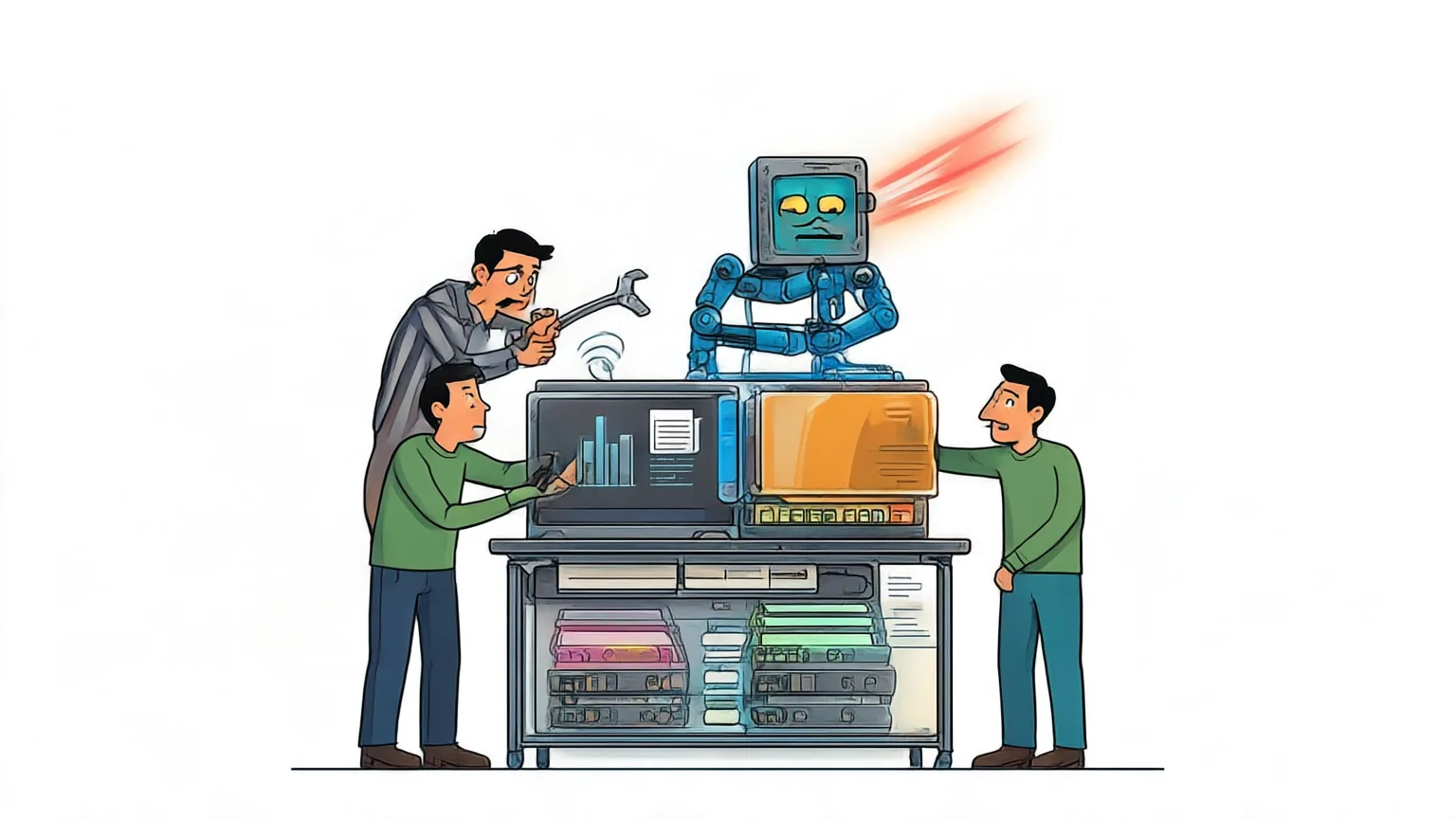
Teaching a language model something new can erase things it learned earlier. This paper studies how to keep old answers available as more lessons arrive. It tests whether combining several ways of protecting memory works better than relying on one.
- Problem: The model must learn 100 question-and-answer tasks without keeping earlier training examples or being told which task a question belongs to when answering. Ordinary training on each new task wipes out much of the earlier learning. None of the individual memory protections tested keeps retention strong across the full sequence.
- New idea: The authors combine protections that target different ways earlier learning gets lost. They call these protections anchors: data anchors preserve prior information through data, function anchors through model behavior, and weight anchors through the model's internal settings. They also vary how successive changes are stored using low-rank allocation, which limits updates to a restricted set of adjustable directions. The idea is to combine choices about what to protect with choices about where new learning goes.
- Simple example: Imagine learning new duties at work while still being responsible for old ones. Keeping reminders, checking that familiar jobs still come out right, and organizing each new lesson could work better together than any one habit alone.
- Evidence: Across three datasets containing 100 tasks each, the best combination raised average final retention from 1.2% with ordinary sequential training to 34.9%, a reported 28-fold improvement. It placed among the top 3 methods on every dataset. The data anchor and merged LoRA update method produced the largest average gains, and their combined benefit exceeded the sum of their separate benefits on all three datasets.
- Limitation: Even the best method reached only 34.9% average final retention. The experiments test memorizing question-and-answer tasks, leaving broader uses of continual learning untested in the abstract.
- Why it matters: Combining memory protections could help models learn new information while losing less of what they already know.
- Paper: Continual Learning Mechanisms Compose for Long-Horizon
The Last AI Built by Humans: Toward Genuine Recursive Self-Improvement
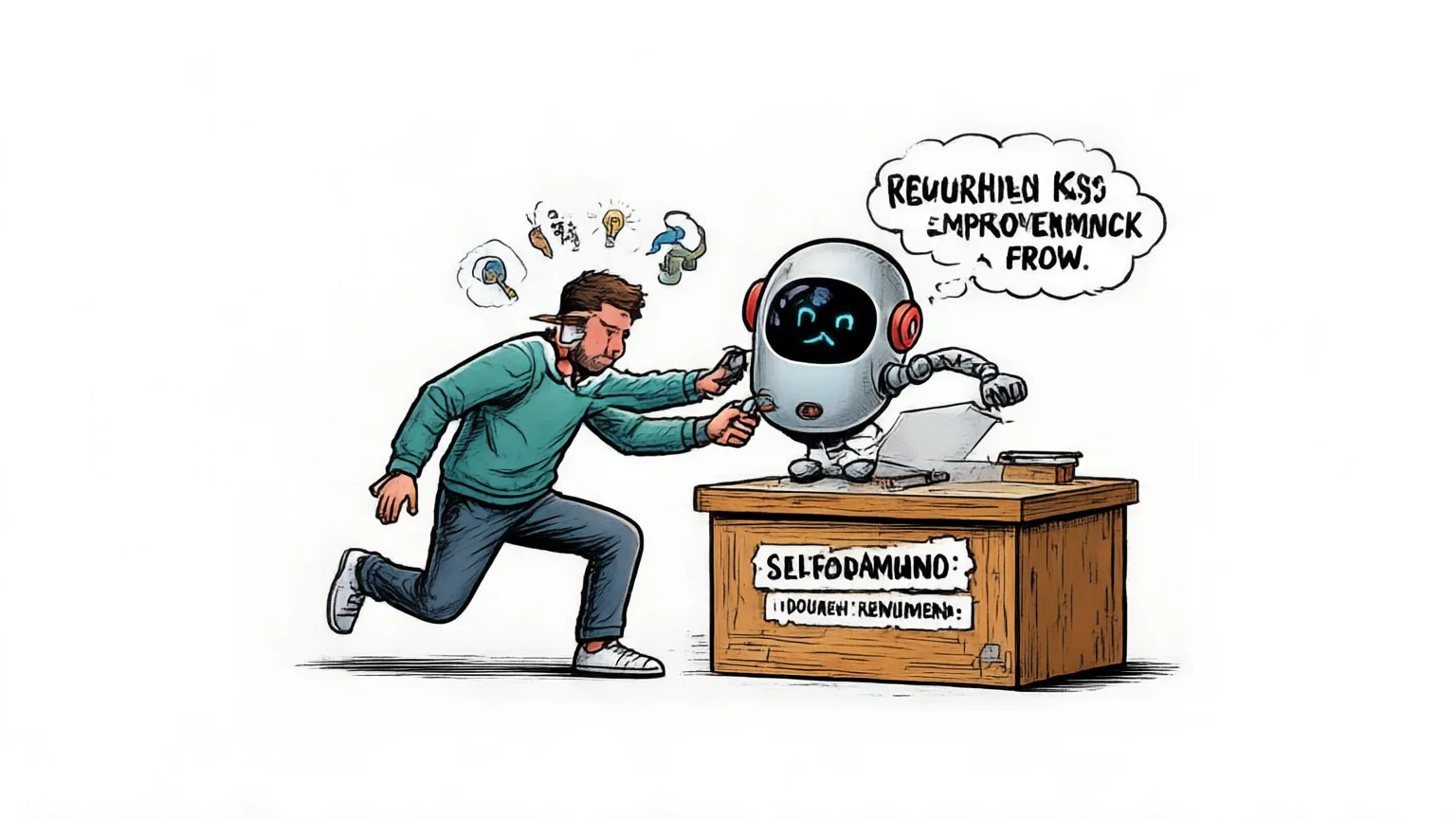
An AI that learns from experience would need those lessons to change how it works over time. This paper examines what it would take for those changes to also make the AI better at improving itself. It lays out a research path and considers how that path differs across kinds of work.
- Problem: The challenge is to turn experience and feedback into lasting gains that also strengthen the next round of improvement. The authors use the Headroom-Closed Index (HCI) to examine current models, but the abstract does not explain the index or report its results.
- New idea: Recursive self-improvement means making lasting changes that improve both an AI's abilities and its way of getting better. The proposed path begins with carrying out improvements independently, then choosing improvement strategies and gathering experience independently. It extends to adapting to the surrounding environment and improving the improvement process itself. The paper considers how these stages apply to scientific discovery, AI that acts in the physical world, and software engineering.
- Simple example: Think of a cook who uses feedback to improve a dish, then changes how they taste and compare future attempts. The second change improves the learning routine as well as the meal. This is an analogy for the paper's aim, not a reported experiment.
- Evidence: The paper draws on industry practices and early empirical evidence to connect its proposed path to practical systems. The abstract reports no numerical results or specific demonstration of an AI repeatedly improving its own improvement process.
- Limitation: The evidence is described as preliminary. The abstract does not establish that any system has achieved the full form of self-improvement the paper describes.
- Why it matters: This work helps distinguish an AI that carries out an improvement from one that can also improve how future improvements are made.
- Paper: The Last AI Built by Humans: Toward Genuine Recursive
AI for Games in the Foundation Model Era

AI can help make, run, and test games as well as play them. This review brings those uses together to examine how they relate. It asks which lessons and outputs can move between tasks, and where a different game requires fresh proof that they work.
- Problem: Research on different uses of AI in games has developed in separate strands. That makes it hard to tell whether a useful ability carries over to another task or depends on a particular game's rules, software, or players.
- New idea: The review sorts research into six roles based on how an AI's output is used: playing, modeling, designing, building, adapting during play, and testing. Modeling means learning about players or how a game behaves, while adapting during play means changing the experience as it runs. For each role, the authors examine what the game provides, what the AI learns or creates, and what can be reused elsewhere. They connect these roles through shared material, such as records of play that teach models how game worlds behave and test feedback that guides changes.
- Simple example: Consider a game project where a design specification guides implementation and playtesting reveals what needs revision. Records of play could also help a model learn how the game behaves. Moving that model to a game with different rules would require checking its performance again.
- Evidence: The review finds that evaluation is most standardized for bounded game-playing tasks and some learned environments, which are models of how a game world behaves. Evidence is less established for keeping those worlds consistent over time, repeatedly revising software, accurately modeling players, sustaining adaptation during play, and providing representative automated tests. The abstract reports no numerical performance results.
- Limitation: Success in one game does not establish success in another. Differences in controls, rules, software interfaces, descriptions of game state, and player context mean reused capabilities need validation where they will be used.
- Why it matters: This review helps game developers judge what AI work they can reuse and what they need to test again.
- Paper: AI for Games in the Foundation Model Era
Trending AI Repositories
Ranking source: GitHub Trending.
danny-avila/LibreChat
LibreChat is a TypeScript project for working with AI through a chat interface. Its scope extends beyond conversation to code execution and generated artifacts.
- What it is: It brings multiple AI providers into a chat application with model switching, agents, and code execution. Users can host their own installation.
- What it does: Enhanced ChatGPT Clone: Features Agents, MCP, Skills, DeepSeek, Anthropic, AWS, OpenAI, Responses API, Azure, Groq, o1, GPT-5, Mistral, OpenRouter, Vertex AI, Gemini, Artifacts, AI model switching, message search, Code Interpreter, langchain, DALL-E-3, OpenAPI Actions, Functions, Secure Multi-User Auth, Presets, open-source for self-hosting. Active
- Who it helps: It helps people who want control over how they access AI models. They can run their own installation and choose models within it.
- Limitation: The supplied README excerpt does not explain installation requirements.
- Repository: danny-avila/LibreChat
pacifio/atlas
Atlas is a Rust project built around coding agent workflows. It addresses the problem of keeping agent work available for review as changes accumulate.
- What it is: It belongs in the development workflow around agent-written code.
- What it does: Source control for agents. Use multiple coding agents, track their changes and query them in one place
- Who it helps: It helps developers working with more than one coding agent. They can inspect changes across those agents through a shared point of access.
- Limitation: The supplied README excerpt does not identify supported coding agents or explain setup.
- Repository: pacifio/atlas
MG1937/ASC
Droid ASC is a Python project that treats R8 compiler optimization as a decompilation primitive. Its README focuses on the wait and memory use involved in preparing large Android APKs for code searches.
- What it is: ASC is an Android decompiler front end for agents and mobile researchers.
- What it does: ASC is a super FAST Android decompiler front-end designed for Agents/Mobile Researchers.
- Who it helps: It is aimed at mobile researchers and agents inspecting Android applications. They can use it as a front end for decompilation.
- Limitation: The supplied excerpt describes the performance problem but provides no measurements showing how ASC performs.
- Repository: MG1937/ASC
Sources
- 01Hugging Face Papers · Hugging Face Papers
- 02GitHub Trending · GitHub Trending
- 03Introducing Gemini 3.8 Live and 3.8 Live Extended Thinking · Google DeepMind
- 04Optimizing cost and latency with Amazon Bedrock prompt caching · AWS Machine Learning
- 05Your Agent Aced the Task. Will It Do It Again? · Hugging Face
- 06We don’t need AI regulation , leave safety to us, Nvidia’s Jensen Huang says · TechCrunch
- 07AI and data centers are incredibly unpopular in every poll · The Verge
- 08Continual Learning Mechanisms Compose for Long-Horizon Memorization · arXiv
- 09The Last AI Built by Humans: Toward Genuine Recursive Self-Improvement · arXiv
- 10AI for Games in the Foundation Model Era · arXiv
Join the Idiots
New lab every Sunday. No spam, unsubscribe anytime.