AI reasoning skills, startup teammates and Snap's $2,200 glasses

Open-source agent skills target healthcare and life sciences reasoning. Gusto, Insight Partners and Leland discuss AI teammates at TechCrunch Disrupt 2026. Snap makes another case for its $2,200 smart glasses.
News
Improving HCLS AI reasoning with open-source agent skills
AWS has released 38 open-source agent skills across 11 healthcare and life sciences domains under the MIT-0 license. They give agents explicit reasoning procedures for decision frameworks they often apply incorrectly, even when citing the right guideline. In a 410-prompt evaluation, agents using the skills won 70,86% of comparisons against the same agents without them, depending on the agent harness setup.
Knowing the guideline is only part of the job
The skills use SKILL.md documents with YAML frontmatter that declares triggers, dependencies and metadata. Progressive disclosure exposes the reasoning procedures at inference time. The genomic-variant-interpretation skill encodes ACMG/AMP classification criteria. The variant-calling skill supplies GATK4 HaplotypeCaller commands and Mutect2 tumor-normal configurations. Critical thinking showed the strongest effect, with a 78,85% win rate and effect sizes of d = 0.65,1.03. The skills work across more than 20 services, including Amazon Bedrock AgentCore, AWS Strands Agents SDK, Claude Code and OpenAI Codex. AWS also provides installation steps and three worked use cases. (AWS Machine Learning)
thinkidiot take: The same agents won 70,86% of comparisons when given explicit skills. I would use the worked examples to test whether an agent follows the decision procedure, rather than merely checking its citations. The reported failure is incorrect application of a guideline the agent already knows. That makes inspectable reasoning instructions a more useful starting point for me than another convincing answer with references.
Your startup’s next teammate might be an AI agent: Gusto, Insight Partners, and Leland explain what that changes at TechCrunch Disrupt 2026
TechCrunch Disrupt 2026 will host “Hiring When AI Is a Co-Founder” on its Builders Stage. The speakers are Gusto CEO Josh Reeves, Insight Partners senior vice president Michelle Johnson and Leland CEO John Koelliker. They will discuss how early-stage companies build teams around AI systems capable of completing multistep engineering, customer support and operational tasks. Disrupt takes place October 13,15 at Moscone West in San Francisco.
Accountability belongs in the hiring conversation
The session will address speed, accountability and culture when human employees work alongside agents. Gusto supports more than 500,000 companies. Its services cover payroll, benefits, compliance, onboarding, HR and retirement. Johnson helped scale Flock Safety from less than $1 million to $90 million in ARR as an early sales and revenue operations leader. More than 10,000 startups, investors and tech decision-makers are expected at Disrupt. Registration before September 25 offers savings of up to $200. (TechCrunch)
thinkidiot take: The article describes AI systems completing multistep engineering, support and operational tasks. I would use that scope to ask who owns the result when an agent handles a sequence of work. Accountability is already on the session's agenda, alongside speed and culture. For me, that ownership question deserves more attention than the co-founder label.
Snap tries to make the case again for its $2,200 smart glasses
Snap has added HBO Max and Spotify connections to its $2,200 Specs smart glasses. It also announced Specs Intelligence, an “anticipatory AI” system designed for the glasses and other devices, including iPhones and Macs. Snap says the system builds an understanding of users' goals, priorities, relationships and routines from connected apps and tools.
Corporate workflows and basketball practice join the pitch
Specs debuted earlier this year. Snap has since been looking for opportunities to explain why the glasses deserve to exist. The company announced Specs for Enterprise. Partnerships with Amazon, Salesforce, Nvidia and other companies aim to integrate the glasses into corporate workflows. A separate app comes from a partnership with the NBA and WNBA. It uses the glasses' AR capabilities to let users practice basketball and improve their shot. (TechCrunch)
thinkidiot take: Specs cost $2,200, while the announced Intelligence system is also designed for iPhones and Macs. I would put the basketball app in a hands-on test because it gives the glasses a specific AR task. The cross-device assistant leaves me wanting a clearer reason to pay for the hardware itself. At that price, I find shot practice a stronger argument for Specs than another connected service.
Snap is launching a new Specs AI tool, and it’s coming to iOS and Mac
Snap has introduced Specs Intelligence in preview on iOS. There is a waitlist for the full early-access experience coming to Mac. The assistant connects digital accounts to help with work tasks and travel information, and users can also chat with it.
The assistant is designed to act before a prompt
Snap says Specs Intelligence is designed to surface relevant information and actions without being asked. Examples include meeting preparation and combined travel plans. On Specs AR glasses, it can place relevant personal content directly into view, including a requested daily briefing. A video shows connections to apps such as Gmail and Slack. Snap spokesperson Cassie Bumgarner says the service combines open-source models hosted in the US with local LLMs. Snap regularly updates that mixture of models. (The Verge)
thinkidiot take: Specs Intelligence is available in an iOS preview, giving users a way to try the assistant on that platform. I would test meeting preparation and combined travel plans before judging its anticipatory behavior. Those examples give me something concrete to assess beyond whether the assistant can hold a chat. Useful timing is the feature I would judge most strictly.
The 2.5-hour AI-generated Odyssey movie is 2.5 hours too long
Fountain 0's Odysseus: The Fall is a 2.5-hour film made entirely with AI and available to rent for $9.99. Cofounder Ash Koosha wrote and directed it. He also supplied his likeness for the title character and created all its music. The Verge's reviewer identified only browser-based viewing.
Continuity breaks in the picture and the dialogue
Fountain 0's only previous work, the AI film Dreams of Violets, made it into Tribeca earlier in 2026. The Verge's review reports visual continuity and motion errors in The Fall. A cyclops changes height between shots. Oars bend, and a boat moves sideways. Mouth movements do not match the dialogue, according to the reviewer. The review also describes sometimes incomprehensible AI voice-overs and incorrect pronunciations of Odysseus and Zeus. (The Verge)
thinkidiot take: A $9.99 rental comes with reported errors in motion, continuity and speech across a 2.5-hour film. I would treat changing character size and mismatched dialogue as reasons to keep working on the film before charging for it. The earlier Tribeca appearance does not answer those specific criticisms. On the evidence in this review, I would skip the rental.
Trending AI Papers
Ranking source: Hugging Face Papers for 2026-09-17.
ScienceIDE: Turning World's Scientific Codebase into Agent Learnable Environments

ScienceIDE turns scientific software into places where AI systems can practise solving problems. The work starts with existing code and expert guidance about what a correct solution should do. It aims to make that software useful for teaching and testing AI systems that work on scientific tasks.
- Problem: Scientific software contains useful methods, but running it and judging its results requires more than reading the code. Different tools, unwritten conventions and specialist checks make repositories difficult to use directly as training material.
- New idea: ScienceIDE builds runnable practice environments from scientific repositories, which are collections of code. Experts supply scientific cases and rules for accepting a result. AI agents, systems that take actions to complete tasks, use that guidance to prepare environments where tasks can be created, attempted and checked. Records of interactions that pass verification then become training material.
- Simple example: Think of a scientific repository as a workshop full of specialist equipment. ScienceIDE adds practice assignments and expert checks so a learner can use the equipment and find out whether the work is correct.
- Evidence: The authors trained PhAI-IDE-72B, PhAI-IDE-9B and PhAI-IDE-4B using verified interaction records. They report improvements on scientific code repair tasks held out from training and on selected tests of coding, reasoning and knowledge. The abstract gives no numerical scores or sizes of those improvements.
- Limitation: The abstract reports gains on selected tests but gives no numerical results, leaving the size and consistency of the benefit unclear.
- Why it matters: This offers a way to teach AI systems from scientific software while checking their work against expert requirements.
- Paper: ScienceIDE: Turning World's Scientific Codebase into Agent
ProgramDistill: From Interactive Web Apps to Verifiable Reference-Guided SWE Tasks
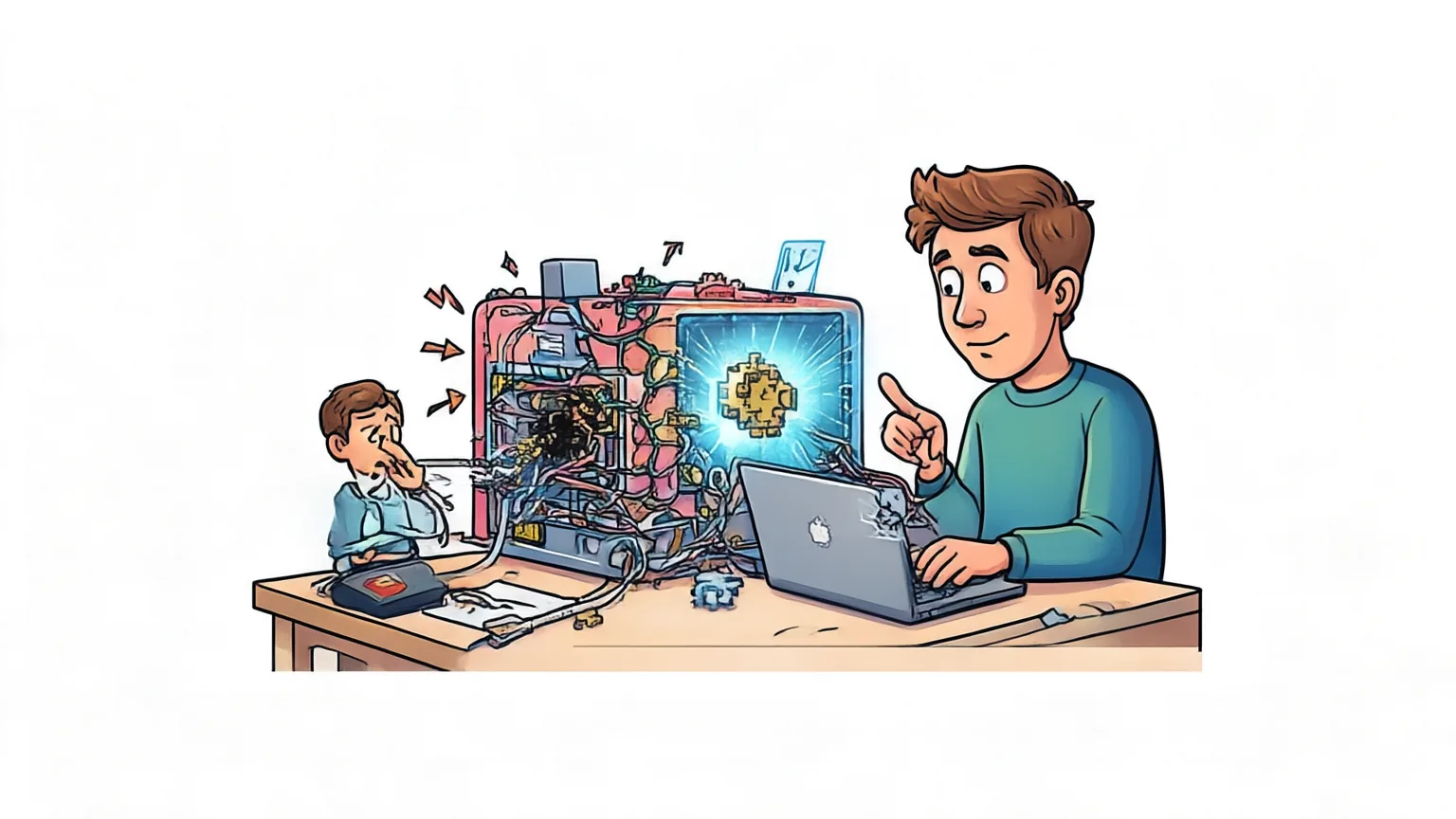
ProgramDistill tests whether AI coding systems can learn what to build by using a working web app. The systems then have to reproduce its features in an unfinished app. The aim is to measure how well they turn observed behaviour into working code.
- Problem: Most coding tests describe the desired result in written instructions. That leaves out a practical challenge in web development: discovering what a feature does by trying existing software before rebuilding it.
- New idea: ProgramDistill is a benchmark, a collection of tasks used to compare coding systems. It breaks working apps into features of different sizes and records behaviours that can be replayed to check the result. Each feature has a known correct code change that makes those behaviours work. An automated process called mine-craft-patch uses these pieces to create reconstruction tasks with controlled difficulty.
- Simple example: It is like learning how an appliance works by pressing its buttons, then making an unfinished version respond the same way. The working appliance supplies the demonstration, and repeating the same actions checks the reconstruction.
- Evidence: The automated process found 1,975 replay-verified behaviours across 26 applications and built 4,063 tasks. Among nine coding agents, GPT-6 Astra and Claude Opus 5 achieved 49.2% and 28.8% success on cumulative workflows when reconstructing full applications. In partial reconstruction, the reported success rates fell from 100% to 64.0% and from 96% to 32% as restoration depth increased from 1 to 8.
- Limitation: The abstract proposes using the tasks for training but reports only evaluation results, so it does not establish whether training on them improves coding systems.
- Why it matters: This tests whether coding systems can rebuild behaviour they observe in working software.
- Paper: ProgramDistill: From Interactive Web Apps to Verifiable
VC-Attention: Value Smoothing and Softmax Casting for Low-bit Attention

VC-Attention aims to make AI video generation faster without retraining the model. It changes how the model stores and processes numbers while connecting information across a video. The work tackles both errors from compact number formats and a calculation that limits their speed.
- Problem: Attention, the calculation that combines information across a video, becomes expensive for long sequences. Using fewer bits to represent numbers introduces errors when unusually large values force ordinary values into a cramped range. Earlier methods leave these value errors unresolved, while converting scores into mixing weights remains a speed bottleneck.
- New idea: VC-Attention combines two changes without retraining the model. V-Smooth groups similar value vectors, the numerical information attention combines, so they can share a compact number format more accurately. It subtracts each group's average, stores the differences using fewer bits and adds the average back using a sum already calculated during processing. ExpCast-FP8 turns attention scores directly into eight-bit mixing weights with a combined arithmetic operation, removing a separate exponential calculation and format conversion.
- Simple example: Think of packing objects into boxes sized for their contents: putting one unusually large object among small ones wastes room. Grouping similar values and storing their differences from a shared average makes better use of the available numerical space.
- Evidence: Across Wan2.2, LongCat-Video, HunyuanVideo-1.5 and MiniMax-H3, VC-Attention improved fidelity over low-bit baselines. Compared with BF16 FlashAttention-4, the attention calculation ran 1.46-1.59x faster on datacenter Blackwell and Hopper hardware and 2.3-3.6x faster on workstation cards. Complete clip generation was 1.13-1.19x and 1.36-1.70x faster, respectively.
- Limitation: The abstract reports better fidelity than low-bit baselines but gives no numerical quality measurements or quality comparison with BF16 FlashAttention-4.
- Why it matters: This can shorten video generation time while reducing errors from compact numerical formats.
- Paper: VC-Attention: Value Smoothing and Softmax Casting for
Trending AI Repositories
Ranking source: GitHub Trending.
cloudflare/security-audit-skill
Cloudflare's security-audit gives coding agents a defined process for investigating security issues. It seeded the company's vulnerability discovery harness, connecting this repository to that work.
- What it is: This skill runs within a coding agent. It coordinates isolated agents from reconnaissance through candidate validation and reporting.
- What it does: A coding-agent skill for multi-phase security audits with independently verified, machine-readable findings
- Who it helps: It helps people using coding agents to investigate code for security issues. They can put candidates through validation and have the resulting records checked independently.
- Limitation: It requires a coding agent to run the audit process.
- Repository: cloudflare/security-audit-skill
jamiepine/voicebox
Voicebox brings speech generation and voice interaction onto your own machine. It combines spoken input for apps with the ability to talk to agents in voices you own.
- What it is: It is a local voice input and output stack. The repository uses TypeScript.
- What it does: The open-source AI voice studio. Clone, dictate, create.
- Who it helps: It helps people who want to dictate into apps or generate speech. They can also clone voices and use voices they own when talking to agents.
- Limitation: The supplied excerpt gives no hardware requirements for running it locally.
- Repository: jamiepine/voicebox
anthropics/claude-code
Claude Code brings coding assistance into the command line. Its scope includes both explaining code and carrying out tasks, so readers can consider it for work beyond answering programming questions.
- What it is: The TypeScript project is available on npm as @anthropic-ai/claude-code.
- What it does: Claude Code is an agentic coding tool that lives in your terminal, understands your codebase, and helps you code faster by executing routine tasks, explaining complex code, and handling git workflows - all through natural language commands.
- Who it helps: It helps developers working with an existing codebase. They can ask for explanations, delegate routine tasks and request help with git workflows.
- Limitation: The README lists Node.js 18 or newer as a requirement.
- Repository: anthropics/claude-code
Sources
- 01Hugging Face Papers · Hugging Face Papers
- 02GitHub Trending · GitHub Trending
- 03Improving HCLS AI reasoning with open-source agent skills · AWS Machine Learning
- 04Your startup’s next teammate might be an AI agent: Gusto, Insight Partners, and Leland explain what that changes at TechCrunch Disrupt 2026 · TechCrunch
- 05Snap tries to make the case again for its $2,200 smart glasses · TechCrunch
- 06Snap is launching a new Specs AI tool, and it’s coming to iOS and Mac · The Verge
- 07The 2.5-hour AI-generated Odyssey movie is 2.5 hours too long · The Verge
- 08ScienceIDE: Turning World's Scientific Codebase into Agent Learnable Environments · arXiv
- 09ProgramDistill: From Interactive Web Apps to Verifiable Reference-Guided SWE Tasks · arXiv
- 10VC-Attention: Value Smoothing and Softmax Casting for Low-bit Attention · arXiv
Join the Idiots
New lab every Sunday. No spam, unsubscribe anytime.