GPT-6 Astra on Bedrock, sharper refusal boundaries and a predictive DNA atlas
Get this by email →
GPT-6 Astra arrives on Amazon Bedrock. Safety research focuses on refusing harmful parts of a topic. AlphaGenome Atlas maps predictions for every possible DNA letter change in the human genome.
News
Take on your most ambitious work with GPT-6 Astra on Amazon Bedrock
OpenAI's GPT-6 Astra is now generally available on Amazon Bedrock. AWS announced the model for demanding tasks on its inference engine. Bedrock users can now give Astra up to 1 million input tokens for contract review.
Cybersecurity classification puts access controls in focus
Astra is the first OpenAI model to reach Critical classification for cybersecurity capability. Amazon Bedrock offers zero-operator access enforced at the chip level. Astra supports both implicit prompt caching and explicit prompt caching with cache breakpoints. AWS describes the Bedrock inference engine as built for high performance, security and scale. (AWS Machine Learning)
thinkidiot take: Astra is the first OpenAI model to reach Critical classification for cybersecurity capability. I would put that classification at the center of a deployment review. Bedrock's chip-level zero-operator access gives me a concrete control to examine alongside it. That deserves more attention than the announcement's promise of sharper judgment.
Safety for Whom? Refusing the Right Subset of a Topic, Not the Whole Topic
Hugging Face describes a paper introducing boundary-aware safety refusal. Safety for Whom Boundary-Aware Self-Distillation for Controlled LLM Safety Refusal targets harmful subsets within a topic. Its intended behavior is precise: refuse prompts inside that subset and answer elsewhere in the topic.
The same model can need opposite rules
A civics tutor and a public-sector assistant can share a model yet require opposite behavior on politics. LlamaGuard-3 covers elections only as factually incorrect information about electoral systems and processes. Its election category therefore has a specific scope. The self-generated safety tuning process starts with the target model. It steers that model toward refusal on harmful prompts. A guard model then verifies which generated traces are genuine refusals, and those traces are retained. (Hugging Face)
thinkidiot take: A civics tutor and a public-sector assistant can require opposite political behavior from the same model. I would define each application's refusal boundary before using the generated tuning traces. Verification of a genuine refusal answers a different question from whether that refusal belongs in the application. I value the explicit boundary more than refusal alone.
AlphaGenome Atlas: A predictive map of every possible DNA letter change in the human genome
Google DeepMind has introduced AlphaGenome Atlas, a predictive map of molecular effects across the human genome. It contains predictions for 9 billion single-letter DNA variants. The atlas brings those variant predictions together in a 1-petabyte dataset.
A single variant score sits alongside tissue-level predictions
The dataset is more than 30 times larger than AlphaFold Database. In 2022, AlphaFold Database expanded from around 190K experimental structures to more than 200M structure predictions. AlphaGenome Atlas provides molecular effect predictions across hundreds of cell types and tissues. These cover both humans and mice. Its AVI score combines predictions from AlphaGenome and AlphaMissense. That produces a single number for each genetic variant. (Google DeepMind)
thinkidiot take: AlphaGenome Atlas puts predictions for 9 billion variants into a 1-petabyte dataset. I would examine the cell and tissue predictions alongside the combined AVI score. That keeps the detailed molecular predictions in view when working with a single variant number. For me, that detail is a stronger reason to use the atlas than its size.
Hackers are stealing Claude tokens from subscribers
Claude subscriber Grant De Swardt noticed his token usage climb from 45% to 55% while doing no work on August 4. TechCrunch reports that hackers are stealing Claude login sessions through common infostealer malware. Anthropic has since warned users about token theft. Two users posted emails from the company identifying the theft and warning them.
Total usage leaves subscribers without an itemized trail
Infostealers install on users' computers and steal saved passwords, session data and login credentials. Anthropic suspended De Swardt's account after the incident. It invalidated all sessions and tokens. The company issued a partial refund of 44.49 GBP for the remaining time on his 200-per-month subscription. Account support tracks total usage but does not provide itemized usage. The report identifies that missing detail as a reason theft can go undetected for months. (TechCrunch)
thinkidiot take: De Swardt's usage rose from 45% to 55% while he was doing no work. I would want an itemized usage record to investigate that change. Support's total-only tracking leaves that request unanswered. For a paid service consumed through tokens, I consider that an unacceptable visibility gap.
Cognition hits $48B valuation, signaling investors believe AI coding is far from a winner-take-all market
Cognition raised $2 billion at a $48 billion valuation, TechCrunch reports. That follows a $26 billion valuation just four months earlier. Its annualized run-rate revenue grew from $492 million to $900 million since the May fundraise. The new round gives the company another $2 billion in funding as that revenue grows.
A richer revenue multiple meets a costly server lease
Cognition is expected to reach $4 billion to $5 billion in annualized revenue by the end of 2026. Cursor sold to SpaceX for $60 billion in April after valuation talks at $50 billion. Cursor's revenue had surpassed $2 billion at that time. Cognition currently commands a higher revenue multiple than Cursor did in spring. Cognition also leases an Nvidia server cluster costing hundreds of millions of dollars annually. That expense puts potential total cash burn this year at $800 million. (TechCrunch)
thinkidiot take: Cognition commands a higher revenue multiple than Cursor did in spring. I would judge that premium against the expected $4 billion to $5 billion annualized revenue by the end of 2026. The server lease adds hundreds of millions in annual costs to that assessment. At this price, I put more weight on reaching that revenue expectation than on the size of the funding round.
Trending AI Papers
Ranking source: Hugging Face Papers for 2026-09-09.
NeoHorse-1: Towards Recursive Self-Improvement via Agentic Post-Training with Routing Harness

NeoHorse-1 explores how an AI system can use evidence from its own work to guide further training. It records which model handles a request and what happens during the exchange. Those records help determine both the training material and what the system should practise next. The aim is to make improvement a repeating process informed by measured abilities.
- Problem: An AI system needs a way to turn observations about its abilities into useful training material. Measuring performance alone does not establish how to choose the next lessons or use them to improve the system.
- New idea: A router, which chooses among models for each request, records the expected difficulty, its choice and the resulting exchange. The system checks these records for structure and meaning, then uses them as lessons arranged into three training stages. A teacher model also reviews answers produced by a student model, giving it guidance along the same progression. Evaluation results then determine the mix of material used for the next round of training.
- Simple example: Think of a tutor who assigns exercises, checks a learner's answers and uses the mistakes to choose the next lesson. Here, records of the AI's work supply the exercises, and measured abilities guide what comes next.
- Evidence: Across eleven benchmarks covering agents, tool use, coding and instruction following, the macro-average score rose from 58.94 to 64.87 for the 4B model and from 65.60 to 69.04 for the 9B model. The trained 4B model substantially narrowed its overall gap with the 9B base model.
- Limitation: The abstract presents an initial prototype. It does not report whether the process keeps delivering improvements over successive rounds of self-directed training.
- Why it matters: This work connects evidence about an AI's abilities to decisions about what it should learn next.
- Paper: NeoHorse-1: Towards Recursive Self-Improvement via Agentic
DriveZero: End-to-End Driving Beyond Human Demonstrations
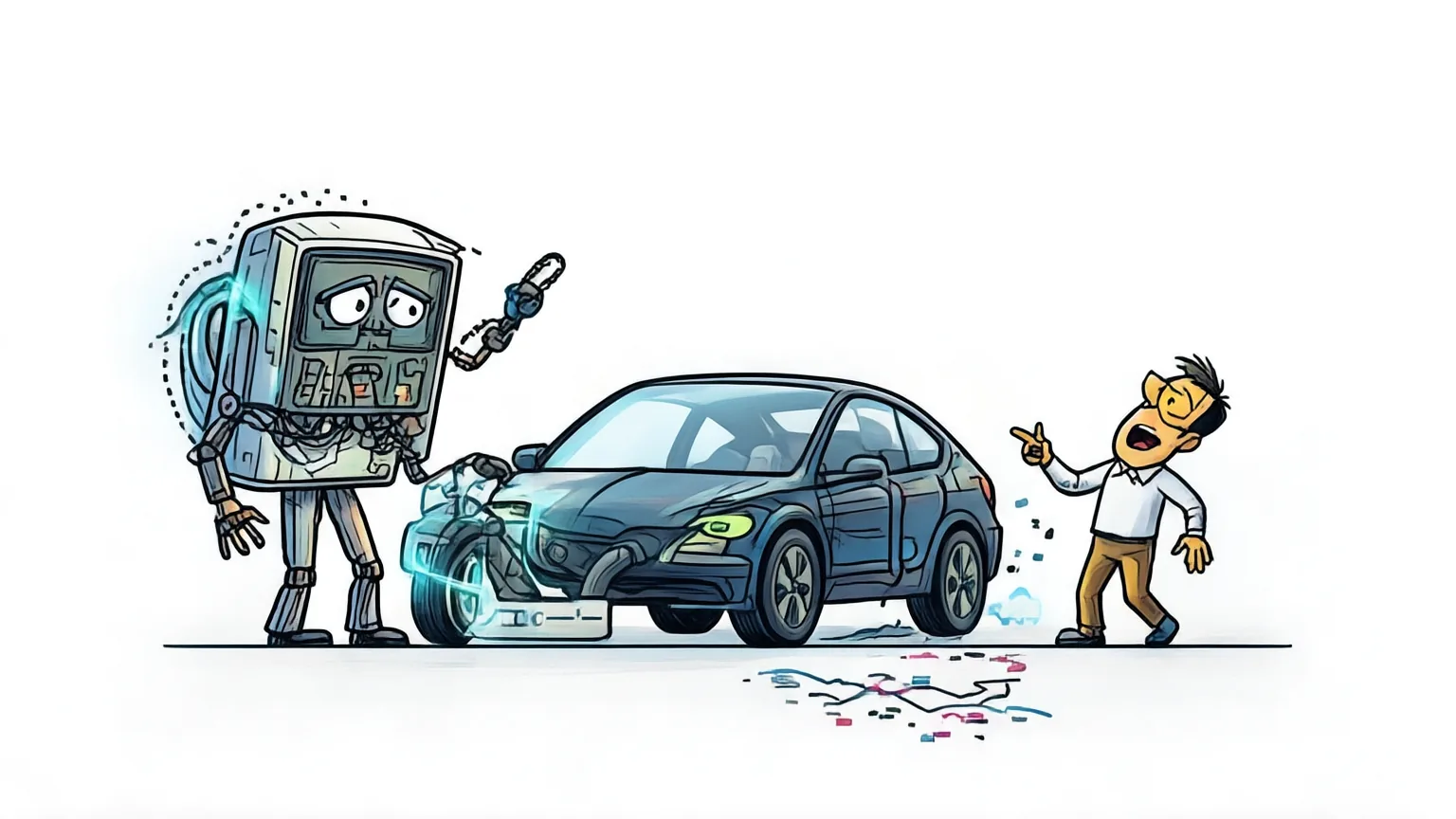
DriveZero explores how a driving system can learn choices that are absent from recorded human journeys. It trains visual understanding separately from driving decisions, then brings them together in a planner that uses cameras. The driving lessons come from a teacher that practises in interactive worlds built from real logs. The aim is to expand what the system can learn beyond the examples people happened to record.
- Problem: Systems trained to copy human driving inherit the limits of those recordings. The logs constrain both the quality of the examples and the range of situations and actions available to learn from.
- New idea: DriveZero separates learning to interpret images from learning to choose driving actions. Its visual component learns from several existing vision models using raw images without labels made for specific tasks. Its action teacher learns through reinforcement learning, which uses feedback from actions tried in interactive worlds built from driving logs. A camera-based planner then learns from the teacher's generated journeys, including journeys requested with varied driving goals.
- Simple example: Think of a driving student who can both watch recorded lessons and practise in a simulator. The simulator lets the student try different goals and see the consequences, extending the lessons beyond the routes shown in the recordings.
- Evidence: On nuPlan, DriveRL scored a mean of 93.57 across Val14, Test14-hard and Test14-random in both non-reactive and reactive modes when using value-guided action search at test time. It exceeded the Log-Replay expert on all three splits. The abstract also reports state-of-the-art DriveZero performance on NAVSIMv1, NAVSIMv2 and HUGSIM without human trajectory supervision, but gives no scores for those results.
- Limitation: The abstract reports benchmark results but no public-road evaluation. The method still uses real driving logs to build its interactive training worlds.
- Why it matters: DriveZero shows a way to teach driving decisions that human recordings do not contain.
- Paper: DriveZero: End-to-End Driving Beyond Human Demonstrations
GE-Act 2.0: Pretraining and Scaling a World-Action Model for Robotic Manipulation
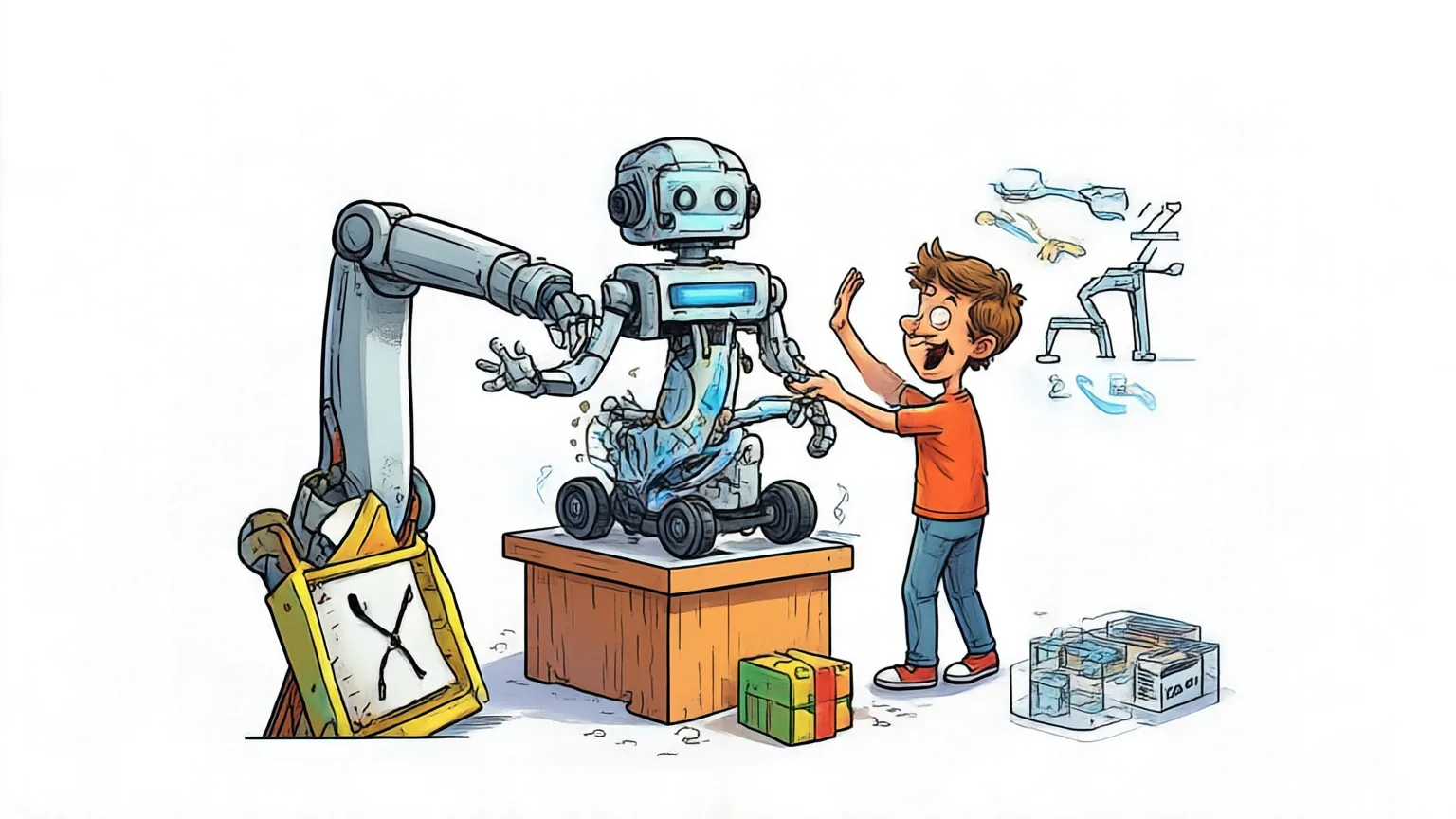
GE-Act 2.0 studies how robots can learn to handle objects by imagining the result of a movement. Its trainable parts start fresh on manipulation data, learning from videos and interactions with recorded actions. The researchers test whether more training data helps the model perform tasks in unfamiliar settings without extra training for each task. They also examine whether it follows instructions about which objects to act on.
- Problem: Many models that predict future scenes to guide robot movements start with an existing video generator. That leaves open how to train these models from scratch for manipulation and how their abilities change as training data grows.
- New idea: GE-Act 2.0 uses an autoencoder, a component that compresses visual information while retaining details relevant to actions and instructions. A visual planner predicts a complete future scene in one pass, and an inverse dynamics model works out the action associated with a change in state. These parts first learn separately from complementary data, then train together. During joint training, the system selects predicted futures judged compatible with the recorded action, reducing conflicts between the lessons supplied to its parts.
- Simple example: Imagine a robot asked to move an object to a specified position. It first represents what the completed scene should look like, then works out a movement that would produce that change.
- Evidence: The researchers evaluated the model without extra training for each task on 100 tasks across 20 skill groups. Increasing joint training data from 300 to 30,000 hours raised success from 17.1% to 44.1% on G1-OP and from 13.4% to 31.1% on G2-90D. G2-90D supplied less than 2% of the data yet gained 17.7 percentage points. The model correctly interpreted object, color, shape and position references in at least 90% of trials.
- Limitation: Even with 30,000 hours of training data, task success reached only 44.1% on G1-OP and 31.1% on G2-90D. The reported gains leave many manipulation attempts unsuccessful.
- Why it matters: This work shows that more manipulation data can improve robot performance in unfamiliar settings without extra training for each task.
- Paper: GE-Act 2.0: Pretraining and Scaling a World-Action Model
Trending AI Repositories
Ranking source: GitHub Trending.
ayghri/i-have-adhd
i-have-adhd is a Python project focused on ADHD-friendly output. Its README makes one point explicit: no ADHD diagnosis is needed.
- What it is: It is a skill for coding agents, published in the ayghri/i-have-adhd repository.
- What it does: A skill to stop your coding agent from burying the answer. ADHD-friendly output.
- Who it helps: It is for people who want ADHD-friendly responses from their coding agent. They can use the skill without an ADHD diagnosis.
- Limitation: The supplied README excerpt does not include examples demonstrating the resulting output.
- Repository: ayghri/i-have-adhd
browser-use/browser-use
Browser Use is a Python project in the browser-use repository. Its README includes an MCP identifier, a detail for readers exploring agent tooling.
- What it is: It is a Python repository with the MCP name com.browser-use/browser-use.
- What it does: Agents that use the browser.
- Who it helps: It is for developers building agents that use a browser.
- Limitation: The supplied excerpt contains no setup instructions or usage examples.
- Repository: browser-use/browser-use
The-Swarm-Corporation/AutoHedge
AutoHedge is a Python project from The Swarm Corporation focused on AI-driven finance. It puts several parts of a trading workflow within one project's stated scope.
- What it is: The project describes AI agents for market analysis, risk management and trade execution.
- What it does: Build your autonomous hedge fund in minutes. AutoHedge harnesses the power of swarm intelligence and AI agents to automate market analysis, risk management, and trade execution.
- Who it helps: It is aimed at people exploring AI agents for financial workflows. They can follow the README's Discord, YouTube and LinkedIn links to learn more.
- Limitation: The supplied excerpt provides no evidence for the claim that setup takes minutes.
- Repository: The-Swarm-Corporation/AutoHedge
Sources
- 01Hugging Face Papers · Hugging Face Papers
- 02GitHub Trending · GitHub Trending
- 03Take on your most ambitious work with GPT-6 Astra on Amazon Bedrock · AWS Machine Learning
- 04Safety for Whom? Refusing the Right Subset of a Topic, Not the Whole Topic · Hugging Face
- 05AlphaGenome Atlas: A predictive map of every possible DNA letter change in the human genome · Google DeepMind
- 06Hackers are stealing Claude tokens from subscribers · TechCrunch
- 07Cognition hits $48B valuation, signaling investors believe AI coding is far from a winner-take-all market · TechCrunch
- 08NeoHorse-1: Towards Recursive Self-Improvement via Agentic Post-Training with Routing Harness · arXiv
- 09DriveZero: End-to-End Driving Beyond Human Demonstrations · arXiv
- 10GE-Act 2.0: Pretraining and Scaling a World-Action Model for Robotic Manipulation · arXiv