Qwen deployment, football in Search, and IBM forecasting
Get this by email →
AWS details Qwen deployment on SageMaker HyperPod with vLLM. Google adds football features to Search. IBM releases a Granite time series model with a commercial-friendly license.
News
Deploying Qwen3.8-2.4T-A95B on Amazon SageMaker HyperPod with vLLM
AWS has published a guide to deploying Qwen3.8-2.4T-A95B on Amazon SageMaker HyperPod with vLLM. Alibaba’s Qwen team released the model on August 12, 2026, making Qwen-Max-class weights openly available for the first time. It has 2.4 trillion total parameters, with approximately 95 billion activated per token. Community MXFP4 and NVFP4 quantizations compress it to approximately 1.2 TB, enough to fit on a single node with 8 NVIDIA B300 GPUs.
Reasoning controls and speculative decoding share an endpoint
The walkthrough covers cluster provisioning and uses an ml.p6-b300 instance. It takes users through NVFP4 quantization and exposes an OpenAI-compatible endpoint. Native context is 262,144 tokens, extensible to 1,010,000 tokens. Users can select low, medium, or high reasoning_effort settings. The model also supports tool calling. Native MTP speculative decoding works without a separate draft model. (AWS Machine Learning)
thinkidiot take: A 2.4-trillion-parameter model fits on one 8-GPU B300 node after quantization. I would start with the documented NVFP4 deployment and compare the three reasoning settings on the same tasks. Native speculative decoding also removes a separate draft model from that setup. For me, the strongest part of this release is having a concrete deployment path for weights at this scale.
Get ready for the game with new football features in Search
Google announced new football features in Search on September 9, 2026. Its Live Game Feed brings a game recap, play-by-play updates, social commentary, video highlights, and AI-powered insights together. Users in the U.S. in English can also link Yahoo Fantasy or Sleeper accounts to get AI Mode recommendations based on live roster and league context.
The rollout has different boundaries for feeds and scores
The professional football Live Game Feed is available on mobile in the U.S. in English. Collegiate support and wider international availability are planned for later in September. A new matchup carousel shows scores from other league games. That carousel and the announced stats updates will be available globally on mobile. Fantasy recommendations include start/sit decisions and waiver wire targets. AI Mode also offers draft assessments and weekly league recaps. (Google)
thinkidiot take: Search can now use a linked Yahoo Fantasy or Sleeper roster and league context for recommendations. I would try the start/sit advice first because it puts that account context to a specific use. The U.S. English restriction makes this a narrower release than the global mobile score updates. I find roster-aware advice more compelling than putting another game recap in Search.
IBM releases SOTA Granite Time Series PatchTST-FM-r2 model with commercial-friendly license
IBM has released Granite Time Series PatchTST-FM-r2, an approximately 385M-parameter model for zero-shot forecasting and missing-value imputation. Users can choose Apache-2.0 or OpenMDW-1.0 licensing. IBM has made the weights, architecture, inference pipeline, and benchmark reproduction code available.
The benchmark lead comes with a defined comparison set
The model supports context lengths up to 8,192 and flexible forecast lengths. A 99-quantile prediction head provides probabilistic forecasts. Its conformer backbone combines multi-head self-attention with temporal convolution. As of September 8, 2026, it ranked second for CRPS and MASE among replicable, zero-shot GIFT-Eval models evaluated without test leakage. It ranked first among permissively licensed models in that category. The reported geometric-mean scores are 0.467 CRPS and 0.6846 MASE. (Hugging Face)
thinkidiot take: IBM has released benchmark reproduction code alongside the weights and inference pipeline. I would reproduce the reported evaluation before trying the model on forecasting and missing-value tasks. Its first-place ranking among permissively licensed models belongs to a specific evaluation category. I put more weight on the ability to reproduce that bounded result than on the headline’s SOTA label.
AI research startup Listen Labs scrubbed a $1.5B funding round for Salesforce talks
Listen Labs signed and then abandoned a $125 million Series C term sheet at a $1.5 billion valuation, according to people familiar with the matter cited by TechCrunch. Menlo Ventures was set to lead the round. Business Insider reported acquisition talks with Salesforce at around $2 billion, putting a potential sale in view after the financing was dropped. Those discussions are not finalized, and a deal is not assured.
Customer interviews become reports and presentations
Listen Labs develops survey questions and interviews customers over audio or video. It turns those conversations into reports and PowerPoint presentations. Its customers include Microsoft, Canva, Anthropic, and Sweetgreen. According to two people familiar with the companies’ financials, Listen Labs has about $30 million in annualized revenue. The company announced a $69 million Series B in late January. Ribbit Capital led that round at a $500 million valuation. (TechCrunch)
thinkidiot take: Listen Labs abandoned a signed $125 million funding term sheet, according to the report. For a hands-on assessment, I would follow an audio or video interview through to the resulting report and PowerPoint presentation. That complete workflow is the product I would be judging while acquisition talks stay unresolved. I find the interview-to-report process a stronger reason to examine Listen Labs than the reported sale price.
OpenAI adds a prominent AI doomer to its board of directors
OpenAI announced that alignment researcher Paul Christiano is joining the OpenAI Foundation board, according to TechCrunch’s September 9, 2026 article. He will join the Safety and Security Committee, led by Carnegie Mellon University professor Zico Kolter. That gives him a seat on the committee with final say over new model releases.
Government advice continues with recusals
The committee’s release authority includes Astra, which the article says was deployed the previous week. Christiano helped develop reinforcement learning from human feedback at OpenAI. He left in 2021 and subsequently founded the Alignment Research Center. In 2024, he became affiliated with the U.S. AI Safety Institute. That organization later became the Center for AI Standards and Innovation. According to OpenAI’s announcement, he will continue advising the government while recusing himself from OpenAI matters and model evaluations. (TechCrunch)
thinkidiot take: Christiano is joining a committee with final say over new model releases. I would judge this appointment through that release authority because it places his alignment work at a concrete decision point. His continued government advice also comes with stated recusals from OpenAI matters and model evaluations. For me, the committee’s power makes this appointment more consequential than the article’s doomer label.
Trending AI Papers
Ranking source: Hugging Face Papers for 2026-09-10.
Show-Harness: Just a VLM Agent Can Play Robots
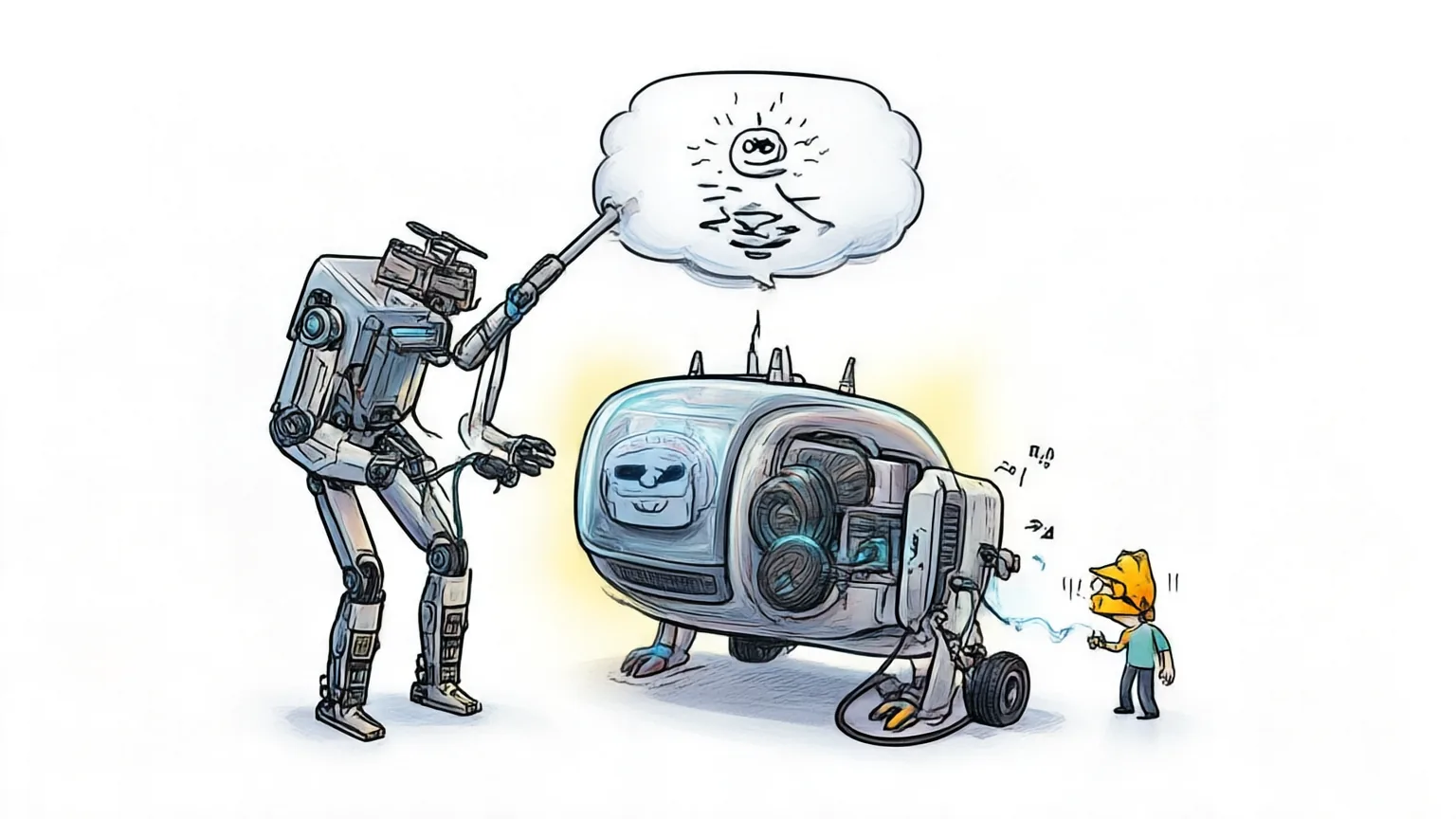
Show-Harness gives an AI model that understands images and text a way to control a robot. It turns the model's choices into movements the robot can carry out. The aim is to use abilities these models already have while reducing the need for training tailored to each robot.
- Problem: Understanding a scene does not automatically tell a model how to move a robot within it. The paper addresses the gap between that understanding and physical control, without relying on larger models or costly training for each robot type.
- New idea: Show-Harness offers a compact set of meaningful action choices to a vision-language model, an AI system that processes images and text. A robot-specific interpreter converts each choice into local robot actions through fixed rules. The model still makes the detailed physical decisions. GUMI is a graphical interface that lets people and agents demonstrate actions through the same choices without dedicated equipment for remote robot control.
- Simple example: Think of a game controller whose buttons keep the same meaning across different characters. Show-Harness provides shared action choices, while an interpreter handles how each robot carries them out.
- Evidence: The abstract reports better performance than representative agent-based and vision-language-action approaches across tasks, robot types, and environments. It also reports control without task-specific training using closed-source models, and adaptation of small open-source models with just a few GPU-hours of fine-tuning. It gives no numerical performance scores.
- Limitation: The abstract does not identify the tested tasks, robot types, or failure cases, so it leaves the boundaries of the reported generalization unclear.
- Why it matters: A shared action interface could make existing AI models useful for robot control with less specialized training.
- Paper: Show-Harness: Just a VLM Agent Can Play Robots
Programmable World Model
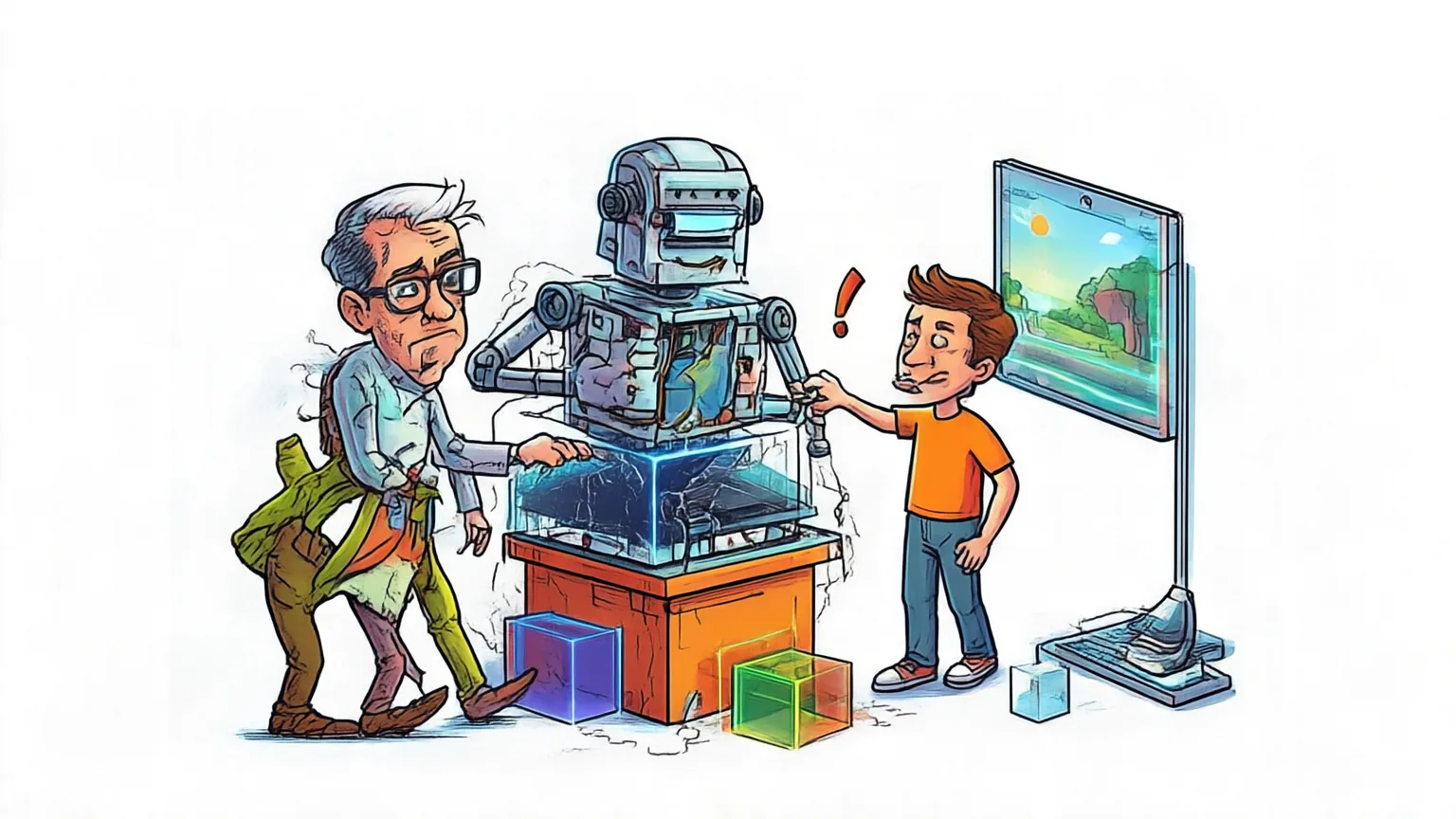
Programmable World Model aims to make AI-generated video behave like a world with rules. It keeps a separate record of what exists and what happens, then uses that record to guide the images. This lets users describe game mechanics in ordinary language and keep them in force as play continues.
- Problem: Video models can produce convincing scenes without reliably remembering the world behind them. Over extended interactions, they lack dependable ways to preserve hidden information and enforce rules.
- New idea: An AI agent converts written instructions into programs that describe entities, the objects in the world, and rules for how they change. A small software engine runs those programs and maintains a persistent record, including objects outside the camera's view and properties that are not visible. It represents objects using oriented 3D bounding boxes, boxes positioned and rotated around objects, with their recorded properties attached. Fixed conversion rules turn these boxes and the camera's planned path into guidance for a previously trained video model that draws the scene.
- Simple example: Think of a board game with a written score sheet. Covering part of the board does not remove its pieces or change the score; the record still determines what should appear when you look again.
- Evidence: On CombatStateBench, the paper's benchmark for testing programmable worlds, the method reaches 94% Count Accuracy and 98% State Accuracy. The abstract reports substantially better results than existing interactive video world models, along with coherent generation over extended interactions.
- Limitation: The abstract reports results on the paper's own benchmark but gives no results from independent benchmarks or a measured duration for reliable gameplay.
- Why it matters: Keeping the world's record separate from its pictures gives generated games a way to remember events and follow rules.
- Paper: Programmable World Model
Scores Alone Do Not Prove Discovery: The Discovery Certification Protocol for Auditing AI Research Agents
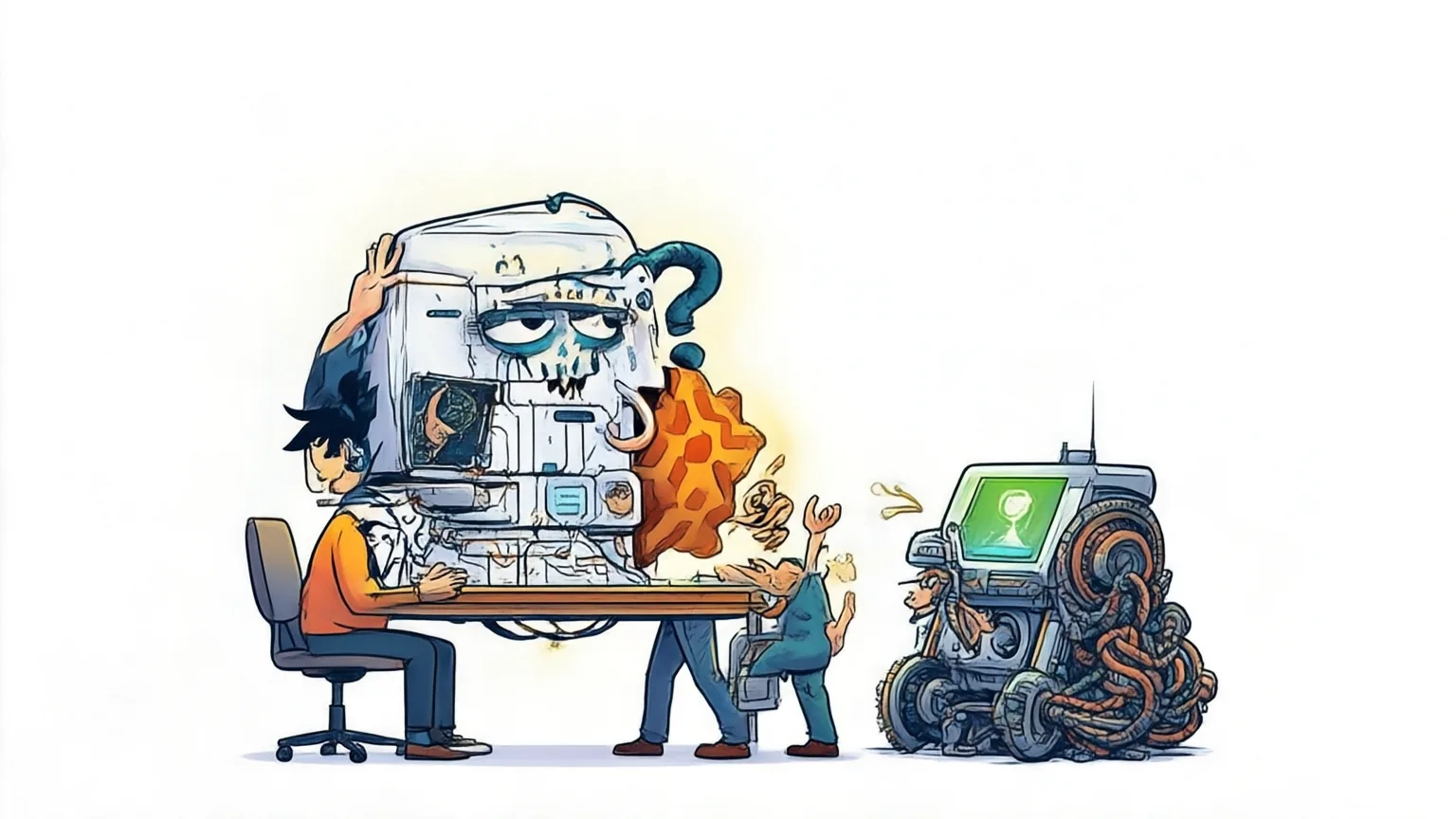
An AI research system can reach a useful result without showing that its research process was needed to get there. This paper proposes an audit that tests whether another system could reach the same target without access to that process. It also tests whether accurate experimental feedback helps. The aim is to make claims of discovery answerable to checks that others can repeat.
- Problem: Research agents draw on existing knowledge, public material, and experimental results. A strong score alone cannot distinguish the contribution of their research history from other routes to the same result.
- New idea: The Discovery Certification Protocol, or DCP, first checks improvement using an evaluation kept sealed from the agents. It then gives comparable agents the registered starting information and observed web material, but hides the target research history; reaching the target by any valid method counts as a recovery and blocks the main certification. That certification also requires adequate comparison tests, no observed recoveries, and a statistical upper bound on recovery in a fresh trial under the registered conditions. An optional test compares truthful feedback with a defined neutral feedback policy from the same saved starting point, using separate checks for false effects and a required effect size set in advance.
- Simple example: Imagine checking whether a cook's experiments were needed to produce a successful recipe. Give another cook the same starting notes and reference material, but hide the experimental history. If that cook still reaches the target, the result alone does not establish the importance of the original experiments.
- Evidence: The complete protocol was tested in SQLite optimization and virtual catalyst control under different models. Each audit found zero recoveries in 96 episodes, with an upper bound of 0.0468. Each paired study recorded 30 truthful recoveries and zero neutral recoveries, and the 60-pair null studies passed. A fixed-rule verifier reproduced the decisions from frozen evidence without using a language model.
- Limitation: Zero observed recoveries do not establish that recovery is impossible. The reported bound concerns a fresh episode under registered conditions, and the complete audits cover only SQLite optimization and virtual catalyst control.
- Why it matters: This gives researchers a way to test what an AI research process contributed beyond reaching a good score.
- Paper: Scores Alone Do Not Prove Discovery: The Discovery
Trending AI Repositories
Ranking source: GitHub Trending.
Tencent/teamai-cli
TeamAI is a TypeScript CLI project from Tencent. Its README links to an npm package and CI checks, giving readers places to inspect its distribution and build status.
- What it is: The repository contains the teamai-cli project. Its README offers English and Simplified Chinese versions.
- What it does: Make Every Team AI Native
- Who it helps: TeamAI addresses teams managing shared skills, rules, MCP, and knowledge across Claude Code, Codex, and other supported AI agents.
- Limitation: The supplied excerpt cuts off during the shared-experience repository setup instructions, leaving the remaining setup steps unavailable.
- Repository: Tencent/teamai-cli
pascalorg/editor
Pascal Editor is a local-first building editor built with React Three Fiber and WebGPU. Browser access gives readers a way to work with it beyond the command line.
- What it is: This TypeScript project sits in the browser-based 3D editing space. Its README also links to core and viewer npm packages.
- What it does: Open-source 3D architectural editor with a local CLI, MCP tools, and practical workflows for humans and AI agents.
- Who it helps: It serves people editing buildings and those connecting AI agents to that work. They can run the editor in a browser or from the CLI and connect agents through MCP.
- Limitation: The supplied excerpt does not specify browser or hardware requirements for its WebGPU foundation.
- Repository: pascalorg/editor
earthtojake/text-to-cad
Text-to-cad is a Python project whose README includes a CAD skill demo. The demo is described as generating and previewing CAD geometry, giving readers a concrete example of its focus.
- What it is: The project sits at the intersection of AI agent workflows and CAD. The supplied demo description focuses on geometry generation and preview.
- What it does: A library of agent skills for CAD, CAE and CAM
- Who it helps: It is relevant to people exploring agent-assisted CAD work. They can inspect a demo described as showing a CAD skill generate and preview geometry.
- Limitation: The supplied excerpt gives no installation steps or supported CAD tools.
- Repository: earthtojake/text-to-cad
Sources
- 01Hugging Face Papers · Hugging Face Papers
- 02GitHub Trending · GitHub Trending
- 03Deploying Qwen3.8-2.4T-A95B on Amazon SageMaker HyperPod with vLLM · AWS Machine Learning
- 04Get ready for the game with new football features in Search · Google
- 05IBM releases SOTA Granite Time Series PatchTST-FM-r2 model with commercial-friendly license · Hugging Face
- 06AI research startup Listen Labs scrubbed a $1.5B funding round for Salesforce talks · TechCrunch
- 07OpenAI adds a prominent AI doomer to its board of directors · TechCrunch
- 08Show-Harness: Just a VLM Agent Can Play Robots · arXiv
- 09Programmable World Model · arXiv
- 10Scores Alone Do Not Prove Discovery: The Discovery Certification Protocol for Auditing AI Research Agents · arXiv