AI Gets Better Tools, Bigger Debts and More Control
Get this by email →
AWS streamlines feature records, Lambda borrows for Nvidia chips, and AI systems improve alignment and run lab work. The EPA also proposes reducing public input on pollution permits.
News
Batch write and discover records in Amazon SageMaker Feature Store
Amazon SageMaker Feature Store now has two new APIs for writing and discovering records. BatchWriteRecord writes up to 25 records across multiple feature groups in one call. ListRecords enumerates record identifiers within a feature group, including records in storage that previously offered no browsing method.
Fewer calls and recoverable identifiers change routine operations
A workload ingesting 10,000 records per second across five feature groups previously required 50,000 individual API calls each second. BatchWriteRecord consolidates those writes. It uses partial-success semantics, so one failed record does not fail the whole request. ListRecords returns identifiers through pagination. It works with both Standard storage backed by DynamoDB and In-Memory storage backed by Redis. The In-Memory tier previously offered no way to browse records, so a lost identifier was permanently unrecoverable. (AWS Machine Learning)
thinkidiot take: Cutting a stated 50,000 calls per second into batches changes the operational shape of heavy ingestion. I would use the partial-success responses to retry individual failures instead of replaying whole requests. ListRecords matters just as much because an identifier lost from the In-Memory tier no longer makes its record unreachable. These are practical fixes to two avoidable sources of operational pain.
Neocloud Lambda secures $1B in debt to buy more chips
Lambda has secured $1 billion in private, short-dated debt to buy Nvidia AI chips and lease them to customers. The neocloud also closed a $1 billion secured credit facility in May 2026. The financing gives Lambda more capital for the costly hardware behind AI computing.
The AI buildout is leaning heavily on borrowed money
Lambda also announced a $926 million loan to fund Nvidia GB300 GPUs. The GB300 is one of Nvidia's newest chip models. Before the latest debt, Lambda raised $1.5 billion in venture capital in November 2025. That round valued the company at $5.43 billion after the investment. Across the wider market, banks and technology companies have raised more than $400 billion in AI-related debt globally during 2026 so far. Lambda's borrowing is part of that broader financing push. (TechCrunch)
thinkidiot take: More than $400 billion in AI-related debt during 2026 shows how much of this buildout rests on financing. Lambda is borrowing to turn Nvidia chips into leased capacity, so the hardware has to support the debt as well as customer demand. Its $926 million GB300 loan and two separate billion-dollar facilities make that pressure concrete. I see this less as a chip story than as a test of whether leased AI infrastructure can carry its own financing burden.
An Anthropic researcher just gave us a peek at self-improving AI
Anthropic published a paper titled “Automated Researchers Can Reliably Mitigate Alignment Failures.” Its automated systems improved results across all 10 alignment benchmarks tested without reducing overall performance. The best automated method beat proposals from experienced humans on average within six hours.
The cost gap makes repeated alignment work practical
The system is described as an automated alignment researcher, or AAR. Running it costs roughly $4 per hour in API inference. Human researchers cost about $150 per hour by comparison. The tests focused on benchmarks for specific misaligned behaviors. Success therefore depended on the automated researcher finding changes that improved those measured behaviors. The system only serves alignment goals to the extent that the benchmarks represent those goals. (TechCrunch)
thinkidiot take: A drop from roughly $150 per hour for human researchers to $4 per hour for API inference changes how often alignment proposals can be tested. I would run the automated method repeatedly against each available benchmark, then compare its proposals with experienced human work. The hard limit is explicit: the system optimizes what the benchmarks capture. My judgement is that cheap automated alignment work is valuable only when benchmark design receives the same scrutiny as model performance.
Google Deepmind's AI Co-Scientist now plans experiments, runs lab equipment, and writes scientific papers
Google DeepMind has expanded Co-Scientist from a hypothesis generator into a system integrated with laboratory work. The Gemini-based multi-agent system now plans experiments, writes code and controls lab equipment. It has delivered experimentally validated results across three disciplines.
Validation moves the system beyond research suggestions
In materials science, the team ran 25 rounds with human refinement. That process produced layered structures resembling the target material. In biology, the system's predictions matched unpublished laboratory results for three of four shape features. The work also included autonomous development of a medical AI architecture. That system, Agent_H, was tested on health benchmarks. It outperformed six frontier models, including GPT-5 and Claude Opus 5. (The Decoder)
thinkidiot take: Experimentally validated results across three disciplines make this more than a hypothesis-writing demonstration. I would focus first on workflows where planned experiments produce measurements that directly test the system's output. The 25 rounds of human refinement in materials science also show that integration still includes substantial human work. Co-Scientist earns attention because it closes part of the loop between proposing an idea and testing it in a lab.
Trump’s EPA wants to let data centers hide their air pollution
The Trump administration wants to scrap a federal air pollution rule that requires public notice and an opportunity to comment. The EPA plan would remove that federal participation requirement for a large set of polluters classified as minor sources. States would instead carry the burden of providing public participation.
A minor permit can still cover a massive AI facility
The rule at issue is New Source Review. The EPA says minor sources have relatively low emissions and limited environmental impact. Advocates argue that the label is misleading. They say this permitting process routinely covers projects with significant consequences for nearby residents. One example is Colossus 1, xAI's massive data center in Tennessee. The facility, billed as the “most powerful AI training system yet,” applied for a minor source permit in 2025. (The Verge)
thinkidiot take: Removing the federal participation requirement shifts the burden to states and reduces a guaranteed route for public input. Colossus 1 shows why the minor label deserves scrutiny: a massive data center applied under that category in 2025. People living near these projects have direct stakes in the permitting decisions. I judge public notice and comment to be a basic requirement when a category can include projects with significant consequences for neighbors.
Trending AI Papers
Ranking source: Hugging Face Papers for 2026-08-29.
Agentic Game Development as a Verifiable Trajectory Data Engine for Scaling World Models

This paper treats game creation as a training ground for systems that learn how environments work. A game engine can check whether a generated scene behaves properly, while a developer decides whether the overall result is acceptable. The aim is to give spatial models clearer feedback and useful records of long tasks.
- Problem: World models are often scaled with more online video and more computing power. Unlike executable code, generated spaces are usually judged with rough measures such as CLIP scores, which can be biased and too vague for reliable reinforcement learning.
- New idea: The paper proposes Reinforcement Learning with Human-Engine Verification, or RLHEV. Reinforcement learning improves a model using feedback about its outputs. A game engine supplies detailed checks for collisions, physics, movement through the scene and limited forms of playability. Human acceptance during development supplies a broader judgment of whether the scene works.
- Simple example: It is like teaching someone to build a playground with both an inspector and a parent. The inspector checks whether the equipment is stable and usable, while the parent decides whether the playground works as a whole.
- Evidence: The abstract reports no measured results or numerical comparisons. It argues that game engines can check scene properties and that game development can provide long sequences of actions for later training.
- Limitation: The abstract does not test RLHEV or show that its feedback improves a world model.
- Why it matters: Better feedback could help spatial models learn from consequences instead of vague similarity scores.
- Paper: Agentic Game Development as a Verifiable Trajectory Data
UrbanGround: From Local Perception to Spatial Agency in a Real-Scale City
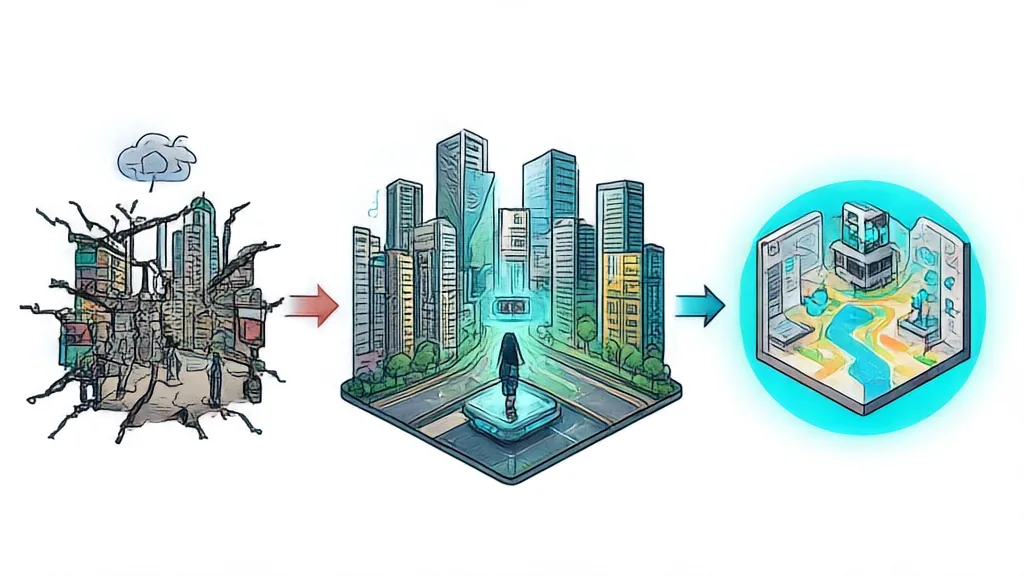
This paper asks whether an AI that understands one street view can still act sensibly after moving through a city. It introduces a virtual Hong Kong where agents can walk, look around and use a map. The goal is to test whether small visual skills can support longer journeys under changing conditions.
- Problem: Current multimodal language models can interpret nearby visual details, but city travel requires those observations to guide many later actions. Their mistakes build up during longer exploration, and they often fail to recover.
- New idea: UrbanGround is a testing environment built from territory-wide 3D geographic data for Hong Kong. Agents interact with it from a first-person view, meaning they see the city from the position of a person moving through it. A closed loop means each action changes what the agent sees and what it can do next. The tests cover local spatial questions, navigation to increasingly distant or unclear destinations, route changes and moving pedestrians.
- Simple example: A visitor may recognize a shop and choose the right nearby turn, yet still get lost when the destination is several streets away or a usual path is blocked.
- Evidence: The tested agents generally handle visual recognition and nearby spatial reasoning. Orientation and movement around pedestrians remain unreliable, while longer exploration causes errors to accumulate without effective correction.
- Limitation: The abstract gives no numerical scores and does not establish how well the findings transfer beyond the Hong Kong replica.
- Why it matters: The work shows where city-going AI breaks when isolated perception must become sustained action.
- Paper: UrbanGround: From Local Perception to Spatial Agency in a
TTPO: Test-Time Policy Optimization

This paper presents a way for a language model to improve while solving a test, without seeing correct answers. It uses agreement among several attempted solutions as a temporary guide but avoids trusting that guide completely. The aim is to make self-training useful even when the model's own consensus is wrong.
- Problem: Reinforcement learning and on-policy self-distillation usually depend on known correct answers, so they cannot readily train a model during testing. Replacing those answers with a majority vote is risky because one wrong consensus can teach errors across the full response.
- New idea: Test-Time Policy Optimization, or TTPO, divides attempted solutions according to whether they agree with the majority answer. On-policy self-distillation trains the model to imitate selected solutions that agree. Grouped reinforcement learning compares attempts and penalizes disagreeing ones, which the authors observe are usually wrong even when the majority is mistaken. Selection at the token level reduces attention to settled positions and applies penalties only to errors made with confidence.
- Simple example: Imagine a study group with no answer key. The group learns from solutions most members reached, but it also examines confident dissenting steps separately instead of treating the vote as unquestionable truth.
- Evidence: Without labels, TTPO matches label-supervised on-policy self-distillation on five competition-level benchmarks. In test-time training, it raises Qwen3-1.7B from 38.0% to 45.2%. Without thinking, it produces gains from +25.2% to +36.4%, and the abstract also reports strong transfer across tasks.
- Limitation: The abstract does not identify the tested benchmarks or give detailed evidence for the claimed cross-task generalization.
- Why it matters: A model that can learn safely without answer labels could improve on tasks where verified solutions are unavailable.
- Paper: TTPO: Test-Time Policy Optimization
Trending AI Repositories
Ranking source: GitHub Trending.
abhigyanpatwari/GitNexus
GitNexus maps a repository into a form people can explore and question. It is notable because the work stays in the browser.
- What it is: It is a TypeScript project from Akon Labs for code intelligence and repository exploration.
- What it does: GitNexus: The Zero-Server Code Intelligence Engine - GitNexus is a client-side knowledge graph creator that runs entirely in your browser. Drop in a git repository (Github, Gitlab, Azure, Local) or ZIP file, and get an interactive knowledge graph with a built in Graph RAG Agent. Perfect for code exploration
- Who it helps: It helps people understand unfamiliar codebases. They can explore relationships in repositories from GitHub, GitLab, Azure, local storage, or ZIP files.
- Limitation: It has no official cryptocurrency, and any token using its name is unaffiliated.
- Repository: abhigyanpatwari/GitNexus
calesthio/OpenMontage
OpenMontage brings structured production knowledge into an AI-assisted video workflow. It is worth attention for the breadth of its production system.
- What it is: It is an open-source Python project built around agentic video production.
- What it does: World's first open-source, agentic video production system. 12 production pipelines, 100+ tools, 700+ agent skill and production-knowledge files. Turn your AI coding assistant into a full video production studio.
- Who it helps: It helps people using AI coding assistants for video work. They can use production pipelines, tools, agent skills, and production knowledge files in one system.
- Limitation: It requires an AI coding assistant.
- Repository: calesthio/OpenMontage
abi/screenshot-to-code
Screenshot-to-code turns visual references into functional interface implementations with AI. It is useful when a design exists but the front-end code does not.
- What it is: It is a Python project for generating interface code from screenshots, mockups, Figma designs, and screen recordings. An official hosted version is also available.
- What it does: Drop in a screenshot and convert it to clean code (HTML/Tailwind/React/Vue)
- Who it helps: It helps people translating visual designs into front-end code. They can work from several kinds of visual input and target HTML with Tailwind, React, or Vue.
- Limitation: It requires a screenshot, mockup, Figma design, or screen recording as input.
- Repository: abi/screenshot-to-code
Sources
- 01Hugging Face Papers · Hugging Face Papers
- 02GitHub Trending · GitHub Trending
- 03Batch write and discover records in Amazon SageMaker Feature Store · AWS Machine Learning
- 04Neocloud Lambda secures $1B in debt to buy more chips · TechCrunch
- 05An Anthropic researcher just gave us a peek at self-improving AI · TechCrunch
- 06Google Deepmind's AI Co-Scientist now plans experiments, runs lab equipment, and writes scientific papers · The Decoder
- 07Trump’s EPA wants to let data centers hide their air pollution · The Verge
- 08Agentic Game Development as a Verifiable Trajectory Data Engine for Scaling World Models · arXiv
- 09UrbanGround: From Local Perception to Spatial Agency in a Real-Scale City · arXiv
- 10TTPO: Test-Time Policy Optimization · arXiv