AI’s bill comes due in court, code and entertainment
Get this by email →
Music publishers accuse Anthropic of piracy, OpenAI drops Cursor, and AI video displaces Chinese performers. Nvidia tackles data bottlenecks while musicians expose synthetic work.
News
Sony Music, Warner sue Anthropic, alleging a “brazen campaign” of intellectual property theft
Sony Music and Warner sued Anthropic late Friday in the U.S. District Court for the Northern District of California. The publishers accuse Anthropic of using thousands of copyrighted works to train Claude. The case now puts broad claims of illegal piracy before the court.
The dispute centers on how training material was acquired
The lawsuit says Anthropic used illegal torrents to obtain millions of books, including works containing lyrics and sheet music. It describes that conduct as blatant theft and flagrant piracy. The same lawyers represent Concord Music Group and Universal Music Group in a separate case filed in January. The filing follows the Bartz case, where a judge ruled that training on copyrighted works was legal but acquiring them through piracy was not. Anthropic was ordered to pay $1.5 billion in that case. An Anthropic spokesperson said the company disagrees with the publishers and will defend itself robustly in court. (TechCrunch)
thinkidiot take: The $1.5 billion Bartz order makes the method of acquiring training data impossible to treat as a minor detail. If I ran these models, I would require a traceable record for every training source before another training run. The industry has focused heavily on whether training itself is legal, while this lawsuit targets the alleged torrenting used to collect the material. Calling that distinction administrative understates the central risk now facing Anthropic.
OpenAI cuts off Cursor after SpaceX acquisition, citing Musk's history of breaking contracts
OpenAI is terminating its contract with Cursor after SpaceX acquired the coding tool. The termination takes effect on November 12, 2026. Cursor co-founder Michael Truell says OpenAI models account for about five percent of the tool’s AI traffic, leaving Cursor able to route most work elsewhere.
A change-of-control clause gives OpenAI its exit
The contract gives OpenAI a limited window to end the agreement after a change in ownership. OpenAI cited Elon Musk’s record of breaking contracts. OpenAI previously paid Twitter about $2 million per year for access to its full tweet data feed for ChatGPT training. Musk acquired Twitter in December 2022. He believed that price was too low and cut off OpenAI’s access. Cursor has downplayed the effect of losing the models. (The Decoder)
thinkidiot take: Losing a provider that handles about five percent of Cursor’s AI traffic is a contained operational change. If I depended on Cursor, I would verify which workflows use OpenAI models before the November 12 cutoff and move those workloads. The larger issue is that ownership changes can activate contract exits even when the affected supplier carries little traffic. OpenAI’s decision is defensible because its earlier Twitter data access ended after Musk rejected the roughly $2 million annual price.
AI-generated videos are already displacing actors and livestreamers across China's entertainment industry
China published about 128,000 short dramas in the first quarter of 2026, three times the total for all of 2025. The China Netcasting Services Association says 95 percent were AI-generated. Digital performers can now produce videos faster and more cheaply than humans, displacing actors and livestreamers.
Production costs have fallen to a tenth of the human rate
One minute of AI video costs $90 to $120. That is about ten percent of what production with human actors used to cost. The shift accelerated after ByteDance launched Seedance 2.0. Some actors are being required to hand over their voices and likenesses to AI tools before being fired. AI-related labor disputes are rising fast. The industry directly employs 690,000 people, while 15 million list livestreaming as their primary job. (The Decoder)
thinkidiot take: When 95 percent of 128,000 short dramas are AI-generated, synthetic production is already the standard in this market. At $90 to $120 per minute, I would expect producers to choose it whenever a human performance is not required. That saving lands directly against an industry employing 690,000 people and supporting 15 million primary livestreaming jobs. Taking an actor’s voice and likeness before firing them is exploitation, regardless of how efficient the resulting video pipeline becomes.
Nvidia’s AI advantage is moving beyond the GPU
Nvidia is rolling out its Vera Rubin architecture to improve data center efficiency through smarter movement of data. The system pairs a Rubin GPU with a Vera CPU, a Groq 3 LPX inference accelerator, and related storage and networking racks. Nvidia has seen improvements of more than three times in operations accelerated by the Vera CPU.
Memory traffic is becoming as important as processor cycles
Jason Hardy, Nvidia’s vice president of storage technology, says a single server can hold only so much memory. Vera lets systems use flash storage to its full potential without creating a bottleneck. The design extends Nvidia’s focus beyond GPU compute into storage, networking and traffic control. OpenAI has taken a related approach with its Jalapeño chip. Jalapeño focuses on reducing data movement and communication delays. Its large domain keeps an entire workload inside one connected system. Nvidia’s market capitalization grew tenfold between the start of 2023 and mid-2025. (TechCrunch)
thinkidiot take: An improvement of more than three times from the Vera CPU shows that feeding a workload matters as much as adding processor cycles. In a data center build, I would measure flash, memory and network bottlenecks before buying more GPU capacity. Nvidia and OpenAI are both designing around reduced data movement, whether through Vera Rubin or Jalapeño. Treating the GPU as the whole AI system is now an outdated engineering choice.
Musicians-turned-detectives are hunting for AI grifters
Musicians are investigating people who publish AI-generated music while presenting it as human work. Max H4RRIS Harris, a 26-year-old EDM producer, calls out suspected examples in videos. Public scrutiny has forced some creators who denied using AI to admit it, giving listeners a way to challenge false accounts of how tracks were made.
Production knowledge has become a tool for detecting deception
Audio generation tools have grown more sophisticated. The internet now contains AI-generated music with melodies and vocals derived algorithmically from human artists’ work. Some creators disclose their use of AI immediately. Others deny it until they face public scrutiny. Harris calls AI music a decoy art form and says it enables people to steal real art and pass it off as their own. His production setup includes Ableton Live, a Novation Launchkey 49 MIDI controller, Ableton Push 3, Launchpad X, analog synthesizers, Serum, Diva and the Kontakt software sampler. (The Verge)
thinkidiot take: Public scrutiny has already forced some people to reverse denials and admit using AI. As someone working with tools such as Ableton Live, Serum and Kontakt, I would treat disclosure of generated parts as basic production information. Sophisticated audio tools make deception easier, while experienced producers have the practical knowledge to inspect the result. Passing algorithmically derived music off as wholly human work deserves exposure, and Harris is right to treat that deception as an artistic failure.
Trending AI Papers
Ranking source: Hugging Face Papers for 2026-08-28.
Self-OPD: On-Policy Distillation for Flow Matching Models without Teacher
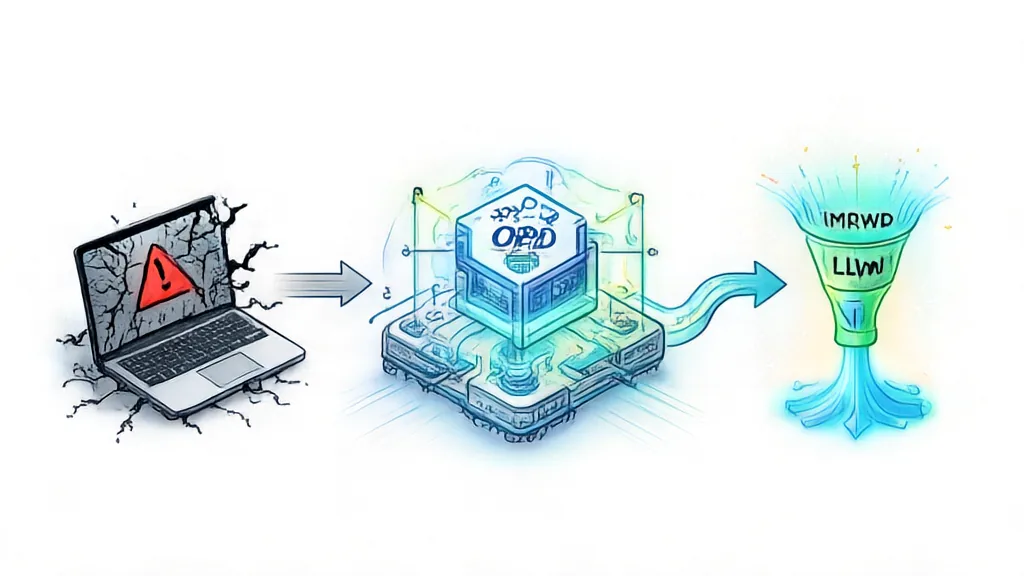
This paper presents a way to improve image or data generation models without training a separate expert model first. The system learns from several possible continuations of its own work. It rewards better paths and discourages worse ones. The aim is to reduce training cost and avoid errors caused by a mismatch between two models.
- Problem: Earlier methods depend on a specialized teacher for each new goal, which is expensive to train. The teacher and student may also produce different kinds of outputs, so small mistakes can accumulate during generation.
- New idea: Self-OPD makes the student model supervise itself. At each stage, it creates K random candidate next steps, completes each candidate, and scores the resulting output. It compares those scores with its usual deterministic path, meaning the path produced without randomness. Better candidates pull future behavior toward them, while worse candidates push it away, with adjustments for direction and random variation.
- Simple example: It is like a cook trying several small variations of the same dish, comparing each one with the standard recipe, then adopting the changes that taste better and rejecting those that taste worse.
- Evidence: On tests with single and combined rewards, Self-OPD performed better than earlier reinforcement learning and on-policy distillation methods without using task-specific teachers.
- Limitation: The abstract gives no numerical results and does not test how the method behaves outside the reported single and mixed reward benchmarks.
- Why it matters: It could make model alignment cheaper while reducing errors caused by relying on a separate teacher.
- Paper: Self-OPD: On-Policy Distillation for Flow Matching Models
GameWAM: A World Action Model for Video Games
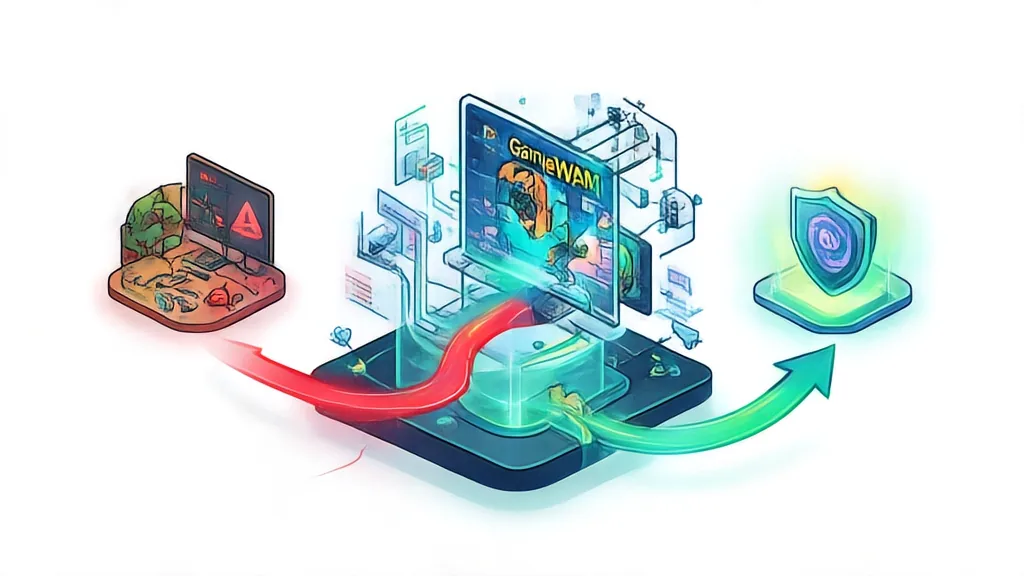
This paper introduces an agent that can predict what a video game will show next while also deciding which keyboard and mouse actions to take. It is designed for direct play rather than for watching or planning in isolation. The system also handles graphical interfaces alongside ordinary gameplay. Its goal is to connect an understanding of the game world with practical control.
- Problem: Current game agents choose actions from images and instructions without explicitly modeling how the world changes. Other systems predict future game images from given actions but cannot choose actions to complete tasks.
- New idea: GameWAM learns future images and usable keyboard and mouse movements together. Its visual process predicts what will appear, while its action process produces controls, and each uses the relevant earlier information. The model labels each action step as gameplay or graphical interface use, then applies a control distribution suited to that mode. It plans farther ahead than it acts, executes a short portion, observes the result, and plans again while retaining recent and longer-term history.
- Simple example: It is like driving while imagining the road ahead, moving the wheel only a little, checking the new view, and then revising the route.
- Evidence: The experiments report competitive task success while executing fewer native actions than the agents used for comparison. The study also finds that low-frequency patterns in the sampled action source can steer broad camera movement even when the other conditions stay fixed.
- Limitation: The abstract provides no numerical success rates and does not establish how broadly the results transfer across games or interfaces.
- Why it matters: Joining prediction and control could help game agents act more efficiently over long, changing tasks.
- Paper: GameWAM: A World Action Model for Video Games
PILOT in the Loop: Live Self-Improvement for Long-Horizon Agents
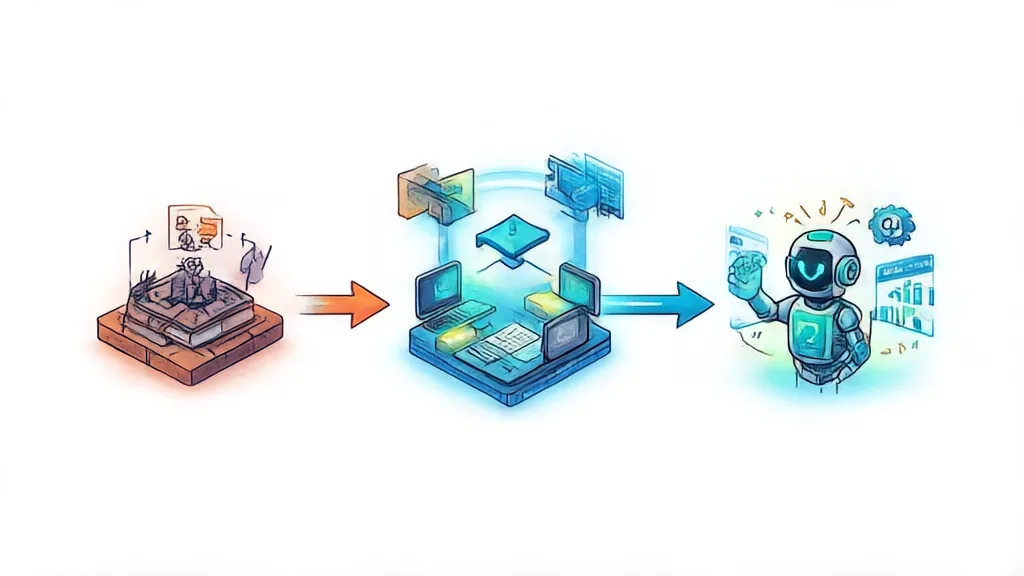
This paper proposes an agent setup that learns while a long task is still running. A supervisor watches a worker and can change its course before the task ends. Lessons from the same run are also saved for later work. The aim is to make agents more responsive, efficient, and capable of lasting improvement.
- Problem: Most self-improvement systems examine experience only after a run finishes, so new lessons cannot rescue the current attempt. A single agent must judge itself inside the same context, while delegated workers usually cannot be redirected once active.
- New idea: PILOT separates the system into a supervisor and a worker. The worker performs the task, while the supervisor independently reviews progress and can redirect or stop it during execution. This ability is called live steering. A second process, live self-evolution, turns useful procedures and observed failure patterns into reusable instructions and stored memory.
- Simple example: It is like a driving instructor correcting a learner during the trip, then adding the mistake and its remedy to the lesson plan for future students.
- Evidence: Across two frozen backbones and three benchmarks, PILOT ranked first in five of six configurations. On Terminal-Bench 2.0, it beat counterpart harnesses by up to 9.8 percentage points. In the self-improvement setting, it gained 14.6 points with GLM-5.1 and 12.4 points with Kimi-K2.6. Mean output tokens fell by 42.9% and 47.4%, while successful evaluations per million output tokens increased by 110.3% and 134.0%, respectively.
- Limitation: The evaluation covers two frozen backbones and three benchmarks, so the abstract does not show whether the gains hold for other models, tasks, or longer deployments.
- Why it matters: Agents that learn during a task can correct failures sooner and reuse successful lessons immediately.
- Paper: PILOT in the Loop: Live Self-Improvement for Long-Horizon
Trending AI Repositories
Ranking source: GitHub Trending.
THU-MAIC/OpenMAIC
OpenMAIC is a TypeScript project for interactive learning with multiple agents. It is worth attention for making this classroom format easy to access.
- What it is: It is an open classroom application built around multiple agents and interactive learning.
- What it does: Open Multi-Agent Interactive Classroom , Get an immersive, multi-agent learning experience in just one click
- Who it helps: It helps learners who want a more interactive classroom experience. They can start a session with multiple agents in one click.
- Limitation: The supplied README excerpt only shows a banner, a short description, and a user guide link.
- Repository: THU-MAIC/OpenMAIC
p-e-w/heretic
Heretic is a Python project for changing how language models respond to restricted prompts. It draws attention because the process is designed to run without manual intervention.
- What it is: It is an automation tool that operates on language models and their response restrictions.
- What it does: Fully automatic censorship removal for language models
- Who it helps: It helps people working with language models who want fewer response restrictions. They can automate that modification process.
- Limitation: The supplied README excerpt does not explain which language models it supports or how to run it.
- Repository: p-e-w/heretic
ComposioHQ/awesome-claude-skills
Awesome Claude Skills is a Python repository that collects material for extending Claude workflows. It is useful as a single place to discover relevant skills, resources, and tools.
- What it is: It is an Awesome-style reference repository focused on the Claude customization ecosystem.
- What it does: A curated list of awesome Claude Skills, resources, and tools for customizing Claude AI workflows
- Who it helps: It helps Claude users looking for workflow extensions. They can browse collected skills, resources, and tools instead of finding each one separately.
- Limitation: The supplied README excerpt does not show the actual entries or their selection criteria.
- Repository: ComposioHQ/awesome-claude-skills
Sources
- 01Hugging Face Papers · Hugging Face Papers
- 02GitHub Trending · GitHub Trending
- 03Sony Music, Warner sue Anthropic, alleging a “brazen campaign” of intellectual property theft · TechCrunch
- 04OpenAI cuts off Cursor after SpaceX acquisition, citing Musk's history of breaking contracts · The Decoder
- 05AI-generated videos are already displacing actors and livestreamers across China's entertainment industry · The Decoder
- 06Nvidia’s AI advantage is moving beyond the GPU · TechCrunch
- 07Musicians-turned-detectives are hunting for AI grifters · The Verge
- 08Self-OPD: On-Policy Distillation for Flow Matching Models without Teacher · arXiv
- 09GameWAM: A World Action Model for Video Games · arXiv
- 10PILOT in the Loop: Live Self-Improvement for Long-Horizon Agents · arXiv