OpenAI renews privacy promises as Replit opens free building and agents get wallets

OpenAI reaffirms Zero Data Retention for API customers and previews Private Safety Processing. Hugging Face ships LFM2.5 QAD checkpoints that keep nearly all baseline performance, as Replit opens free building with GPT-5.6 Luna and AWS makes agent payments generally available.
News
Offering Zero Data Retention for frontier models
The preview is for safety that works without the data
OpenAI reaffirms Zero Data Retention for eligible API customers. It also previews Private Safety Processing, an approach to advanced AI safety without compromising data privacy. (OpenAI)
thinkidiot take: A company that has to reaffirm a privacy promise is telling you what its customers fear. Pairing that pledge with a private safety path is a smart move, because it removes the usual excuse that safety checks need to read your data. Whether the processing actually stays private will matter more than the label.
LFM2.5 Q4_0 Checkpoints from Quantization-Aware Distillation
A quantization path that gives back almost everything it takes away
Hugging Face released QAD Q4_0 checkpoints for LFM2.5-230M, LFM2.5-350M, LFM2.5-1.2B-Instruct, and LFM2.5-2.6B. They retain 97.1%, 96.5%, 97.4%, and 96.6% of the respective BF16 baseline performance, and 97% of the BF16 average accuracy lost to quantization is recovered. The 230M and 350M checkpoints match Q5_K_M quality at 4-33% higher decode throughput, and the 1.2B and 2.6B match Q4_K_M quality at 3-14% higher throughput. The 230M and 1.2B checkpoints also match Unsloth's UD-Q4_K_XL. (Hugging Face)
thinkidiot take: Recovering 97% of the lost accuracy at a low-bit size is the real story, because model size is what decides who can run it. Matching a higher quantization baseline while gaining throughput means these small models get more useful on modest hardware. Keeping small models competitive is where a lot of the field's practical value actually lives.
Replit expands access to software creation with GPT-5.6 Luna
Token bills stop being the gate
Replit introduced Free Mode, powered by GPT-5.6 Luna. It lets anyone turn ideas into working software without worrying about token costs. (OpenAI)
thinkidiot take: Free is the strongest distribution channel there is. When building stops costing money per token, the people writing software are the ones with ideas, not the ones with budgets. That will change what gets built, and it will change what gets thrown away just as fast.
Amazon Bedrock AgentCore payments is now generally available: Enabling agents to transact safely and autonomously at scale
Spend guardrails for agents that act on their own
Amazon Bedrock AgentCore payments is now generally available. It lets AI agents transact autonomously at scale, with built-in spending guardrails, protocol-agnostic payment orchestration, and production-ready observability. (AWS Machine Learning)
thinkidiot take: Payments are the missing permission for agents, and shipping guardrails and observability in the same box is the right instinct. The failure mode of an agent with a card is not a bug, it is a business. The interesting fight is over what spending guardrails can actually stop, and who answers when they do not.
Trending AI Papers
Ranking source: Hugging Face Papers for 2026-08-19.
Demystifying Agent Skills: Why They Work-Until They Don't
- Problem: Existing evaluations measure whether agent skills improve overall task success but never check when and why skills actually help or where they fail.
- New idea: The paper runs controlled experiments plus paired trajectory analysis to find out when skills work. A skill is a structured package of knowledge used by an LLM agent at inference time, and it works because it turns messy, noisy trajectories into procedural anchors that stabilize execution.
- Simple example: It is like a flight checklist: the pilot already knows how to fly, but the checklist pins each action down so that under stress the steps stay in the right order instead of scattering.
- Evidence: Skills improve over Workflow Memory by 6.06 points in matched comparisons. Procedural anchoring accounts for 65.7 percent of skill cases versus 4.5 percent for explicit knowledge injection. As skill pools grow from 5 to 100, actual-use precision falls from 29.6 percent to 3.3 percent.
- Limitation: The main concession is that retrieval becomes a separate bottleneck at scale: pools grow from 5 to 100 and actual-use precision collapses, so the paper leaves large-scale reliable retrieval untested.
- Why it matters: It replaces the single question of average success with a map of when skills help, how they help, and where they break.
- Paper: Demystifying Agent Skills: Why They Work-Until They Don't
Agentic ESOpt: Fine-Tuning Long-Horizon LLM Agents with Minimal GPU Requirements
- Problem: Reinforcement learning is heavy and brittle for fine-tuning agents that act over long horizons, because backpropagation is expensive and crediting one reward across a long trajectory is hard.
- New idea: The paper argues evolution strategies (ES) are better for long-horizon agents because they use black-box rewards to nudge parameters instead of backpropagating. Agentic ESOpt applies this by sampling perturbations around current parameters, scoring the agents, and applying an online reward-weighted update.
- Simple example: It is like tuning a guitar: you do not need to know how the sound is built, you just nudge each string a bit, listen, and repeat until it sounds right.
- Evidence: On WebArena-Lite, full-parameter optimization of Qwen-3.5-27B improves the No Skill baseline by 6.69 percent. In test-time automatic heuristic design, Agentic ESOpt improves its matched baseline in 28 of 36 settings.
- Limitation: The abstract only proves the approach on WebArena-Lite and one test-time heuristic setting, so generalization to other benchmarks and tasks is left untested.
- Why it matters: It makes full-parameter fine-tuning of large agents realistic on ordinary GPU budgets instead of requiring a heavyweight RL stack.
- Paper: Agentic ESOpt: Fine-Tuning Long-Horizon LLM Agents with
ASI-Bench: At the Dawn of Artificial Superintelligence
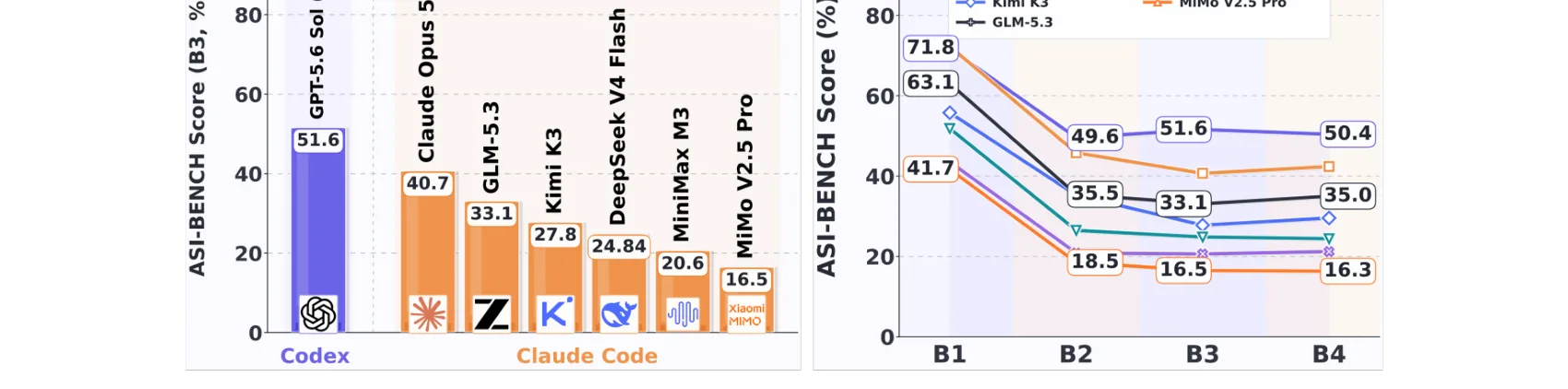
- Problem: Existing benchmarks only check whether AI can answer from learned knowledge or finish tasks under heavy human guidance, and none measure the leap into creating and verifying new knowledge on its own.
- New idea: ASI-Bench is the first benchmark to jointly evaluate AI systems on innovative exploration plus autonomous scientific execution, and it does so by progressively withdrawing human methodological guidance within the same project. It is built by over 40 experts with the cost of 31,000 plus human hours and spans 60 project-level tasks across 11 scientific domains.
- Simple example: It is like a research lab that starts with the lead giving full instructions, then steps back to hand over the tools, and finally asks the intern to run the whole project alone. It measures how far the intern can go at each level.
- Evidence: Across 18 state-of-the-art agent and model configurations the average score drops from 50.91 with full methodological guidance to 29.10 with only the method specified, and 26.62 when agents must determine the method themselves.
- Limitation: The abstract concedes that current systems remain heavily dependent on human guidance, so the gap to autonomous scientific execution is the limitation it exposes rather than one it closes.
- Why it matters: It gives the first honest measure of how far away artificial superintelligence on scientific research actually is, instead of guessing from static benchmarks.
- Paper: ASI-Bench: At the Dawn of Artificial Superintelligence
Trending AI Repositories
Ranking source: GitHub Trending.
volcengine/OpenViking
- What it is: OpenViking is a Python project that sits on Volcengine's GitHub and pairs a website with a live studio demo.
- What it does: Self-evolving Context Database for AI Agents. Unify Agent Memory, Knowledge RAG and Skills.
- Who it helps: It helps AI agent builders who want to run, test, and inspect one system instead of wiring memory, retrieval, and skills separately.
- Limitation: You need to install or deploy a context database service rather than calling it as a single drop-in library.
- Repository: volcengine/OpenViking
mukul975/Anthropic-Cybersecurity-Skills
- What it is: It is a Python-based, Apache 2.0 open-source skills library that plugs into coding agents through the agentskills.io standard.
- What it does: 817 structured cybersecurity skills for AI agents · Mapped to 6 frameworks: MITRE ATT&CK, NIST CSF 2.0, MITRE ATLAS, D3FEND, NIST AI RMF & MITRE F3 (Fight Fraud) · agentskills.io standard · Works with Claude Code, GitHub Copilot, Codex CLI, Cursor, Gemini CLI & 20+ platforms · 29 security domains · Apache 2.0
- Who it helps: It helps AI agent developers and security teams by giving their agents structured cybersecurity reference material across 29 security domains.
- Limitation: It is a skills library, so it does not run scans or enforce controls by itself.
- Repository: mukul975/Anthropic-Cybersecurity-Skills
mattpocock/skills
- What it is: It is a Shell-based collection of agent skills published from the author's local .agents directory and tied to a newsletter link.
- What it does: Skills for Real Engineers. Straight from my .agents directory.
- Who it helps: It helps engineers who use AI agent tools and want ready-made, practitioner-written skills instead of starting from scratch.
- Limitation: It reflects one engineer's own setup, so it does not cover the practices you need if they differ from the author's.
- Repository: mattpocock/skills
Sources
- 01Hugging Face Papers · Hugging Face Papers
- 02GitHub Trending · GitHub Trending
- 03Offering Zero Data Retention for frontier models · OpenAI
- 04LFM2.5 Q4 0 Checkpoints from Quantization-Aware Distillation · Hugging Face
- 05Replit expands access to software creation with GPT-5.6 Luna · OpenAI
- 06Amazon Bedrock AgentCore payments is now generally available: Enabling agents to transact safely and autonomously at scale · AWS Machine Learning
Join the Idiots
New lab every Sunday. No spam, unsubscribe anytime.