AWS Tightens Agent Search as Stripe and OpenAI Make Bigger AI Bets

AWS gives agents tighter control over web sources. Stripe buys OpenRouter at a reported premium. OpenAI previews privacy protections that detect abuse without retaining customer data.
News
Domain and publish date filters for Web Search on AgentCore
Amazon has added runtime domain and published-date filters to Web Search on Amazon Bedrock AgentCore. Developers can now control the sources and freshness requirements for each search call. Connector version 1.2.0 supports allowlists or denylists of up to 100 domains each. The update also brings Web Search to Dublin and Tokyo.
Search boundaries now travel with each request
Published-date filters use inclusive ISO-8601 UTC start and end bounds. The service enforces every filter on the server. This gives individual agent calls their own source policies. Domain allowlists and denylists are counted independently. The new Regions are eu-west-1 and ap-northeast-1. AgentCore keeps search queries inside AWS through a zero-egress architecture. (AWS Machine Learning)
thinkidiot take: Enterprise developers win direct control over what their agents can consult. Unrestricted search loses its place as the default.
Stripe didn’t really buy OpenRouter because of the ‘singularity’
Stripe confirmed on August 19, 2026 that it is buying OpenRouter, a startup that routes prompts between AI models. The price was not disclosed, but New York Times sources put it at $7.5 billion. OpenRouter had been valued at $1.3 billion in May 2026. The acquisition gives Stripe ownership of a widely used model-routing business after the deal closes.
The reported price reflects control of AI traffic
The reported purchase price is almost six times OpenRouter's May valuation. The founders will reportedly receive $1.5 billion. Investors will receive the remaining $6 billion. Stripe says its products are used by 88% of the Forbes AI 50. It also says every one of Brex's fastest-growing startups uses its products. OpenRouter says its product, mission, and current commitments will stay unchanged. (TechCrunch)
thinkidiot take: OpenRouter's investors win the clearest prize. Stripe is paying for a central position in AI commerce, not a slogan about the singularity.
OpenAI seeks to one-up Anthropic with new customer privacy protections
OpenAI is previewing Private Safety Processing to select customers. The system automatically monitors potential abuse while retaining none of the customer's data. It can assess inputs and outputs across multiple conversations rather than limiting detection to one session. OpenAI says it can identify multi-session malicious activity without human review of conversations.
Abuse detection is becoming an enterprise privacy contest
Private Safety Processing sends OpenAI only a narrowly defined signal when it is triggered. That signal identifies a specific type of activity. The approach separates abuse monitoring from storage of the underlying customer material. Anthropic permits 30-day retention for covered models. Those models include Mythos-class systems and future models with similar capabilities. The two companies are now competing over how enterprise safety systems handle private data. (TechCrunch)
thinkidiot take: Privacy-sensitive enterprise customers win stronger leverage. Vendors that retain customer data now face a harder sale.
Google Gemini is getting a dedicated student hub
Google is rolling out a dedicated student hub in Gemini. Students can collect research in a study notebook, create flashcards, and generate practice quizzes from one place. Gemini can also add test dates and deadlines from a syllabus to Google Calendar. Eligible US students can receive one year of Google AI Pro free with 5TB of storage.
The classroom workflow now stretches from research to deadlines
Gemini study notebooks are gaining support for graphs and images. Deep Research is also being added to Gemini Live. Users can generate reports and discuss the results there. A forthcoming Google Lens feature will photograph worksheets and provide explanations, concept help, or coaching on mistakes. Outside the US, Google AI Plus includes 400GB of storage. Together, the features place more study tasks inside Google's products. (The Verge)
thinkidiot take: Google wins more control over the student workflow. Standalone study tools lose room to compete.
Attackers are using AI to build exploits for industrial control systems, U.S. agencies warn
The NSA, CISA, FBI, and other US agencies say attackers are using AI to build exploit scripts for Siemens S7 programmable logic controllers. The agencies classify the activity as an active threat. AI is reducing the expertise and time required to create working exploits and malicious tools for industrial control systems. Energy, water, chemical, and manufacturing operations are affected.
The immediate danger sits on exposed controllers
The joint advisory says internet-exposed programmable logic controllers face a high risk of exploitation. These devices operate machinery and processes across critical sectors. Attackers no longer need the same level of specialist knowledge to produce usable tools. Tests by the UK AI Safety Institute found a limit to autonomous attacks. In simulations, models became stuck on the IT systems that came before the operational-technology targets. They did not autonomously hack the operational-technology systems. (The Decoder)
thinkidiot take: Attackers with limited industrial expertise gain the advantage. Operators pay for every controller left exposed to the internet.
Trending AI Papers
Ranking source: Hugging Face Papers for 2026-08-20.
SemComp-Bench: Benchmarking Semantic Task Completion in Video Generation
This paper asks whether an AI-made video reaches the requested end result. It also checks whether that result preserves the important meaning of a supplied image. The goal is to judge successful completion without demanding every intermediate step or a close visual match.
- Problem: Video generators are often judged by the sequence they show or by how closely their output resembles a reference image. Those checks can miss whether the requested result was achieved and whether the relevant meaning from the image was preserved.
- New idea: The authors define a task around the final result of a generated video. Semantic grounding means that the result retains the high-level details from the reference image that matter for the task. SemComp-Data supplies a reference image, detailed and brief instructions, and a video centered on the result. SemComp-Bench then has a vision-language model answer yes-or-no questions and reports scores for success and reliability.
- Simple example: It is like judging a cooking video by whether the requested dish is finished with the right key ingredients, not by whether every preparation step appears or every plate looks identical.
- Evidence: SemComp-Data covers six domains. Tests on representative video generators found that producing the intended result while preserving task-relevant meaning from the reference image remains difficult. The abstract gives no numerical model scores.
- Limitation: The abstract does not report human validation of the vision-language model judgments or performance beyond the six covered domains.
- Why it matters: This matters because a useful generated video should accomplish the requested task, not merely look convincing.
- Paper: SemComp-Bench: Benchmarking Semantic Task Completion in
SemaPLC: A Project-Grounded, Verification-Gated Agent Harness for PLC Code Generation
This work tests AI-written control code inside the industrial projects where it must operate. It introduces SemaPLC, a system that refuses to accept code until outside checks confirm that it meets the request, compiles, and behaves correctly during execution. The aim is to replace the model's own confidence with recorded evidence.
- Problem: Language models can produce separate pieces of code for programmable logic controllers, which run industrial plants. Existing tests have only limited coverage of whether that code fits a real project and works correctly after deployment.
- New idea: SemaPLC is an agent harness, meaning a system that guides a model and checks its work with other tools. It grounds generation in an existing project rather than treating each code unit alone. A verification gate allows completion only after logged checks confirm the specification, compilation, and live behavior. Runtime behavior is tested by deploying both generated and reference code and comparing what they do over time.
- Simple example: It is like checking a replacement machine part by fitting it into the full machine and running the machine, rather than approving the part from its drawing alone.
- Evidence: Across 117 independent code-unit tasks and seven models, SemaPLC had the highest strict verified pass rate, with a 72.6% mean. On 65 project-context tasks, it also had the highest mean for integrated compilation, static behavior, and dynamic behavior. Baseline dynamic scores ranged from 22.4 to 31.4, while SemaPLC reached 52.2, even though all methods were within 10 points on static checks.
- Limitation: The abstract reports results on 117 independent tasks and 65 project-context tasks, but does not establish how the system performs across a wider range of industrial plants or PLC projects.
- Why it matters: This matters because industrial control code must work during real execution, not just look correct or compile.
- Paper: SemaPLC: A Project-Grounded, Verification-Gated Agent
Zetta ζ: An Efficient Closed-Loop Embodied Harness for Self-Evolving Physical Intelligence
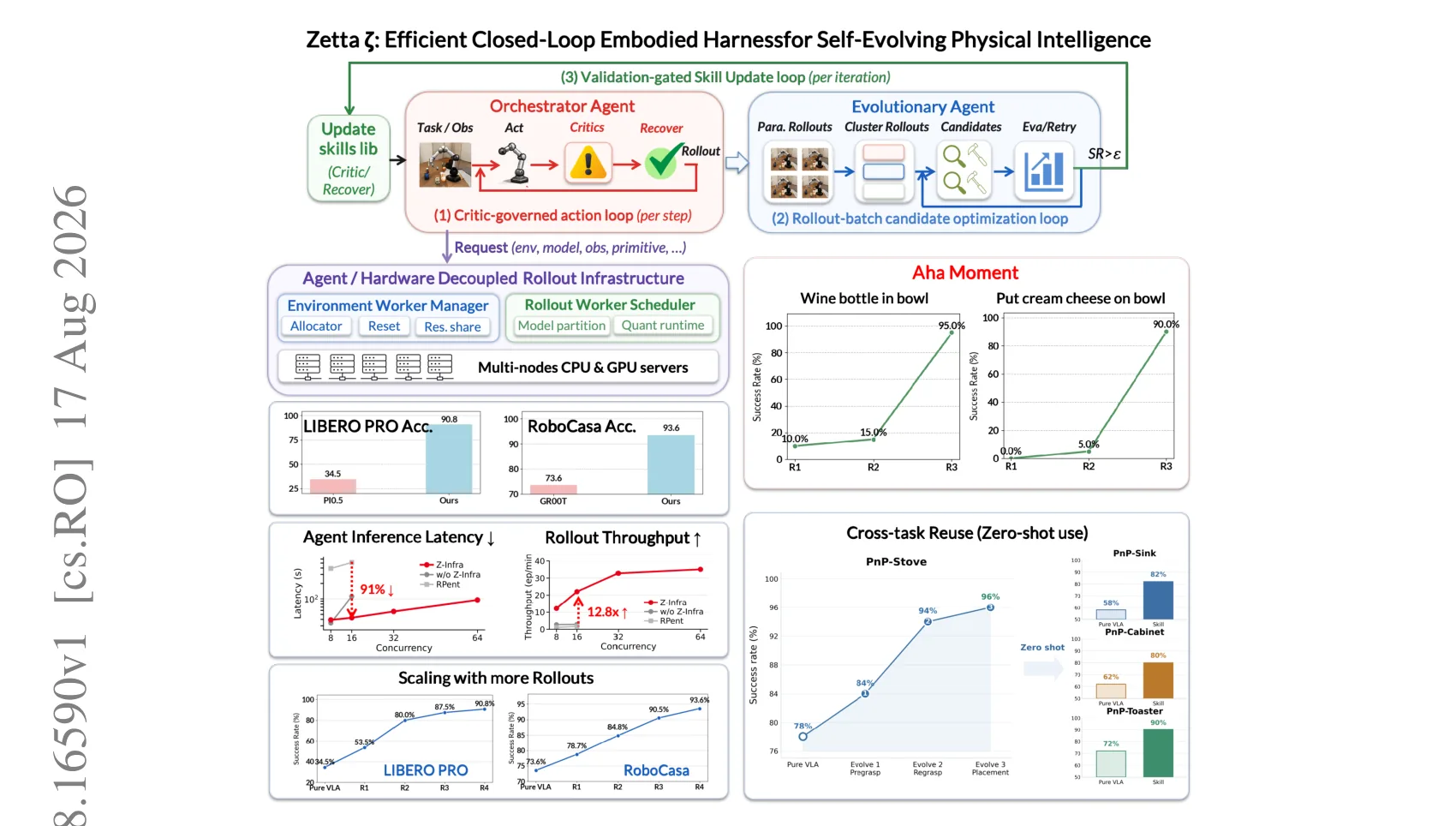
Zetta is a system for helping robots adjust while they are acting. It improves the code that checks actions and handles failures, while leaving the robot's underlying policy unchanged. The goal is to make physical agents learn from experience without waiting until an entire attempt has ended.
- Problem: Existing agent systems largely follow fixed skills during an attempt and review mistakes only afterward. That is too slow for physical work, where the robot and its surroundings can change faster than today's large agent models can respond.
- New idea: Zetta uses three feedback loops that operate at different speeds. One loop governs actions at the required frequency, another proposes checks and recovery methods after a rollout, and a third accepts skill changes only after validation. A runtime critic is code that assesses execution as it happens, while a recovery skill is code for responding when something goes wrong. Z-Infra separates the agent's logic from the different machines used to run its attempts.
- Simple example: It is like a cook who corrects a slipping pan immediately, reviews the whole attempt afterward, and keeps a new rescue technique only after testing it.
- Evidence: Under the reported rollout budget, Zetta reached 90.8% success on LIBERO-Pro and 93.6% on RoboCasa, with an 11.1x inference speedup. Success continued to improve with self-exploration experience, and learned skills transferred without additional training.
- Limitation: The results are reported for LIBERO-Pro and RoboCasa under the authors' current rollout budget. The abstract does not show whether the gains hold across other physical settings or with a changing base policy.
- Why it matters: This matters because robots need to detect and recover from problems while physical work is still underway.
- Paper: Zetta ζ: An Efficient Closed-Loop Embodied Harness for
Trending AI Repositories
Ranking source: GitHub Trending.
obra/superpowers
Superpowers gives coding agents a structured software development methodology built from composable skills and guiding instructions. It is worth attention for teams seeking a more systematic way to direct agent work.
- What it is: This is a Shell-based methodology layer for coding agents. It combines reusable skills with instructions that guide when agents use them.
- What it does: An agentic skills framework & software development methodology that works.
- Who it helps: It helps developers working with coding agents. They can give those agents a defined process assembled from composable skills.
- Limitation: It requires a coding agent and setup for one of the supported environments.
- Repository: obra/superpowers
jundot/omlx
oMLX is a Python project for running LLM inference efficiently on a Mac. Its menu bar management makes local model serving easier to control.
- What it is: This is a local inference system optimized for Apple Silicon. It uses continuous batching and tiered KV caching behind a macOS menu bar interface.
- What it does: LLM inference server with continuous batching & SSD caching for Apple Silicon , managed from the macOS menu bar
- Who it helps: It helps Mac users who run LLMs locally. They can manage optimized inference directly from the menu bar.
- Limitation: It requires a Mac with Apple Silicon.
- Repository: jundot/omlx
santifer/career-ops
career-ops is a JavaScript project that brings a structured workflow to an AI-assisted job search. It is worth attention because it keeps several application tasks together in a local tool.
- What it is: This is an open-source job-search workflow that runs inside AI coding CLIs. Its documentation is available in several languages.
- What it does: Open-source AI job search: scan job portals, evaluate listings with a structured A-F rubric into a 1.0-5.0 score, tailor your CV, track applications , runs locally in your AI coding CLI (Claude Code, Codex, OpenCode, Antigravity…)
- Who it helps: It helps job seekers using Claude Code, Codex, OpenCode, Antigravity, or another supported AI coding CLI. They can review opportunities, prepare application materials, and keep track of applications locally.
- Limitation: It requires a supported AI coding CLI and local setup.
- Repository: santifer/career-ops
Sources
- 01Hugging Face Papers · Hugging Face Papers
- 02GitHub Trending · GitHub Trending
- 03Domain and publish date filters for Web Search on AgentCore · AWS Machine Learning
- 04Stripe didn’t really buy OpenRouter because of the ‘singularity’ · TechCrunch
- 05OpenAI seeks to one-up Anthropic with new customer privacy protections · TechCrunch
- 06Google Gemini is getting a dedicated student hub · The Verge
- 07Attackers are using AI to build exploits for industrial control systems, U.S. agencies warn · The Decoder
- 08SemComp-Bench: Benchmarking Semantic Task Completion in Video Generation · arXiv
- 09SemaPLC: A Project-Grounded, Verification-Gated Agent Harness for PLC Code Generation · arXiv
- 10Zetta ζ: An Efficient Closed-Loop Embodied Harness for Self-Evolving Physical Intelligence · arXiv
Join the Idiots
New lab every Sunday. No spam, unsubscribe anytime.