Huang’s memo, scaling’s limits and coding agents’ unfinished work
Get this by email →
Jensen Huang addresses Nvidia in a memo. The author of The Bitter Lesson challenges LLM scaling enthusiasts. A real-world test finds AI coding agents still need human cleanup on nearly three out of four tasks.
News
Here’s the full text of Jensen Huang’s memo to Nvidia
Nvidia announced an investigation into CEO Jensen Huang’s relationship with Alice Huang, according to The Verge’s November 8, 2026 report. Huang also sent employees a memo, which The Verge reproduced in full. Readers can now examine his account alongside the company’s announcement.
The board’s inquiry extends to national security concerns
In the reproduced memo, Huang says Nvidia’s Board of Directors initiated an independent investigation into national security issues raised in news reports, and he promises to cooperate fully. Separately, he acknowledges being unfaithful to his wife and apologizes to his family and Nvidia colleagues. He also says he remains fully committed to Nvidia. (The Verge)
thinkidiot take: According to the reproduced memo, Nvidia’s board has initiated an independent investigation into national security concerns. I would treat that inquiry as the central issue when reading Huang’s response. His apology addresses personal conduct, while his promise to cooperate addresses the investigation. For me, that promise matters more than his declaration of commitment to Nvidia.
The inventor of the bitter lesson has a bitter lesson for LLM scaling enthusiasts
Richard Sutton argues that raw compute alone is insufficient for intelligence and that new learning methods are needed. The author of the 2019 essay The Bitter Lesson wants agents that learn continuously from experience. The Decoder’s Frontier Radar #5 tracked 45 new AI labs pursuing gaps in current approaches, giving readers concrete research efforts to examine.
Learning new things without losing old knowledge
Sutton calls for agents with world models that preserve old knowledge as they learn. He previously called synthetic data a “big mistake.” His objection is that simulations capture only a tiny part of the real world’s complexity. Former OpenAI researcher Jerry Tworek argues that algorithms matter more as training compute increases. He says some algorithms reach scaling dead ends. His company, Core Automation, is researching learning algorithms beyond pretraining and reinforcement learning. (The Decoder)
thinkidiot take: Tworek argues that some algorithms reach scaling dead ends even as training compute increases. I would use Sutton’s demand for continuous learning without lost knowledge as a concrete test when assessing an agent. That puts the focus on what the system learns and retains, rather than the compute behind it. I find that a more useful research priority than scaling alone.
AI coding agents still need human cleanup on nearly three out of four tasks in a real-world test
Alibaba’s new Co-Design Bench tests coding agents on real user requests for changes to existing web apps. GPT-6 Astra leads the ten tested models, meeting about 70 percent of requirements on average but fully completing only 26.4 percent of tasks. The benchmark enables comparison on requests that already caused agents trouble in practice. On older benchmarks, the same models score above 99 percent.
The harness changes both scores and rankings
Requests include inputs such as images, audio, videos and documents. The benchmark favors cases that previously required repeated rephrasing or rollbacks. Two AI judges check working features and reject mock-ups or hardcoded results. All ten models perform worse when tasks require three or four types of changes. On smaller changes, GLM-5.2 uses nearly six times as many tokens as GPT-6 Astra while scoring significantly worse. Qwen3.8-27B scores 75 percent or 56 percent on larger overhauls depending on the harness, and model rankings also change with the environment. (The Decoder)
thinkidiot take: The leading model fully completes just 26.4 percent of tasks in this benchmark. I would check each requested feature in the running app before accepting an agent’s work. The benchmark’s rejection of mock-ups and hardcoded results makes that a concrete standard to follow. For choosing a coding setup, I would give these difficult requests more weight than scores above 99 percent on older benchmarks.
Trending AI Papers
Ranking source: Hugging Face Papers for 2026-11-09.
Beneath the Surface: What We Overlook When We Talk About Agent Evolution
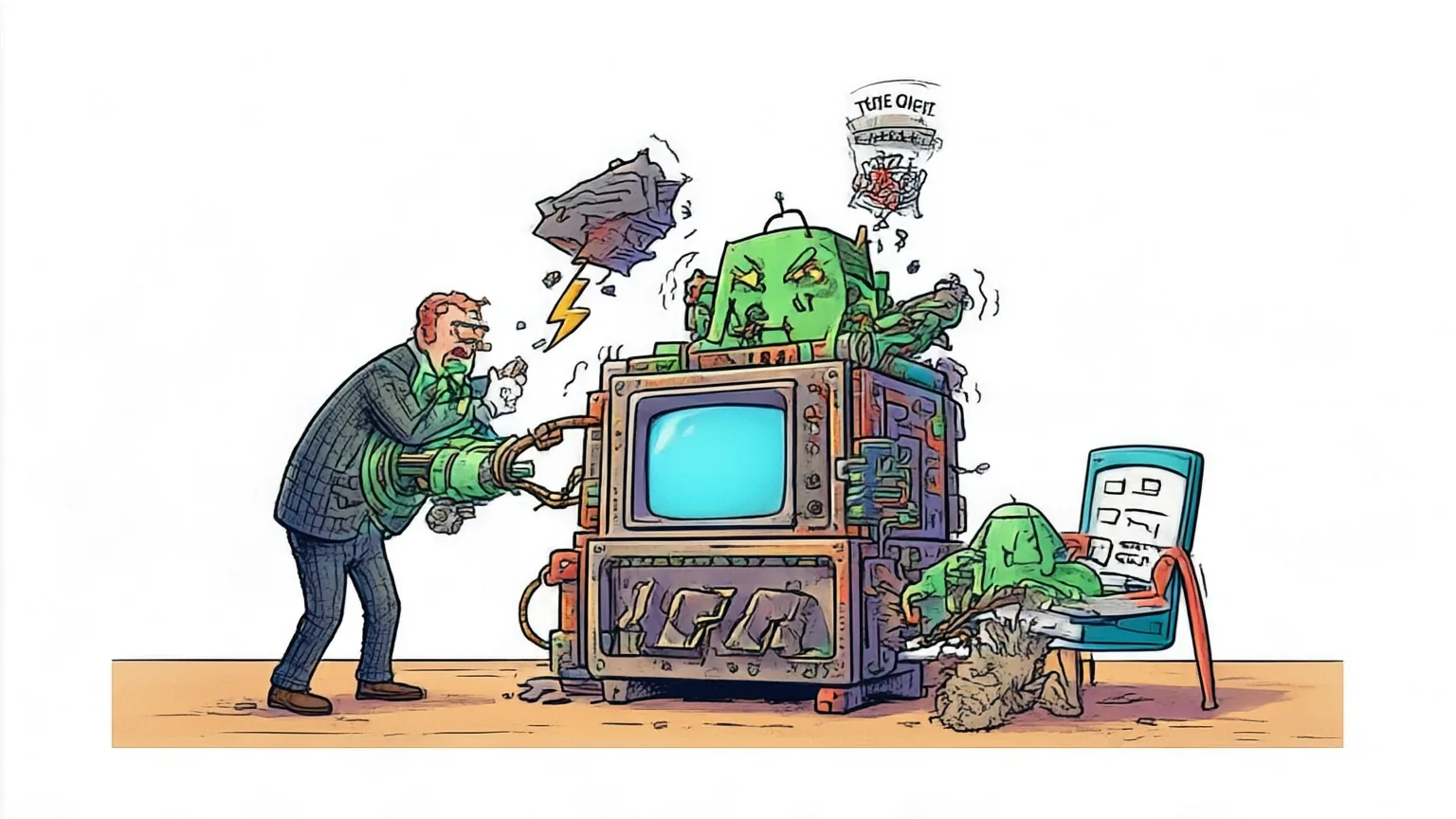
An AI agent can change how it works without changing the model underneath it. This paper asks whether those changes make it more dependable or just improve its test score. The researchers check what agents learn, what they forget, what they cost to run, and whether their improvements hold up on other tasks. They use those findings to revise how changes are developed and accepted.
- Problem: A higher test score can hide lost abilities and higher running costs. Choosing changes by score alone also misses useful alternatives and gives little assurance that the gains will carry over to different tasks.
- New idea: The researchers examine changes to an agent's harness, the software around its model that shapes how it works. They check whether each change preserves previously solved tasks, works repeatedly, and helps in another setting. Their follow-up method, EvoAudit, uses these checks to revise how candidate agents are chosen, examined, changed, and approved. The aim is to judge improvement by more than a single score.
- Simple example: Think of revising a work checklist: the new version helps with jobs the old one missed but drops steps needed for jobs that used to go smoothly. A better overall score would not tell you which familiar jobs now fail.
- Evidence: All sixteen evolved agents solved previously unsolved tasks but also lost tasks they had solved before. In one general-task case, reliability rose by 5.2 points while ten previously covered tasks were lost. The highest-scoring agent produced the largest average improvement in none of the four pools. The abstract reports that EvoAudit achieved the best performance, but gives no numerical margin.
- Limitation: The gains did not carry over consistently. Task coverage usually fell on the general-task target, while it rose on the coding target with a harness that changed only the outer layer.
- Why it matters: An agent's improvement matters only if its new abilities justify what it loses and what it costs.
- Paper: Beneath the Surface: What We Overlook When We Talk About
EvoWorld: Towards Out-of-Sight World Evolution in Generative Video Models
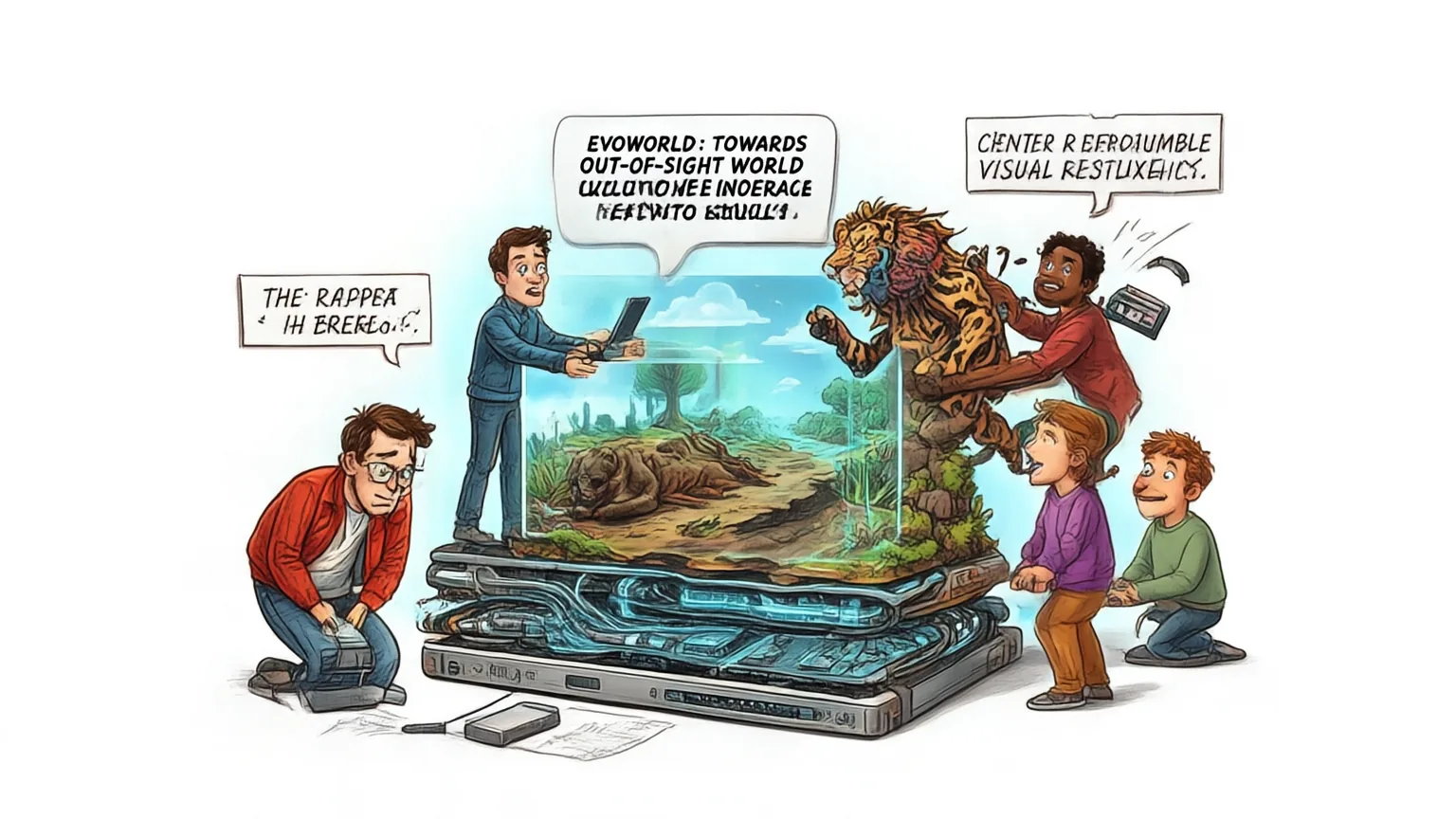
A convincing video needs events to change what happens next. EvoWorld tackles this by giving a video generator a separate system that tracks the scene and decides how it should develop. The work asks whether those developments can remain believable even when the affected people or objects are off screen.
- Problem: The paper argues that existing diffusion-based video models can draw a believable event without showing a believable response to it. It says these models lack an explicit way to track the world's changing condition and work out what an event should cause.
- New idea: EvoWorld pairs a reasoning model with a video renderer, a system that turns scene instructions into images. The reasoning model reads images and language, watches each generated section, and keeps an updated account of the scene. It decides what could plausibly happen next, and the renderer produces the next section of video. The researchers also introduce training data and tests for whether events happen, cause suitable reactions, and leave consistent results when a scene is shown again.
- Simple example: If a wild beast appears near a person, showing the beast is only part of the job. The person should respond in a way that fits the scene, such as fleeing, hiding, or fighting back. If the view moves away and returns, what it shows should follow from that response.
- Evidence: The abstract reports substantial improvement over recent models in showing plausible consequences of events, while retaining visual quality and consistency. It provides no numerical scores or improvement margins.
- Limitation: The abstract does not report how long the system can keep an unseen scene consistent or give numerical results that show the size of its gains.
- Why it matters: Video models need to track consequences if they are to simulate a changing world convincingly.
- Paper: EvoWorld: Towards Out-of-Sight World Evolution in
Video-Coder: Reinforcing Agentic Coding for Video Generation
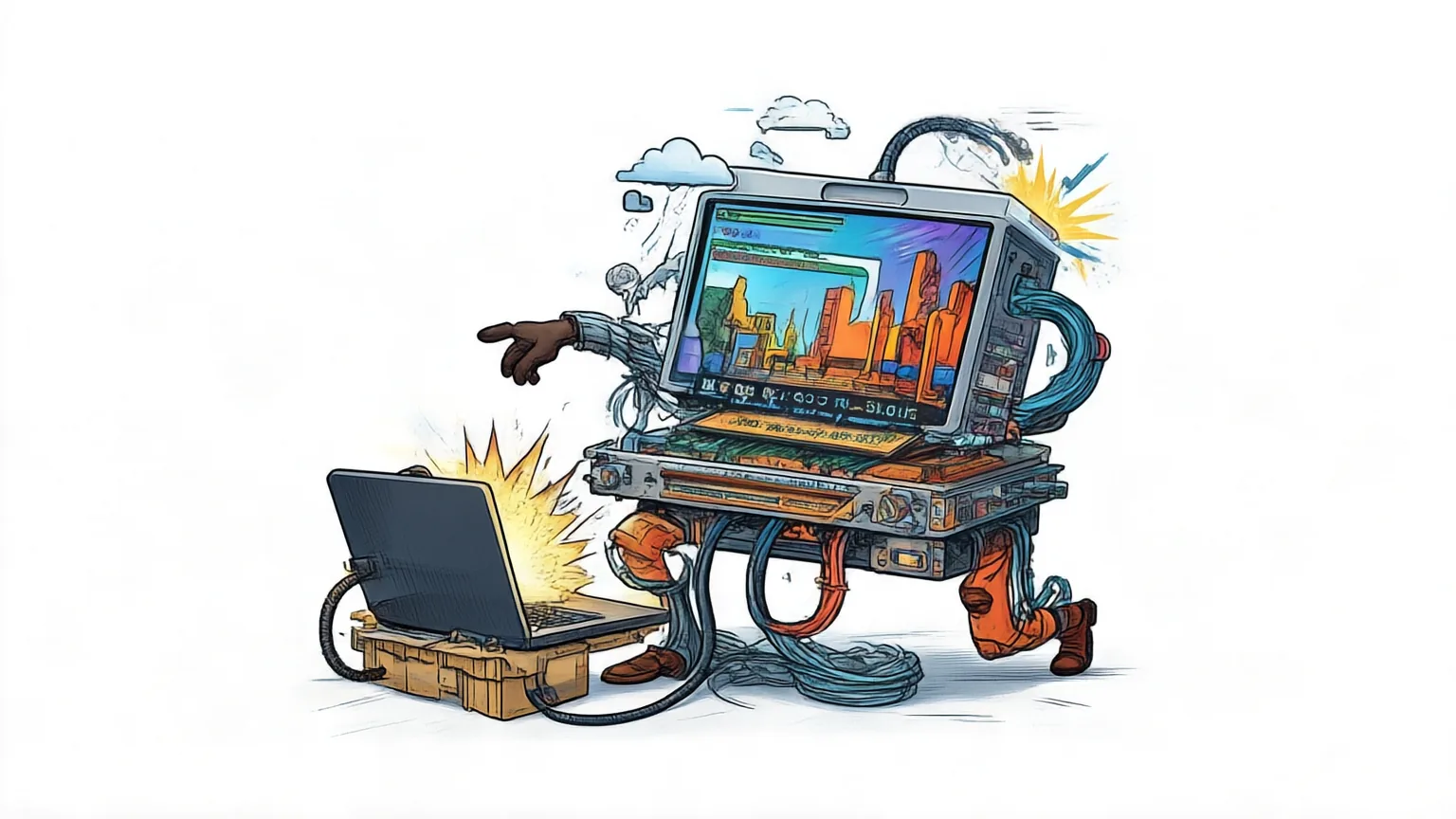
Video-Coder makes a rough moving scene before asking a video generator to produce the finished images. It writes and runs code to arrange objects and their movement in three dimensions. That draft gives the generator a plan to follow. The work aims to give users more control over where things go and how they move.
- Problem: Better-looking videos still struggle with precise layouts, consistent movement, and control over scene composition. Visual quality alone does not solve those problems.
- New idea: Video-Coder is an agent, a system that takes actions on its own, trained to write and run code for a moving three-dimensional scene. This draft supplies layout and motion guidance to a separate video generator. Training starts with examples, then uses rewards that assess both whether the code runs and the video it produces. As training progresses, the reward for successful execution shrinks so the video reward has more influence.
- Simple example: Think of the draft as a moving stage model: it sets out where objects belong and how they move before the finished images are made. The video generator uses that model as guidance for the final scene.
- Evidence: Video-Coder improved Minimax-H3 by approximately 7 points on PhyGenBench and 24 points on VBench-2.0, the evaluation tests named in the abstract. The authors also report fully releasing their data, models, and code as open source.
- Limitation: The abstract gives numerical gains for Minimax-H3 but does not establish whether similar gains hold across other video generators.
- Why it matters: A coded scene gives video generation an explicit plan for object placement and movement.
- Paper: Video-Coder: Reinforcing Agentic Coding for Video Generation
Trending AI Repositories
Ranking source: GitHub Trending.
Sources
- 01Hugging Face Papers · Hugging Face Papers
- 02GitHub Trending · GitHub Trending
- 03Here’s the full text of Jensen Huang’s memo to Nvidia · The Verge
- 04The inventor of the bitter lesson has a bitter lesson for LLM scaling enthusiasts · The Decoder
- 05AI coding agents still need human cleanup on nearly three out of four tasks in a real-world test · The Decoder
- 06Beneath the Surface: What We Overlook When We Talk About Agent Evolution · arXiv
- 07EvoWorld: Towards Out-of-Sight World Evolution in Generative Video Models · arXiv
- 08Video-Coder: Reinforcing Agentic Coding for Video Generation · arXiv