Web answers, simulated worlds and longer video clips
Get this by email →
AWS introduces Web Answer on Amazon Bedrock AgentCore. NVIDIA presents Cosmos 3 open models for interactive world simulation. Google DeepMind announces Gemini Omni 1.2 Flash with longer clips and a focus on speed and cost.
News
Getting started with Web Answer on Amazon Bedrock AgentCore
AWS has made Web Answer on Amazon Bedrock AgentCore generally available. It returns a synthesized answer to a natural-language question through a single tool call. Developers no longer have to build the search, retrieval, synthesis and citation pipeline themselves.
The tool decides when it has enough evidence
Web Answer runs fresh searches for every question. Its model receives today's date to support up-to-date answers. It plans its own searches and runs several in parallel. It reads pages to verify facts, then decides when it has enough evidence to respond. Each claim in the answer maps to a citation with a source URL. AWS also explains how to add Web Answer to an AgentCore Gateway and call it from an agent. (AWS Machine Learning)
thinkidiot take: A single tool call now replaces an entire search-to-citation pipeline. I would start by following the source URLs attached to its claims, because those links give me something concrete to inspect. The tool also takes over the decision about when to stop gathering evidence. That is a useful trade: I would rather review the answer and its sources than build every stage of that pipeline.
New NVIDIA Cosmos 3 Open Models for Interactive World Simulation
NVIDIA has added four open-weight checkpoints to Cosmos 3 for interactive world simulation. They are Cosmos3-Nano-Transfer-Auto, Cosmos3-Nano-Sim-Auto, Cosmos3-Nano-Sim-Transfer and Cosmos3-Nano-Sim-Bimanual. The release gives users access to four post-trained examples of Cosmos 3 Nano.
Synchronized cameras and a streaming variant
All four models have 16B trainable parameters. They use the OpenMDW1.1 license, which permits commercial and non-commercial use. Cosmos3-Nano-Transfer-Auto generates synchronized video across up to 11 camera views, including fisheyes. It also supports joint RGB,LiDAR generation. Cosmos3-Nano-Sim-Auto is a causally distilled variant of Transfer-Auto built for streaming observations. (Hugging Face)
thinkidiot take: Transfer-Auto supports up to 11 synchronized camera views alongside joint RGB,LiDAR generation. I would make those linked outputs the focus of a first test, with fisheye views included. For streaming observations, the release provides a separate Sim-Auto variant. That division makes the choice of checkpoint more interesting to me than the total number released.
Gemini Omni 1.2 Flash: Fast and cost-effective with longer clips
Google DeepMind has announced Gemini Omni 1.2 Flash with support for fifteen-second videos, up from 10 seconds in Omni 1.1. The price is down 30% from Gemini Omni 1.1. The model is available at $0.07 per second for 720p video.
Edits can continue without rebuilding the whole clip
The model supports multi-turn conversational editing. That allows faster adjustments without regenerating the entire clip. Generation can combine character, product or style images as references. Short motion clips of up to 3 seconds and audio cues can also guide the result. Google DeepMind reports stronger character, object and scene consistency from the first frame to the last, with less visual drift. (Google DeepMind)
thinkidiot take: Conversational editing lets users adjust a video without regenerating the whole clip. I would test that workflow first, using a character reference and then requesting changes across several turns. That puts the editing controls and the stated consistency improvements to work together. For me, keeping a clip editable matters more than extending its maximum length.
OpenAI is stepping back from NDAs for data center projects
OpenAI has announced that it will stop using non-disclosure agreements with public officials on data center projects. The change forms part of new commitments to communities where it is developing those projects. It follows this week's midterms, when voters voiced strong opposition to data center expansion. The announcement addresses a practice that has drawn scrutiny for hiding project discussions.
Power costs and local hiring enter the commitments
OpenAI says it will retain only narrow protections for legitimate security information, trade secrets, and proprietary or competitively sensitive information. It has committed to paying the full cost of the electricity it uses. The commitment also covers infrastructure needed to serve communities. OpenAI will publish the jobs it expects to create and report on hiring for local communities. Every future data center will have a local compact reflecting local priorities. The company is rebranding these facilities as compute campuses. (The Verge)
thinkidiot take: OpenAI's commitment puts the full cost of its electricity and community infrastructure on the company. I would read that alongside the published job expectations and local hiring reports when assessing a project. Those commitments give residents specific promises to compare with what happens locally. I put more weight on those obligations than on calling a data center a compute campus.
Airbnb is working on an AI travel agent
Airbnb plans to roll out an AI travel agent in the first half of 2027. The company set out the plan in its Q3 2026 earnings shareholder letter. The agent is intended to help users plan and book travel directly in Airbnb.
A travel interface assembled as the conversation unfolds
Airbnb says today's AI agents handle simple, routine tasks such as restaurant reservations and appointment scheduling well. It argues that its experience matching hosts and guests, together with its role in reservations, gives it an edge. Its new interface draws from a library of hundreds of travel-specific elements. Maps, photos, comparisons, calendars and itineraries are composed in real time. The agent is designed to help guests explore options and make decisions with traveling companions. (The Verge)
thinkidiot take: Airbnb plans to compose its travel interface in real time from hundreds of elements. I would test it by comparing options with a traveling companion, using the maps, calendars and itineraries it provides. That brings the proposed interface into the same process as the shared decision. I find that a stronger reason to try the agent than its ability to handle another routine reservation.
Trending AI Papers
Ranking source: Hugging Face Papers for 2026-11-06.
Random Is Almost Enough? Stable and Low-Cost Benchmark Compression via BestRand

Testing an AI model on a full collection of tasks can take too much time and money. BestRand aims to get a dependable score from a smaller selection. The researchers find that a random selection usually works well, but occasionally gives a badly misleading result. Their method targets those failures while keeping the selection process cheap.
- Problem: A small test selection needs to reflect how a model would perform on the full test. Random selection often does this well, but rare selections produce much larger errors. Evaluating more models does not remove this instability.
- New idea: The researchers develop a mathematical estimate of how errors vary when a small selection stands in for a full test. It describes a pattern in which small mistakes are common and very large mistakes are rare. BestRand is a method for choosing smaller tests that retains the low cost of random selection while reducing those rare large mistakes. The abstract does not explain the selection procedure itself.
- Simple example: Think of judging a whole bag of fruit by inspecting a handful. Most random handfuls give a useful impression, but an unusually good or bad handful can mislead you. BestRand addresses the equivalent problem when the handful consists of test tasks.
- Evidence: The researchers tested BestRand on more than 70 text, multimodal, and agent benchmarks and extended it to VLA evaluation. Compared with competing methods, it reduced high-error risk by 50.2% and average estimation error by 16.4%, using 51.3% of the construction cost. Average estimation error fell by 21.8% under shifts in score range, model family, and time.
- Limitation: The abstract reports lower risk of large errors, not their elimination, and does not explain how to identify a remaining unreliable estimate.
- Why it matters: More dependable small tests could make model evaluation cheaper without letting rare sampling mistakes distort the results.
- Paper: Random Is Almost Enough? Stable and Low-Cost Benchmark
Towards Foundation Decision Models: Drex

Many AI tasks ask for a choice rather than a written response. Drex is a family of open models built to assign probabilities to choices supplied by the user. It aims to make these decisions faster and more consistent than generating an answer word by word. The Max version also handles images.
- Problem: Language models can achieve high accuracy by generating long reasoning responses, but this adds delay and cost. Their answers can vary, and software must extract the decision from the generated text.
- New idea: Drex uses decision models, which assign a probability to each supplied option without generating a response word by word. A request provides material such as a document or record, plus questions with choices, yes/no answers, or an ordered scoring scale. Training combines examples with known answers and reinforcement learning, which uses feedback to improve decisions. It also uses training penalties that discourage answers from changing when the options are rearranged.
- Simple example: Imagine giving a model a document and asking whether it answers a particular question, with yes and no as the options. Drex assigns probabilities to those options instead of writing a paragraph that another program must interpret.
- Evidence: Max scored 67.52 on the public Decision Index 0.4.1 suite, compared with 60.70 for Jev 1.14.0. On Decision Bench v4, it was statistically tied with d3-turbo and GPT-6 Sol and trailed Claude Opus 5.5 by 1.6 points. It had the highest accuracy among decision models on DecideBench. A typical request took 183 ms, compared with about 2.0 s for GPT-6 Sol and 3.5 s for Claude Opus 5.5, and its outputs remained stable when options were reordered.
- Limitation: Drex requires users to supply the available choices, so the reported results do not establish its usefulness for tasks that need open-ended answers.
- Why it matters: Direct probabilities over supplied choices can make AI decisions faster and easier for software to use.
- Paper: Towards Foundation Decision Models: Drex
EDGAR: Efficient Diffusion-Driven Gaussian Avatar Refinement via Synthetic Failure
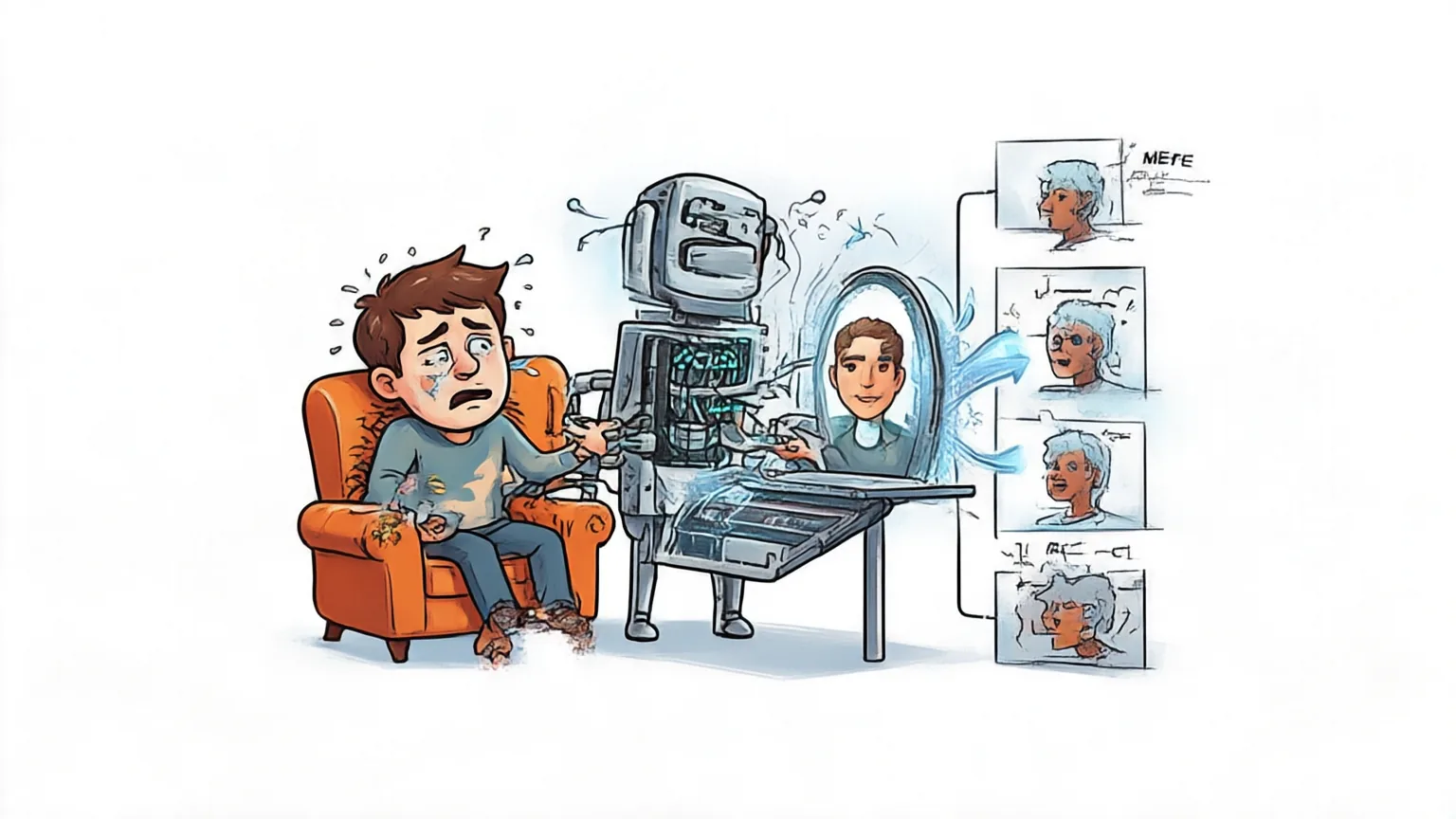
A digital head made from photos or video can look convincing until parts blur, stretch, or flicker. EDGAR repairs these visual defects while trying to keep the person recognizable. It uses corrected views to improve the underlying digital head. That lets the final head produce images without repeating the repair process for every frame.
- Problem: Photos or video from a single camera do not fully determine a head's shape and surface appearance. Existing reconstruction methods can therefore produce blurred or stretched details and changes between frames that should stay consistent.
- New idea: EDGAR learns from groups of damaged images, correct images, and reference images that show the person's identity. It uses a diffusion model, an image repair model that here makes its correction in a single step, guided by information about the person's appearance. A mixture-of-experts design, which combines specialized model components, handles different kinds and degrees of damage. The repaired views become training targets for improving the underlying avatar, the digital head used to generate images.
- Simple example: Imagine repairing several views of a digital head, then using those corrected pictures as guides to fix the head itself. Once the head is improved, each new picture no longer needs a separate repair.
- Evidence: Tests covered three Gaussian avatar reconstruction methods, each under three settings. EDGAR improved both visual-quality and reconstruction measures over the original outputs and an SDEdit-style repair method. Tests also found better consistency across views and robustness when heads turned far to the side or mouths opened. The abstract gives no numerical improvement sizes.
- Limitation: The claimed benefit is limited to appearance defects that can be recovered; the abstract does not establish that EDGAR can repair arbitrary failures in the reconstructed head.
- Why it matters: Improving the underlying digital head could deliver cleaner, more consistent images without repairing every frame separately.
- Paper: EDGAR: Efficient Diffusion-Driven Gaussian Avatar
Trending AI Repositories
Ranking source: GitHub Trending.
Usagi-org/ai-goofish-monitor
This project gives Xianyu searches separate keywords, price filters and AI instructions. Account rotation, scheduled runs and several notification channels make it worth a look for people managing multiple searches.
- What it is: It uses Playwright and AI to monitor multiple Xianyu searches in real time or on a schedule, analyze listings, and manage the work through a web interface. Docker deployment is supported.
- What it does: 基于 Playwright 和AI实现的闲鱼多任务实时/定时监控与智能分析系统,配备了功能完善的后台管理UI。帮助用户从闲鱼海量商品中,找到心仪产品。
- Who it helps: It helps Xianyu shoppers narrow searches by shipping, listing age and location. They can create tasks in natural language and receive matching results through services such as Bark or Telegram.
- Limitation: AI analysis relies on a multimodal model.
- Repository: Usagi-org/ai-goofish-monitor
google/skills
This repository offers an installable collection of skills that includes Google Cloud. The installer lets readers choose individual skills, target agents and a project or global scope.
- What it is: It is a skill collection installed through the shell with npx skills add google/skills. Installation configures the agents selected by the user.
- What it does: Agent Skills for Google products and technologies
- Who it helps: It helps people configuring agents for work with Google technologies. They can install selected skills or the whole collection at project or global scope.
- Limitation: The installation command shown requires npx.
- Repository: google/skills
vercel-labs/agent-browser
This tool lets agents open web pages, read their accessibility trees and act on page elements. It brings those steps into the shell.
- What it is: It is a Rust project that connects shell commands with browser actions. Page reading uses an accessibility tree.
- What it does: Browser automation CLI for AI agents
- Who it helps: It helps people building agents that need to interact with web pages. Their agents can open pages, inspect them and act on elements from the shell.
- Limitation: The supplied excerpt does not include installation instructions.
- Repository: vercel-labs/agent-browser
Sources
- 01Hugging Face Papers · Hugging Face Papers
- 02GitHub Trending · GitHub Trending
- 03Getting started with Web Answer on Amazon Bedrock AgentCore · AWS Machine Learning
- 04New NVIDIA Cosmos 3 Open Models for Interactive World Simulation · Hugging Face
- 05Gemini Omni 1.2 Flash: Fast and cost-effective with longer clips · Google DeepMind
- 06OpenAI is stepping back from NDAs for data center projects · The Verge
- 07Airbnb is working on an AI travel agent · The Verge
- 08Random Is Almost Enough? Stable and Low-Cost Benchmark Compression via BestRand · arXiv
- 09Towards Foundation Decision Models: Drex · arXiv
- 10EDGAR: Efficient Diffusion-Driven Gaussian Avatar Refinement via Synthetic Failure · arXiv