Decision models for agent checks, documents into JSON, and Apple's reported AI cuts
Get this by email →
AWS shows how to use decision models in agent evaluations. Dharma Field Extractor turns document images into structured JSON. Apple is reportedly cutting internal AI spending.
News
Use decision models with Amazon Bedrock AgentCore Evaluations
AWS has published a guide to connecting decision models to Amazon Bedrock AgentCore Evaluations. It connects two backends: TypeSafe’s hosted Jev and the self-hosted, open-source Strands Decider 2B. The guide shows how to use them for narrow, repeatable questions through code-based evaluators.
Predefined answers before deeper assessment
Decision models return probability distributions over predefined answers instead of free-form text. Both backends can answer several questions about the same state in one request. That supports screening before deeper assessment by built-in evaluators. AgentCore Evaluations provides 15 built-in evaluators and supports custom LLM-as-a-judge evaluators. Evaluation can run on demand during development, in batches of stored sessions, or on production traffic. Code-based evaluation logic runs in AWS Lambda and can call external systems, models, or APIs. The guide also explains how to validate a decision-model check before using it to gate a release. (AWS Machine Learning)
thinkidiot take: Both backends can answer several questions about the same state in one request. I would use that to screen narrow questions before running deeper assessments. I would also validate those checks before giving them control over a release. For repeatable questions, predefined answers are a better starting point than free-form judgement.
Dharma Field Extractor: Any Document In, Structured Fields in JSON Out
A November 4, 2026 article on Hugging Face introduces Dharma Field Extractor, a 2-billion-parameter model. It takes a document image and returns structured JSON. The same checkpoint handles different document types without per-type fine-tuning.
Requested fields get explicit types and missing values
The output supports nested fields and ordered invoice line items. Open mode uses document context and layout to identify fields. It returns key-value pairs without a supplied schema. Schema-directed mode accepts exact key names. It supports string, number, and boolean field types and fills tables row by row. When a requested field is absent from the document, that mode returns null. (Hugging Face)
thinkidiot take: Schema-directed mode returns null when a requested field is absent. I would use that mode for invoice extraction because it accepts exact keys and field types. Open mode leaves field identification to document context and layout. For a workflow with a defined output structure, I value explicit missing values more than automatic field discovery.
Apple is reportedly cutting budgets for its internal AI usage
Apple reportedly lowered its engineering teams’ daily AI spending cap in October. According to Bloomberg, the cap fell from $300 to $200. That gives those teams a smaller daily allowance for AI use.
Lower allowances extend beyond engineering
Bloomberg sources said further cuts were in progress. Some allowances were falling to $100 a day. Outside engineering, Apple was reportedly considering a daily AI spending limit. That limit was as low as $25. TechCrunch said in its November 4, 2026 report that it had reached out to Apple for comment. (TechCrunch)
thinkidiot take: The reported engineering cap fell from $300 to $200 a day. With that allowance, I would decide which AI tasks deserve the budget before starting them. The reported move toward $100 allowances makes that choice sharper. I would treat these caps as constraints on tool use, not as a verdict on the tools themselves.
After the midterms, a bigger clash over data centers could be coming
TechCrunch reports that opposition to data centers crossed party lines in the November 3 midterms. The results gave Democrats control of Congress while Republicans held the White House. An NBC exit poll found almost 80% opposed data centers in their neighborhoods. Almost 60% considered data centers a crucial or major factor in their vote.
Local bans meet proposals for national limits
An Ohio county passed a ban on data centers. Meta had planned a 700,000-square-foot facility there. Goldman Sachs predicts construction delays in Georgia and Texas because of Democratic gains. A bill introduced by Bernie Sanders and Alexandria Ocasio-Cortez proposes a nationwide moratorium on new data centers until Congress establishes guardrails. Martin Heinrich’s proposed GRID Savings Act would prevent grid infrastructure costs from large AI data center buildouts from being passed on to communities. (TechCrunch)
thinkidiot take: An Ohio county passed a data center ban where Meta planned a 700,000-square-foot facility. I would treat local permission as a central concern in any infrastructure plan. Heinrich’s proposal addresses who pays for grid infrastructure, while the Sanders and Ocasio-Cortez bill proposes a nationwide pause. I prefer targeting the costs passed to communities over stopping new construction nationwide.
Hackers exploited iOS and Android flaws to infect phones
Ars Technica reports that attackers exploited iOS and Android flaws to infect phones. Sekoia assessed with moderate to high confidence that the attackers were part of Russia’s Foreign Intelligence Service. All exploited vulnerabilities had already been patched. The attacks therefore worked only against outdated versions of iOS or Android.
Legitimate web content carried malicious code
The campaign used three infection vectors: JavaScript injection into legitimate website traffic, proxy domains, and a compromised Ukrainian web analytics service. The attackers used america250[.]holiday as a reverse proxy for america250.org. That proxy added malicious JavaScript to the legitimate site’s content. Injected JavaScript profiled browsers and devices before delivering one of three zero-click exploit chains. Those chains included the iOS exploit kit DarkSword. Payloads attempted to steal browser cookies and, in some cases, Wi-Fi passwords and full mobile device data. (Ars Technica)
thinkidiot take: Every exploited vulnerability already had a patch. I would put checking phone updates first because these attacks worked only against outdated versions. The use of legitimate web content and zero-click exploit chains makes advice about suspicious links an incomplete response to this campaign. Here, patching deserves priority over trying to judge a page by its appearance.
Trending AI Papers
Ranking source: Hugging Face Papers for 2026-11-05.
GameVerse: A Minute-Scale Gameplay Dataset for Long-Horizon Interactive World Modeling

GameVerse is a collection of gameplay recordings for training systems that create environments in response to player controls. It aims to help those environments stay consistent during longer play. The recordings include extended scenes, camera movement and descriptions of events. These give models longer examples to learn from.
- Problem: Current systems struggle to keep generated environments consistent beyond about one minute. Most existing gameplay datasets offer clips shorter than ten seconds and broad descriptions of each clip. That leaves too little sustained activity or detail about when events happen for models to learn longer interactions.
- New idea: GameVerse supplies longer gameplay recordings with descriptions tied to individual events. A processing pipeline, a sequence of preparation steps, separates scenes, filters quality and estimates the camera's position and direction. Each clip includes a camera trajectory, a record of camera movement that stays consistent over minutes. Its captions distinguish the scene's stable surroundings from changing activity and follow event boundaries.
- Simple example: It is like learning to follow a journey from a continuous recording instead of disconnected glimpses. Seeing the route unfold makes it easier to connect movement with changes in the surroundings.
- Evidence: GameVerse contains 69.7K clips, 1,655 hours and 349.6 million frames. This includes 1,358 hours of continuous two-minute sequences. The authors report better scale, variety and annotation quality than existing public datasets, plus longer-lasting generation after training on GameVerse, but give no numerical measure of that improvement.
- Limitation: The abstract does not say how much longer trained models remain consistent or give numerical results for the generation experiments.
- Why it matters: Longer training examples can help generated environments stay consistent as a player continues to act.
- Paper: GameVerse: A Minute-Scale Gameplay Dataset for Long-Horizon
PyRUA-DataFarm: LLM Agent as a Cost-Efficient Teleoperator for Real-Ready Robot Data
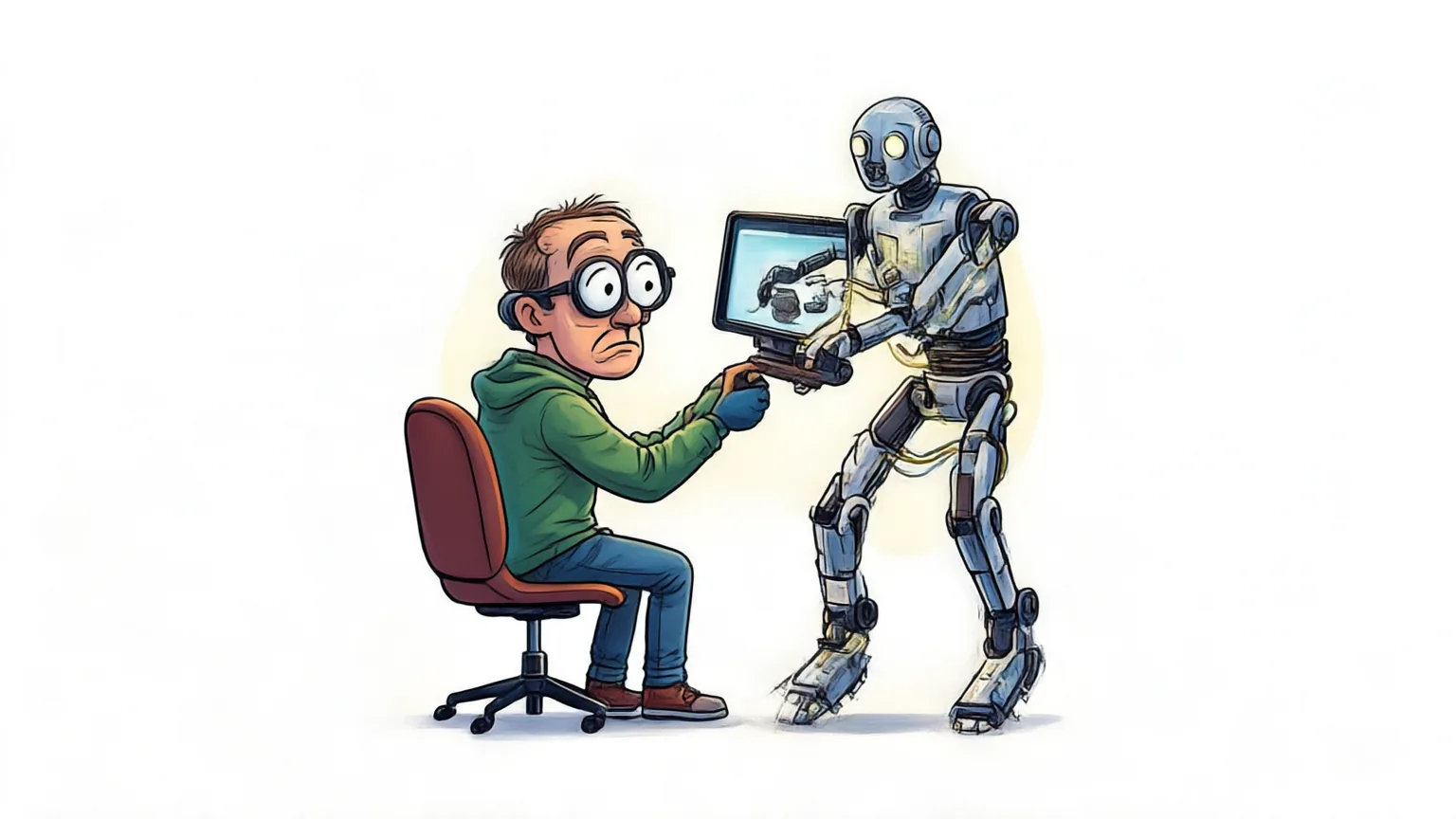
PyRUA-DataFarm creates robot training examples through software, reducing the need for a person to guide each attempt. A coding agent builds a simulated task using a request and a sample recording from the real robot. Generated video then shows the simulated actions in a photographic form. The aim is to produce examples that teach a physical robot how to act.
- Problem: Collecting demonstrations by remotely guiding a robot uses both human time and robot time for every attempt. A new task requires a fresh collection effort, so the work repeats as the robot's duties change.
- New idea: A coding agent, software that writes code, uses a task request and one calibration episode, a sample run of the robot in its intended scene. It builds a simulation, a software version of the task, along with a controller that performs it and a checker that evaluates success. A video model uses real images to turn simulated runs into photographic footage with consistent views from multiple cameras and matching action labels. Separate evaluators check the controller and each rendered run before the data trains a policy, the system that chooses the robot's actions.
- Simple example: It is like filming practice demonstrations on a virtual set after taking a reference recording in the real workspace. The set can produce more demonstrations without asking a person to guide the physical robot through each one.
- Evidence: Across five real-robot tasks, policies trained only on generated data achieved 93 successes in 100 trials, compared with 84 for policies trained on the same number of human-guided demonstrations. With an unseen tablecloth and coloured light, the respective success counts were 87 and 46.
- Limitation: The reported physical tests cover five tasks. The method still needs a calibration episode from the robot in the target scene, and the abstract does not establish how broadly it works beyond those tasks.
- Why it matters: Generating usable demonstrations in software can reduce the human and robot time needed to teach new tasks.
- Paper: PyRUA-DataFarm: LLM Agent as a Cost-Efficient Teleoperator
From Pixels to Actions - Towards Native Vision-Language-Action Policies

NEO-VLA changes how a robot uses images when deciding what to do. Many systems first condense an image and then use that summary to choose an action. This work lets action decisions draw on visual information at several stages of processing. It aims to preserve small details that matter when handling objects.
- Problem: Robot systems often compress images before reasoning about actions. That step can obscure object edges, depth and small changes that determine how an object should be handled. Decisions then depend on a final image summary that may have already lost useful information.
- New idea: NEO-VLA is a vision-language-action system, a model that connects images and language instructions to movements. It converts small image patches into units the model can process, without first passing them through a separate visual encoder, a component that produces an image summary. Visual information and language are processed together through successive layers, or computational stages. The action component draws on instruction-shaped visual information from multiple stages to choose movements.
- Simple example: It is like choosing how to grasp an object while looking at its edges and depth, rather than relying only on a brief description of what it is. The details needed for movement can matter more than the overall summary.
- Evidence: Controlled comparisons favour the proposed architecture over versions with visual encoders. Updating all model parameters narrows the gap but does not remove it, and increasing model scale alone does not close it. Tests of individual layers find that information most useful for actions often peaks before the final visual output. The abstract reports stronger control across manipulation settings and changed conditions, but provides no numerical scores.
- Limitation: The abstract gives no numerical performance gains or detailed account of the tested tasks, so it does not establish the size or breadth of the advantage.
- Why it matters: Access to visual details throughout processing can help robots make more reliable movements.
- Paper: From Pixels to Actions - Towards Native
Trending AI Repositories
Ranking source: GitHub Trending.
NVIDIA/auto-ontology
Auto Ontology addresses a reliability problem in agentic analytics: a fast answer is useless if the number is wrong. It focuses on the data context agents need before answering.
- What it is: It builds context from enterprise metadata, reconciles definitions across systems, and checks generated queries against certified definitions and data lineage.
- What it does: Auto Ontology is a Python framework for building semantic, graph-based reasoning layers over data. It enables deterministic query generation, better context retrieval, and more explainable AI for LLM and agent workflows.
- Who it helps: It helps people building agents that retrieve documents or query databases. They can give those agents context about where data comes from and how to use it.
- Limitation: The supplied README excerpt does not show how to set up or validate that context.
- Repository: NVIDIA/auto-ontology
github/spec-kit
Spec Kit is a Python project for working with a coding agent. Its stated scope includes building from a spec, fixing a bug and assessing an idea.
- What it is: Spec Kit gives coding agents structured processes, reusable templates, and documented outcomes.
- What it does: 💫 Toolkit to help you get started with SDD or any other process!
- Who it helps: It helps developers working with coding agents. They can use it to approach a spec, a bug or an idea.
- Limitation: The supplied excerpt does not identify supported coding agents or setup requirements.
- Repository: github/spec-kit
The-PR-Agent/pr-agent
PR Agent is a Python project focused on pull request review. That focus makes it relevant to readers looking at tools for reviewing code changes, though the supplied README excerpt contains only logo markup.
- What it is: PR Agent is an open-source, AI-powered code review agent. It is a community-maintained legacy Qodo project, distinct from Qodo’s primary offering.
- What it does: 🚀 PR Agent: The Original Open-Source PR Reviewer. This project is not the Qodo free tier.
- Who it helps: It is aimed at people reviewing pull requests. The supplied material does not describe the review actions they can perform with it.
- Limitation: The supplied excerpt gives no setup instructions, supported integrations or details of review behavior.
- Repository: The-PR-Agent/pr-agent
Sources
- 01Hugging Face Papers · Hugging Face Papers
- 02GitHub Trending · GitHub Trending
- 03Use decision models with Amazon Bedrock AgentCore Evaluations · AWS Machine Learning
- 04Dharma Field Extractor: Any Document In, Structured Fields in JSON Out · Hugging Face
- 05Apple is reportedly cutting budgets for its internal AI usage · TechCrunch
- 06After the midterms, a bigger clash over data centers could be coming · TechCrunch
- 07Hackers exploited iOS and Android flaws to infect phones · Ars Technica
- 08GameVerse: A Minute-Scale Gameplay Dataset for Long-Horizon Interactive World Modeling · arXiv
- 09PyRUA-DataFarm: LLM Agent as a Cost-Efficient Teleoperator for Real-Ready Robot Data · arXiv
- 10From Pixels to Actions - Towards Native Vision-Language-Action Policies · arXiv