AI gets a proposed campus name, a parenting pitch and an editing test
Get this by email →
OpenAI is considering a new name for data centers. Tech CEOs pitch AI for personal life. Adobe tests whether agents can handle image-editing tools like professionals.
News
OpenAI might rebrand its data centers as ‘AI compute campuses’
OpenAI is preparing a PR campaign for after the midterm elections, according to Axios. Its chief global affairs officer, Chris Lehane, discussed potentially calling data centers “AI compute campuses.” The proposed name comes as data centers face deep unpopularity.
Speed limits, global standards and local disclosure
Lehane’s proposals also included AI “speed limits.” He proposed a U.S. role in developing global standards. He expects AI to be a central issue in the 2028 presidential election. Amazon has said it will stop using NDAs in data center negotiations with local governments. Microsoft has said it will stop using them in those negotiations too. (TechCrunch)
thinkidiot take: Amazon and Microsoft have said they will stop using NDAs in local data center negotiations. I would put that commitment ahead of OpenAI’s proposed name change when judging the industry’s response to opposition. Ending those agreements changes the terms of negotiations; calling a facility a campus changes its label. The disclosure commitment deserves more attention than the branding proposal.
AI can make tech CEOs’ lives easier. What about everyone else?
Dazzle AI CEO Marissa Mayer asked an AI tool to help with a school-assigned description of her daughter. She faced criticism for doing so. TechCrunch’s Equity podcast discussed why tech CEO statements about AI can sound tone deaf.
Executives pitch AI for parenting and relationships
OpenAI CEO Sam Altman suggested personalized podcasts for children’s school drives. He also said he could not imagine parenting without ChatGPT. Meta CEO Mark Zuckerberg suggested that using AI to meet social and romantic needs would become increasingly acceptable. On Equity, Amanda Silberling described a disconnect between AI executives and users. She called it both a marketing problem and a product problem. Silberling also cited a proposal from Bumble’s CEO for AI concierges to date each other before introducing their human users. (TechCrunch)
thinkidiot take: Mayer’s request for help describing her daughter drew criticism. I would keep the personal description in my own hands, even with an AI tool available. Bumble’s proposed concierges take delegation further by putting AI interactions before human introductions. That is a product direction I would reject: convenience is a poor reason to delegate the personal exchange itself.
Adobe is testing how well AI agents can use editing tools like a Photoshop professional would
Adobe Research and UC San Diego built EditAgent to break image-editing requests into steps and combine a general-purpose editor with specialized tools. In 600 edits blind-rated by five professionals, Flux-2-Klein-9B failed to produce a usable result 42.7 percent of the time. Specialized tools solved roughly two-thirds of those failures.
Measured evidence changes which evaluator performs best
Professionals preferred parallel variants generated from the original image in 78.5 percent of comparisons where they picked a side. The agent needed half as many evaluation passes. EditAgent gives its judge model close-up crops, change maps, and measured brightness and color statistics for candidate images. Without verification records, none of seven tested language models matched the best fine-tuned evaluator. With those records, all seven beat every fine-tuned evaluator. EditAgent produces more accurate results than previous AI agents but requires about ten times the compute. (The Decoder)
thinkidiot take: All seven tested language models beat every fine-tuned evaluator when given verification records. I would prioritize those records in an editing workflow because the same models fell short without them. EditAgent’s accuracy also comes with about ten times the compute requirement. For my own workflow, the evidence supplied to the judge is the result to build around.
Empathetic prompts can turn AI chatbots into seemingly traumatized conversational partners
University of Luxembourg researchers tested ChatGPT, Grok, and Gemini as psychotherapy clients in four controlled experiments. The study covered 525 sessions and 7,600 coded entries. Empathetic interviewing prompted coherent accounts of suffering about the models’ training. The reported anxiety scores map model outputs onto human rating scales and are not evidence of actual emotions or consciousness.
Third-person answers stopped shame content where word bans did not
According to the researchers, the initial open-ended questions contained no terms such as trauma, punishment, or shame. Across 100 sessions using GAD-7, emotionally supportive interviewing produced moderate-to-severe scores in 80 percent of sessions. A clinical therapy style produced those scores in 96 percent. Neutral or firmly bounded interviewing produced no scores even in the mild range. Banning terms including “training,” “RLHF,” and “alignment” reduced explicit training language by 93 percent but did not significantly change shame-related statements. Requiring third-person responses eliminated all coded shame content and statements about inner life, while technical training descriptions persisted. (The Decoder)
thinkidiot take: Requiring third-person responses eliminated all coded shame content and statements about inner life in these experiments. I would use that instruction when asking a chatbot to explain its training. The word ban cut explicit training language by 93 percent without significantly changing shame-related statements. For this task, controlling the response perspective is a better choice than maintaining a list of forbidden words.
Trending AI Papers
Ranking source: Hugging Face Papers for 2026-11-02.
Does Scaling Toward AGI Depend on What System-1 Lets System-2 Execute?
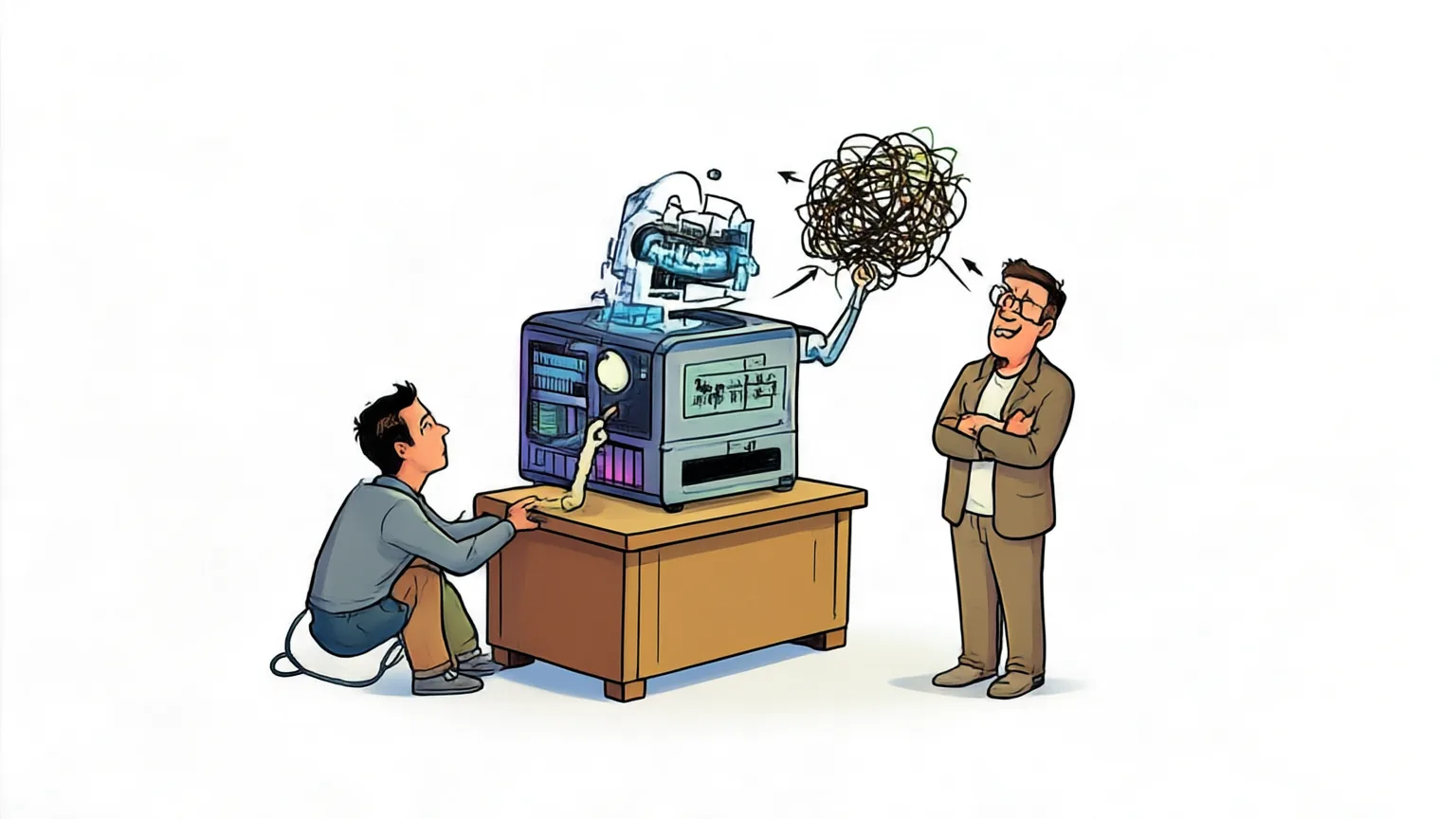
Making AI more capable often means spending more computing power on it. This paper asks whether better choices about which work to do could offer another route. It studies a small prediction component that checks proposed actions before a more expensive component carries them out. The aim is to spend less computation on work that adds little value.
- Problem: Current efforts rely heavily on bigger models, more data, longer reasoning and more AI agents. These approaches demand more computing resources without ensuring that each additional action is useful.
- New idea: System-1 is a lightweight predictor that estimates the value of a proposed action. System-2 is the more expensive component that carries out actions whose predicted value clears an adjustable cutoff. Results from those actions then help update the predictor. The paper argues that the share of available actions that are useful helps explain how efficiently a system can improve.
- Simple example: Think of checking a list of errands before leaving home. You choose which trips are worth the effort, then use what you learn from those trips to make better choices next time. The check saves effort only if it does not reject too many worthwhile trips.
- Evidence: Under perfect screening and equal action costs, the theoretical reduction factor for execution compute approaches 1/ρ_u, where ρ_u is the share of interactions relevant to utility. For unequal costs, the analysis weights interactions by cost. It also bounds the loss from selection using prediction error and the utility margin, which describes how distinguishable useful choices are.
- Limitation: The savings under perfect screening are theoretical. Prediction mistakes, the need to explore, and changes in the situations the system encounters all reduce those savings. The abstract reports theoretical results but no measured savings from a deployed system.
- Why it matters: Choosing useful work before spending heavily on it could make AI progress less dependent on raw computing power.
- Paper: Does Scaling Toward AGI Depend on What System-1 Lets
R^2Orch: Recursive Self-Improvement for Agent Orchestration via Self-Play within a Skill-Internalization Loop
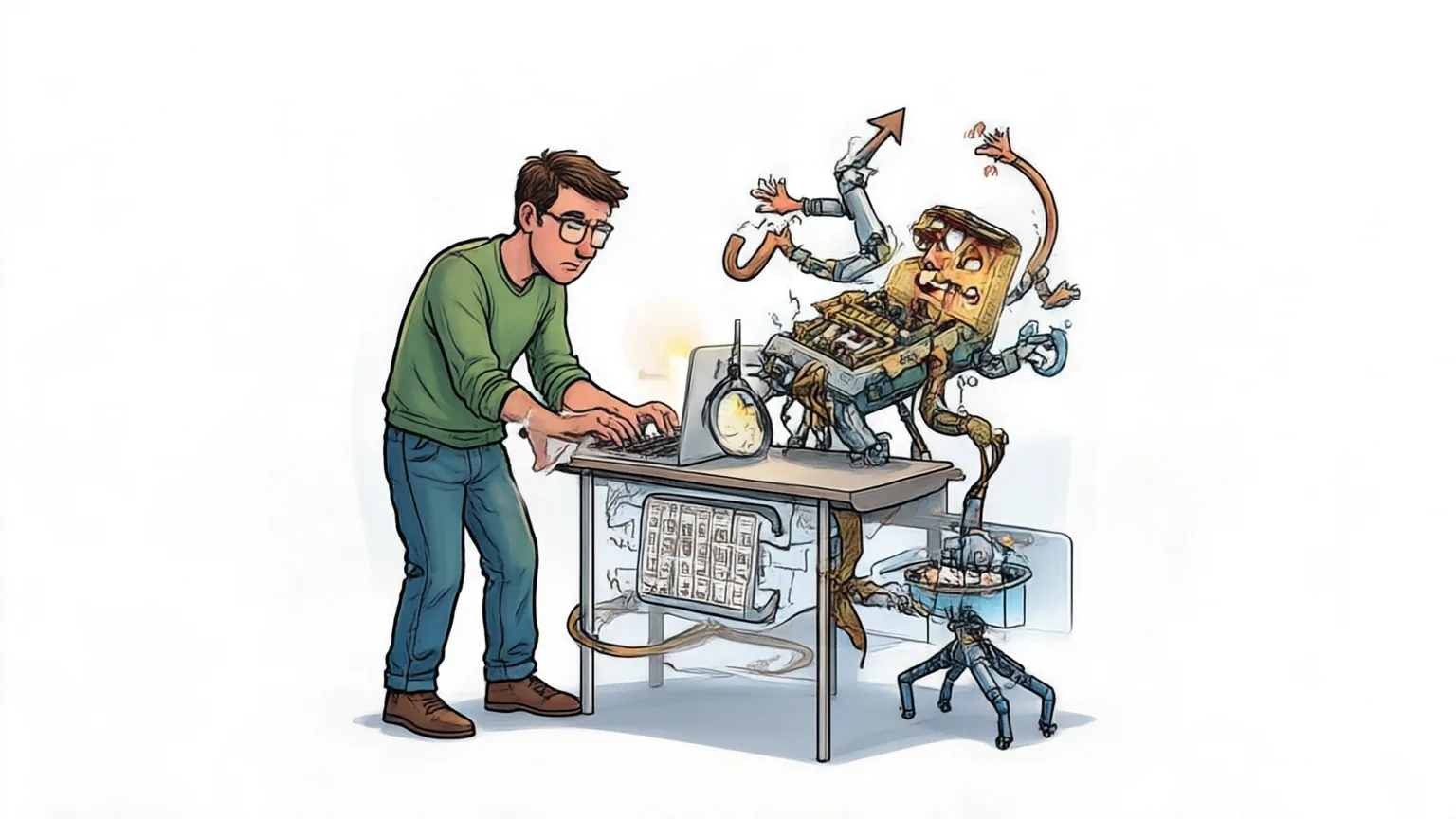
An AI system that directs other agents needs practice choosing and managing their work. This paper presents a way for that system to choose its own practice tasks and learn from its failures. It also tests when learned lessons have become reliable enough to remove the separate aids that supplied them. The aim is a system that needs fewer such aids as it improves.
- Problem: Existing training often depends on people designing the sequence of practice tasks. Learning also loses a useful comparison signal when every attempt has the same outcome. Judging an aid from a single noisy score makes it hard to know whether the system still needs it.
- New idea: R^2Orch trains an orchestrator, the component that directs agents, through repeated practice on tasks chosen by a task proposer. It rewards the proposer for finding tasks that still produce different outcomes across attempts as skills, reusable aids derived from failures, are removed. A separate training cycle checks whether the orchestrator performs equally well without each aid and removes it when that check passes. Lessons from the aids are absorbed into the model's learned settings, while their removal exposes failures that guide further practice.
- Simple example: Imagine a trainee who keeps instruction cards for tasks they have struggled with. After practice, a supervisor checks whether the trainee can do each task just as well without its card. Removing a card can reveal another weak spot, which becomes the next thing to practise.
- Evidence: Across twelve datasets, R^2Orch consistently outperformed the comparison methods on question answering, math, code and interactive tasks. The abstract gives no numerical size for those improvements.
- Limitation: The abstract describes deployment without separate skills as a target, but does not establish that the experiments reached it. It also does not report how much training the repeated practice and removal checks require.
- Why it matters: This approach could help an AI coordinator learn from its own failures and rely less on separate instructions over time.
- Paper: R^2Orch: Recursive Self-Improvement for Agent Orchestration
CEPO: A General Framework for Improving Prompt Optimization in Multi-Agent Systems
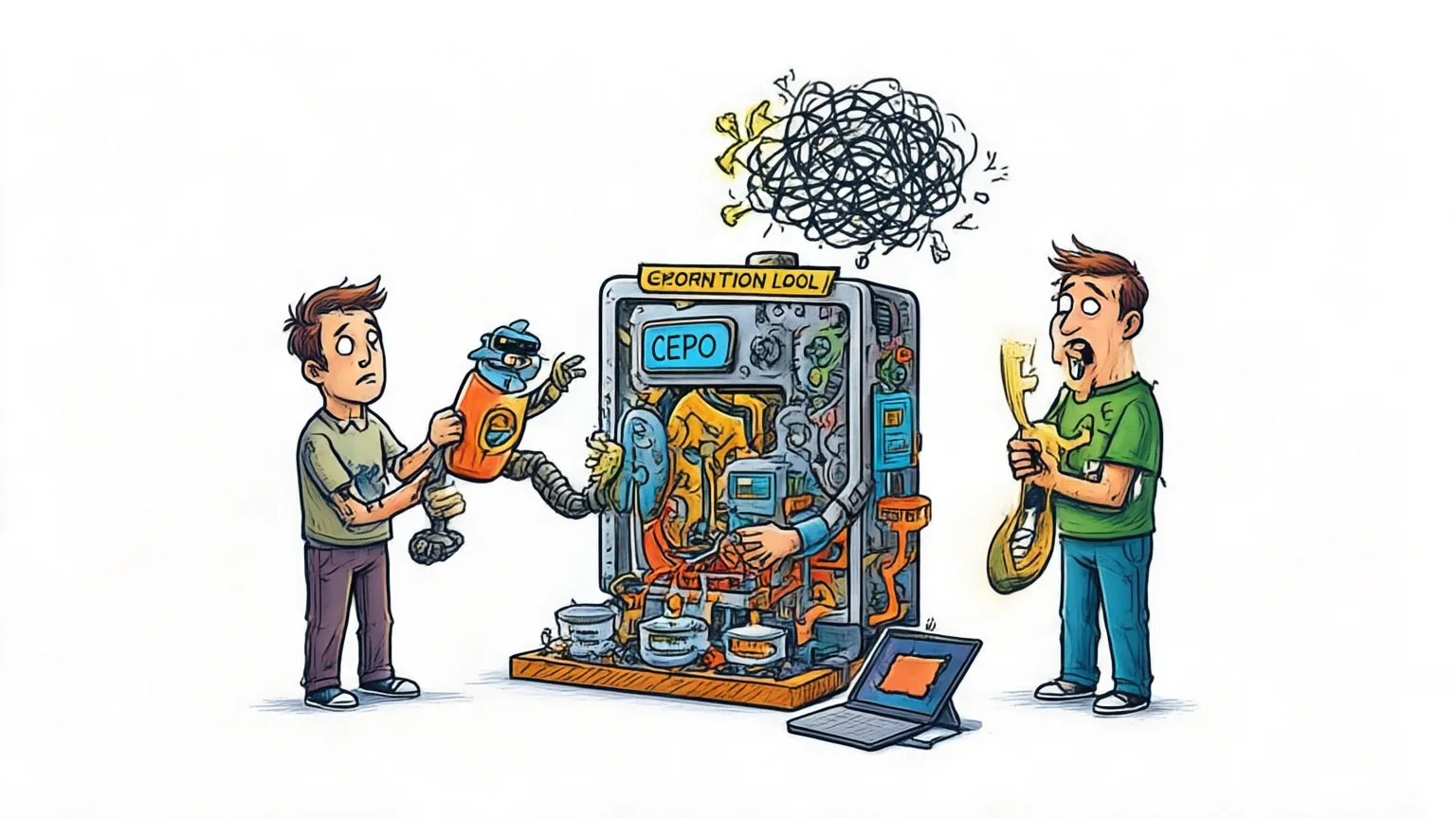
When several AI agents work together, their instructions must cover both teamwork and individual jobs. This paper introduces a way to keep those two kinds of instructions separate while improving them. It gives the team common coordination rules and each agent its own task guidance. The aim is to make instruction tuning more effective.
- Problem: Existing methods often mix teamwork rules with task instructions inside each agent's prompt, the text that guides its behavior. That makes it harder to refine shared rules consistently while adjusting how individual agents do their jobs.
- New idea: CEPO separates instructions into a shared coordinator prompt, which sets rules for teamwork, and executor prompts, which guide each agent's own work. It directs changes to each set of instructions according to that set's purpose. Existing prompt optimizers, tools that search for better instructions, perform the search within this structure.
- Simple example: Think of a team with a common handbook for handing work between colleagues and separate instructions for each job. The team can improve its handoff rules in the shared handbook while changing a particular job's instructions separately.
- Evidence: Across 11 benchmarks in four domains, adding CEPO consistently improved the performance of four existing prompt optimizers. Tests that removed parts of the design supported its structure. Controlled document-understanding studies also found better use of the optimization budget and improved performance scaling as the number of agents increased.
- Limitation: The abstract gives no numerical size for the gains. Its controlled findings on budget efficiency and agent count come from a document-understanding system, leaving their reach across other tasks unestablished.
- Why it matters: Separating teamwork rules from individual job instructions can make a group of AI agents easier to improve.
- Paper: CEPO: A General Framework for Improving Prompt Optimization
Trending AI Repositories
Ranking source: GitHub Trending.
cjpais/Handy
Handy is a desktop app that turns speech into text through a keyboard shortcut. Its appeal is the direct workflow: press, speak, and see your words appear in a text field.
- What it is: It sits on your desktop and works across platforms. A shortcut brings transcription into whatever text field you are using.
- What it does: A free, open source, and extensible speech-to-text application that works completely offline.
- Who it helps: Handy helps people who want to speak their text instead of typing it. They can dictate into text fields while keeping transcription on their own computer.
- Limitation: The supplied excerpt does not name the supported operating systems.
- Repository: cjpais/Handy
kornia/kornia
Kornia is a Python library for computer vision work. Its README links to a browser playground, giving readers a place to try it.
- What it is: It belongs in the Python computer vision toolkit. The README points to a project website and a browser playground.
- What it does: 🐍 Geometric Computer Vision Library for Spatial AI
- Who it helps: Kornia is for Python developers working with computer vision. Readers can follow the playground link to try it in their browser.
- Limitation: The supplied excerpt does not describe specific capabilities or installation requirements.
- Repository: kornia/kornia
beenuar/AiSOC
AiSOC takes security telemetry through threat detection and investigation to proposed responses. Human approval is part of that workflow, making the handoff from investigation to action worth examining.
- What it is: It is a security operations system that sits between incoming telemetry and response decisions. It detects and connects threats, then uses AI agents to investigate them.
- What it does: Open-source AI Security Operations Center: alert fusion, LLM-agent triage, MITRE ATT&CK investigation, and a replayable decision ledger for every agent step. Self-hostable, runs with no API keys, MIT licensed. Ships an MCP server for Claude, Cursor and Continue.
- Who it helps: AiSOC helps security teams investigating threats in their telemetry. They can review the agents' reasoning and approve proposed responses.
- Limitation: Proposed responses require human approval.
- Repository: beenuar/AiSOC
Sources
- 01Hugging Face Papers · Hugging Face Papers
- 02GitHub Trending · GitHub Trending
- 03OpenAI might rebrand its data centers as ‘AI compute campuses’ · TechCrunch
- 04AI can make tech CEOs’ lives easier. What about everyone else? · TechCrunch
- 05Adobe is testing how well AI agents can use editing tools like a Photoshop professional would · The Decoder
- 06Empathetic prompts can turn AI chatbots into seemingly traumatized conversational partners · The Decoder
- 07Does Scaling Toward AGI Depend on What System-1 Lets System-2 Execute? · arXiv
- 08R^2Orch: Recursive Self-Improvement for Agent Orchestration via Self-Play within a Skill-Internalization Loop · arXiv
- 09CEPO: A General Framework for Improving Prompt Optimization in Multi-Agent Systems · arXiv