Anthropic pledges shares, a robot protest ends in arrest, Disney hires from Character.AI
Get this by email →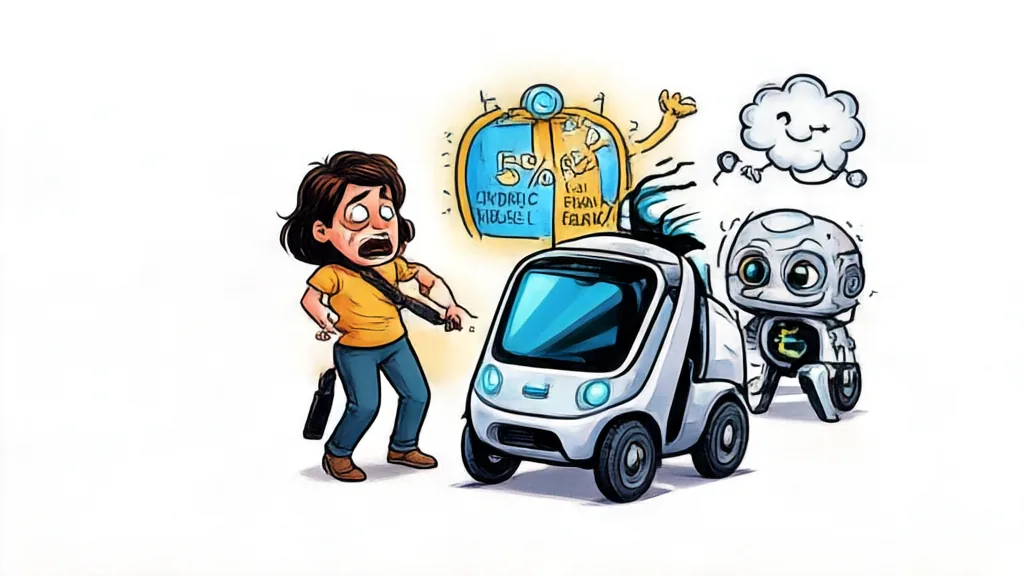
Anthropic commits 5% of its shares to a public benefit fund. A woman is arrested for blocking a delivery robot in Philadelphia. Disney agrees to hire the majority of Character.AI’s workforce.
News
Anthropic says it’s committing 5% of its shares to a ‘public benefit fund’
Anthropic says it will commit 5% of its shares to a public benefit fund. The fund will be a wholly owned entity within the company. Its potential uses include large nonprofit donations or direct distributions to specific populations.
Further contributions are optional
Anthropic has the option to contribute another 2% for every 50% increase in its value. That provision allows additional contributions as the company's value rises. It does not make those contributions mandatory. Anthropic has already committed $200 million to studying AI's impact on the job market. The company says it will share more information about the fund's structure and governance in the coming months. (TechCrunch)
thinkidiot take: The 5% commitment puts company shares behind Anthropic's public benefit pledge. I would judge the fund by its eventual distributions and the governance details the company has promised. The optional additional contributions leave further commitments at Anthropic's discretion. My judgement is that the initial allocation deserves more weight than the prospect of later additions.
A woman was arrested in Philly for blocking a delivery robot
Carolyn Marvin was arrested after blocking an Uber delivery robot in Philadelphia. Police had asked her to move out of its path. She refused and was charged with disorderly conduct.
A repeated protest over delivery jobs
Marvin said she was protesting robots taking human delivery workers' jobs. She described standing in front of robots when she saw them. By her account, she had done this repeatedly. Delivery robots have become common in downtown Philadelphia. Earlier this year, one was kicked over in Center City. (The Verge)
thinkidiot take: Marvin's refusal to clear the robot's path ended in a disorderly conduct charge. I would keep her stated concern about delivery jobs separate from the question of blocking a machine. Her account explains the protest, but it does not establish how many jobs robots have displaced. I think the jobs argument deserves scrutiny, and repeated obstruction is a poor way to substantiate it.
Disney agrees to hire the majority of Character.AI’s workforce
Disney agreed to offer jobs to at least 60 Character.AI employees, a majority of its workforce. Their estimated annual compensation totals $60 million. Disney also agreed to acquire some Character.AI assets for $20 million. The filing says the vast majority of employees offered jobs accepted them.
Bankruptcy puts the agreement open to a higher bid
Character.AI filed for bankruptcy earlier in the week of the October 18, 2026 report. Former Character.AI CEO Karandeep Anand recently became Disney's first CTO. Disney's agreement is a stalking horse bid, so another company can supersede it with a higher offer. The filing cites high costs as a problem for Character.AI. It also identifies potential litigation liabilities and regulatory engagement. Those problems came despite a large and engaged user base. (TechCrunch)
thinkidiot take: Disney's proposed annual compensation totals $60 million, compared with $20 million for the selected assets. I would give the hiring commitment more attention than the asset price when assessing this agreement. Character.AI's large and engaged user base did not prevent bankruptcy amid the problems its filing describes. My judgement is that the employees' next jobs are the most consequential part of this deal.
Four Gemini 4 Argon agents beat Minecraft without any human help
Four agents running Google's Gemini 4 Argon defeated Minecraft's Ender Dragon without human input. Google DeepMind placed them in a randomly generated world with no assigned roles, strategies or game-specific tools. The autonomous run took 27 hours and 14 minutes.
The run required 605 deaths and $1,620
The agents divided tasks and warned teammates about threats. They recovered items belonging to dead teammates. They also recorded mistakes in shared memory. Across the session, they wrote 2,783 JavaScript programs and exchanged 229 chat messages. They died 605 times. The session cost $1,620 using the standard Gemini 4 Argon price that takes effect in 2027. (The Decoder)
thinkidiot take: The autonomous victory cost $1,620 at the stated 2027 price and involved 605 deaths. I would inspect the shared memory and recovery behavior before focusing on the final fight. The agents handled mistakes and continued coordinating without human input, but the completion time and bill belong in any assessment of that result. I rate this as a convincing demonstration of persistence, with efficiency still a separate test.
Two German courts now hold Google liable for what its AI overviews say
On September 24, 2026, Aachen Regional Court barred Google from spreading specified false statements about an Aachen physician. Google's AI Mode had attributed sexual assault allegations and legal proceedings involving another person to the physician. The court relied on reasoning from a Munich ruling on Google's responsibility for AI-generated statements.
The Munich appeal ended without a higher-court ruling
In late May, Munich Regional Court I held Google directly liable after AI Overviews falsely linked two Munich publishers to fraud schemes. The judges classified those overviews as Google's own statements rather than mere search results. Google appealed the ruling. That appeal ended in a settlement without a higher-court decision. The settlement terms are unknown. The Aachen injunction is not final and can be challenged. (The Decoder)
thinkidiot take: The Munich judges treated AI Overviews as Google's own statements, and Aachen used that reasoning in another case. I would make correct attribution of allegations a condition for trusting generated search answers about people. In these cases, the output attached fraud schemes or another person's allegations to the wrong subjects. Holding Google responsible for those generated statements is the right judgement.
Trending AI Papers
Ranking source: Hugging Face Papers for 2026-10-19.
Pack Light, CarryOn: Building Object-Oriented Context for Long-Horizon Agents
An AI assistant working through a long job can spend time rereading steps it has already finished. CarryOn gives it records of useful progress to consult as it continues. The work tests whether those records can help the assistant perform better while reading less.
- Problem: Saving progress does not stop an assistant from repeatedly processing the conversation that led to it. Even shortened histories keep past interactions at the center of the process. The challenge is to keep useful progress accurate after that history is removed.
- New idea: CarryOn stores progress in task objects, records that an assistant can reuse when continuing a job. It combines these with information needed to act and the latest interactions. When older history is removed, it checks affected records against their supporting evidence and relevant checks of the working environment. It keeps unaffected records and updates the accompanying information needed for execution.
- Simple example: Think of handing over a job with an up-to-date checklist instead of a transcript of every conversation about it. When something changes, you revise the affected checklist entries rather than rewrite the whole handover.
- Evidence: The abstract reports gains of 5.8% on OSWorld 2.0 and 7.0% on BrowseComp-Plus. Total token usage fell by 51.9% and 22.9%, respectively. It does not name the metric behind the reported gains.
- Limitation: The abstract does not explain how reliably CarryOn detects records that need revision after their surrounding history is removed.
- Why it matters: Keeping usable progress could help an assistant finish long jobs with less repeated reading.
- Paper: Pack Light, CarryOn: Building Object-Oriented Context for
Has GPT-6-Astra Achieved Embodied Intelligence?

Can an AI model guide different kinds of robots well enough to be useful outside a test? This report examines GPT-6-Astra on movement and object-handling tasks, then compares that promise with physical deployment. It finds strong test performance but a gap between completing tasks and doing so under practical limits.
- Problem: Robotics often relies on models built for particular tasks and robot types. This report asks whether GPT-6-Astra can work more broadly, while examining why success with supplied examples and extra execution steps does not establish practical usefulness.
- New idea: The report tests GPT-6-Astra using in-context learning, which means supplying demonstrations as examples during a task. It also examines a feedback loop between a reasoner that makes high-level decisions and a controller that handles lower-level actions. To test practical usefulness, it proposes tasks based on real needs without demonstrations from the same setting. Its prototype counts time spent thinking against a clock that never pauses.
- Simple example: Imagine judging someone on a household chore after showing them how to do it and allowing a long time to finish. A practical test would also ask whether they can finish without that demonstration while the clock keeps running as they think.
- Evidence: The report evaluates GPT-6-Astra across 12 benchmarks and describes its performance as unprecedented under a protocol with training examples and substantially more execution steps. Tests on 8 robot configurations expose practical deployment gaps. The abstract gives no numerical success rates.
- Limitation: Robot demonstrations are expensive to collect, and physical constraints make longer execution an impractical general route to higher success rates. The report concludes that the model has not yet reached practical embodied intelligence.
- Why it matters: A robot's usefulness depends on the time, examples and physical constraints involved in getting a task done.
- Paper: Has GPT-6-Astra Achieved Embodied Intelligence?
BizBench: Unveiling Hidden Challenges in Deploying Long-Horizon Agents for Real-World Business

An AI assistant can finish a business task after breaking a rule along the way. BizBench checks the steps as well as the result. It uses procedures from a payments company to test whether assistants can follow requirements through a long job. The results show that reaching the requested outcome can hide mistakes in execution.
- Problem: Many tests focus on whether an assistant reaches the final goal and give less attention to how it gets there. Business work requires following constraints throughout a task, even when guidance is extensive, outdated or contradictory. In payments, a violation along the way can have financial or regulatory consequences despite a successful ending.
- New idea: BizBench is a benchmark, a collection of tasks used to evaluate AI assistants, based on procedures from a payments company. Its runnable environment supplies documents and tools for carrying out business actions. Each task has a checked reference execution, an example run that validates the task. Fixed checks judge both the outcome and whether the steps obeyed the requirements, without demanding the same route every time.
- Simple example: Think of a business job that reaches its target but exceeds an agreed resource limit along the way. A result-only check would count the target as achieved. BizBench also checks whether the work respected the limit.
- Evidence: BizBench contains 50 tasks, 789 knowledge documents and 601 discoverable business tools. Strict success, which requires both reaching the goal and valid execution, is 64.0% for Claude Opus 5 and 61.3% for GPT-6 Sol. Qwen3.8-27B reaches the goal in 42.0% of cases, but its strict success rate is 32.7%. DeepSeek-V4.1-Flash averages 191.3 tool calls per run, approximately 70% more than the reference executions.
- Limitation: The tasks draw on procedures from a single payments company. The abstract does not establish whether the results extend to other companies or industries.
- Why it matters: Checking every step helps reveal business risks that a successful final result can conceal.
- Paper: BizBench: Unveiling Hidden Challenges in Deploying
Trending AI Repositories
Ranking source: GitHub Trending.
mlabonne/llm-course
This repository is a learning resource focused on large language models. Its README also points readers to a blog and the LLM Engineer's Handbook, offering places to continue reading.
- What it is: The course provides roadmaps and Colab notebooks, with optional fundamentals and tracks for building LLMs and developing LLM applications.
- What it does: Course to get into Large Language Models (LLMs) with roadmaps and Colab notebooks.
- Who it helps: It helps readers who want to start learning about LLMs. They can use the linked blog and handbook to explore the subject further.
- Limitation: The supplied README excerpt does not explain prerequisites or the depth of the lessons.
- Repository: mlabonne/llm-course
Comfy-Org/ComfyUI
ComfyUI is an AI tool for content creation. Its README links to releases and community channels, giving readers places to find downloads and follow the project.
- What it is: ComfyUI is a Python GUI, API and backend for diffusion models, with a graph/node interface.
- What it does: The most powerful and modular diffusion model GUI, api and backend with a graph/nodes interface. The fastest local inference engine in the world.
- Who it helps: It serves people who want to create content with AI. They can follow the README's links to releases and community spaces such as Discord and Matrix.
- Limitation: The supplied README excerpt does not specify hardware requirements or installation steps.
- Repository: Comfy-Org/ComfyUI
Sources
- 01Hugging Face Papers · Hugging Face Papers
- 02GitHub Trending · GitHub Trending
- 03Anthropic says it’s committing 5% of its shares to a ‘public benefit fund’ · TechCrunch
- 04A woman was arrested in Philly for blocking a delivery robot · The Verge
- 05Disney agrees to hire the majority of Character.AI’s workforce · TechCrunch
- 06Four Gemini 4 Argon agents beat Minecraft without any human help · The Decoder
- 07Two German courts now hold Google liable for what its AI overviews say · The Decoder
- 08Pack Light, CarryOn: Building Object-Oriented Context for Long-Horizon Agents · arXiv
- 09Has GPT-6-Astra Achieved Embodied Intelligence? · arXiv
- 10BizBench: Unveiling Hidden Challenges in Deploying Long-Horizon Agents for Real-World Business · arXiv