Anthropic works on agent deal rules, Meta revises terms, Replit picks OpenAI
Get this by email →
Anthropic consults lawyers on fair negotiation norms for AI agents acting on behalf of users. Meta removes terms that raised concerns about scraping and AI training. Replit makes OpenAI its default while keeping Claude available.
News
Anthropic consults law firms to set fair negotiation norms before AI agents start cutting deals
Anthropic is consulting law firms on fair negotiation norms for AI agents, according to the Financial Times. The agents would haggle over prices, resolve complaints, or improve contract offers for users. Anthropic is also recruiting lawyers as Conceptual Reasoning Fellows, offering $100,000 to $167,000 for four months of work.
Better negotiators raise questions about unequal outcomes
Anthropic's experiments found that stronger models negotiate better deals. The story identifies this gap as a potential source of wider societal inequality. The fellowship effort also includes humanities scholars. Fellows will test Claude on questions involving judgment in law, philosophy, cognitive science, economics, and political science. Reliable training data is scarce in these areas. Experts will build test cases and evaluations for problems where correct answers are rarely clear-cut. (The Decoder)
thinkidiot take: Stronger models negotiated better deals in Anthropic's experiments. I would make that gap central to the negotiation tests, because fairness has to account for unequal model capability. A better result for one user's agent is not evidence of a fair process. Setting norms before agents start cutting deals is the right priority.
Meta removes language that raised scraping and AI training concerns
Meta has removed a provision from its commercial terms that raised concerns about scraping and AI training, The Verge reported. Meta says it has clarified the scope of its consolidated crawling terms. A spokesperson said the update did not change how Meta uses web crawlers.
Business account terms reached into linked websites
The provision covered content from business accounts' domains, web pages, or URLs. It permitted Meta to use that content to develop and research its products and services. Training and maintenance were also listed uses. Legal experts interviewed by Nieman Lab interpreted the language as permission to scrape publishers' websites. Their interpretation also included using publishers' content to train AI models. Meta said the crawling terms applied only to ads and business products. (TechCrunch)
thinkidiot take: Meta removed the disputed provision while saying its crawler practices had not changed. I would treat that as a correction to the terms, not evidence of reduced crawling. The gap between the experts' reading and Meta's stated scope is the problem here. Terms covering website content should state that scope without requiring a spokesperson to explain it.
Replit makes OpenAI its default over Anthropic, CEO says
Replit CEO Amjad Masad clarified over the weekend that OpenAI's ChatGPT is now the platform's default, replacing Anthropic. Customers can still choose Claude or other supported models. Masad said performance, economics, and the strength of the partnership made OpenAI the preferred partner for Replit Agent.
The model switch comes as business revenue grows
Masad said Sol and Astra consistently perform better on Replit's public benchmark. That benchmark tests building vibe-coded applications from scratch. A late-September Replit blog post listed Claude Fable 5 and Claude Fable 5.1 as running in Replit Agent's production environment. Masad said enterprise contracts account for about 15% of revenue this year, up from about 2% last year. B2B accounts for more than 50% of revenue. He expects enterprise and government customers to generate more than half of Replit's revenue in 2027. (TechCrunch)
thinkidiot take: OpenAI is now Replit's default, but Claude is still available. I would compare the supported models on my own application before accepting that default. Masad's benchmark claim concerns building applications from scratch, while his choice also reflects economics and the partnership. Keeping model choice matters more to me than which provider gets the default slot.
Websites are closing their doors to AI agents
Users of Meta's Muse, xAI's Grok, OpenAI's Dots, and Instinct have reported blocks that stop their agents from completing tasks on major websites. Delta Air Lines prevents agents from booking tickets for users. JPMorgan Chase and Charles Schwab confirmed that they block agents from accessing accounts because of security concerns.
Access depends on licensing, site policies, and litigation
Yelp told TechCrunch it allows only AI agents that pay for its data licensing program. Amazon banned Perplexity's agentic shopping feature and sued the company last year. In August, an appeals court overturned an order barring Perplexity agents from shopping on Amazon. Amazon has since filed an amended complaint. Amazon said Meta Muse's continued access violates its site policies. Reports also describe Grok, Instinct, and Dots being unable to use Amazon. (The Verge)
thinkidiot take: Delta prevents agents from booking tickets, and JPMorgan Chase and Charles Schwab block account access. I would test access to the intended website before handing an agent a task. These restrictions put site permission directly in the path of completing the job. For practical use, demonstrated access deserves more weight than promises about what an agent can do.
Trending AI Papers
Ranking source: Hugging Face Papers for 2026-10-18.
MJev-Spatial: System One Spatial Intelligence via Native Attention Matching
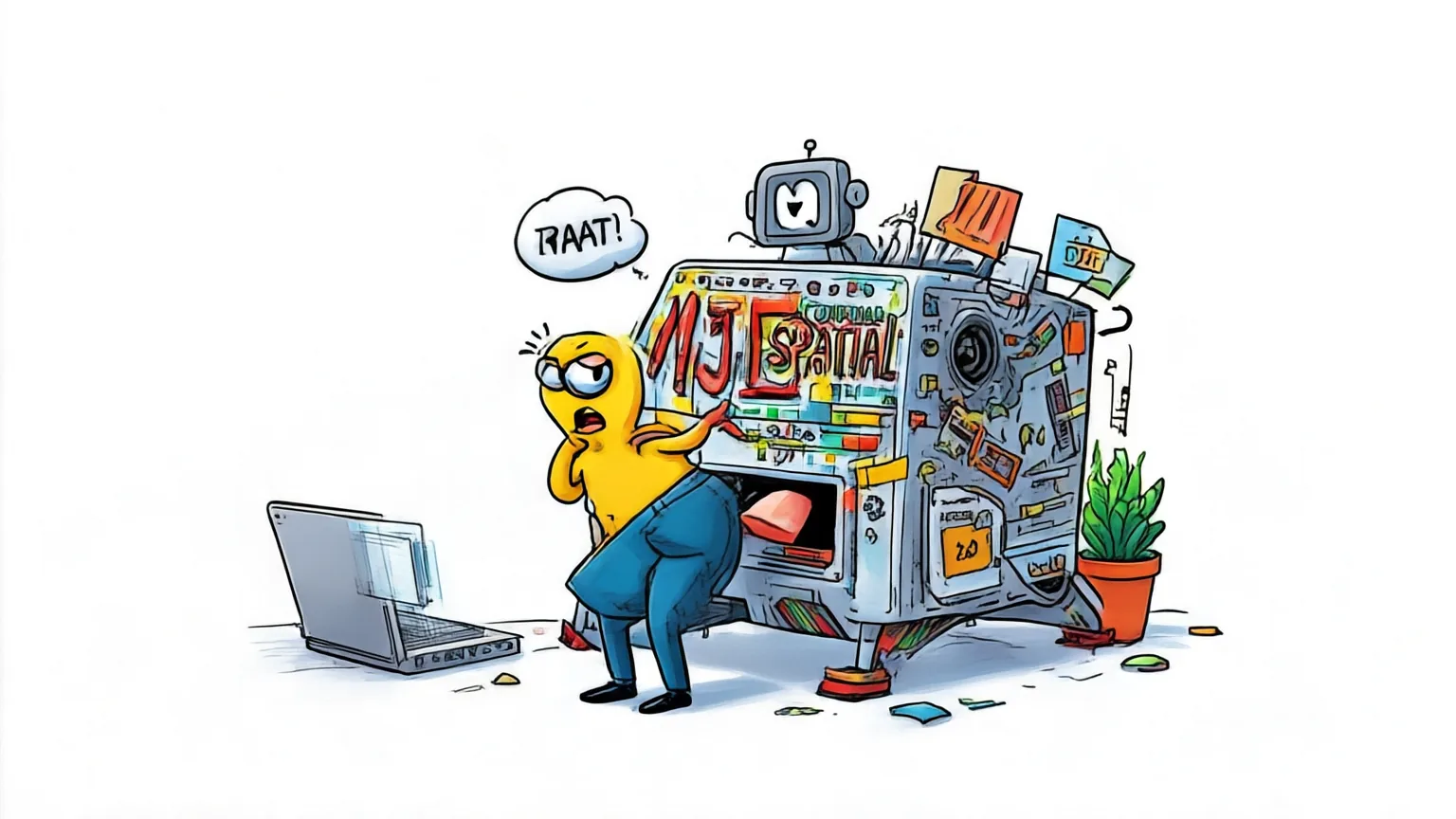
An AI system should not need to write a sentence just to pick a location in a picture. MJev-Spatial answers questions about positions, distances and placement by selecting among possible answers. The work aims to make these decisions faster while improving accuracy.
- Problem: Models that handle images and language often answer spatial questions by generating text. That takes time to produce and interpret, even when the answer is just a choice, a number or a point in an image.
- New idea: MJev-Spatial turns each possible answer into a category the model can score. It reuses existing attention components, which help the model relate information, without adding new learned parameters. For numbers and locations, it first chooses a broad range or image area, then narrows that choice. Each selection requires one computation through the model and produces no answer text.
- Simple example: Think of choosing where to put something in a picture: first pick a broad area, then a smaller spot inside it. The model narrows down a location this way instead of writing out an answer.
- Evidence: Built on Qwen3.5-4B and trained on 12.3M question-answer pairs, MJev-Spatial scored 65.64% overall, the highest among eight tested models. It ranked first on seven of twelve benchmarks and beat its unmodified base model on all twelve. It ran 2.5 times faster than the fastest text-generating baseline and 5.6 times faster than its base model. Training throughput rose by 30.8% over the original batching strategy.
- Limitation: The abstract reports benchmark results but does not establish how well the system works when controlling actions in the physical world.
- Why it matters: Faster spatial answers could help agents respond more promptly when deciding where objects are or where to place them.
- Paper: MJev-Spatial: System One Spatial Intelligence via Native
RoTA-Bench: Evaluating 3D Spatial Reasoning through Interactive Projection Alignment
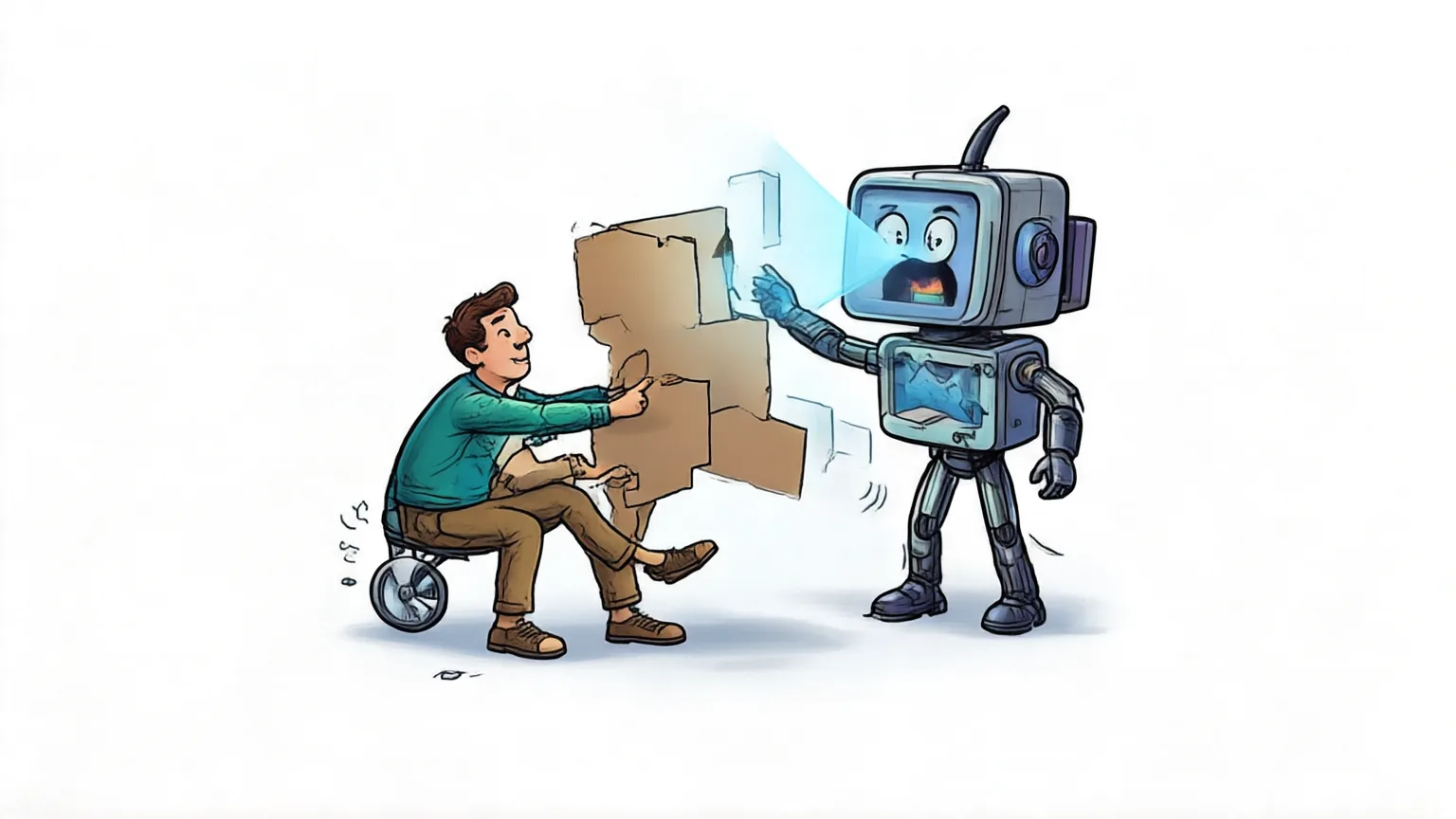
A picture can look nearly right while an object is still turned the wrong way. RoTA-Bench tests whether AI models can rotate a digital object until its outline matches a target. It asks models to learn from the view after each move. The reported results show a large gap between model and human performance.
- Problem: Recognizing an image does not establish that a model understands how an object will look after a turn. Precise control requires choosing rotations and correcting them from visual feedback, and a closer outline match can hide worse physical orientation.
- New idea: RoTA-Bench is a test collection in which a model rotates a digital object to match a target silhouette, meaning its visible outline. The model sees the result of each turn and has a limited number of moves. The researchers build the objects from flat icons and start them with rotations that can be undone, ensuring a solution exists. The collection contains 674 tasks and a stratified test set of 100 tasks.
- Simple example: Imagine turning an object until its shadow matches a shape on the wall. A turn might make the shadow look closer to the target while moving the object farther from the intended orientation.
- Evidence: GPT-5.6-Sol succeeded on 17% of tasks. Twenty undergraduate participants collectively completed the test set four times with 100% success. At matched states, the model improved outline overlap while worsening orientation alignment more often than humans: 19.4% versus 10.9%. Removing interaction history left 96.8% of model actions at a coarse 30-degree step size and sharply reduced observed success.
- Limitation: The reported tasks use digital objects built from flat icons. The abstract does not establish whether the same results hold for manipulating physical objects.
- Why it matters: The test exposes errors that image matching alone can miss when an AI system must choose precise movements.
- Paper: RoTA-Bench: Evaluating 3D Spatial Reasoning through
Self-Evolving Agent Harness
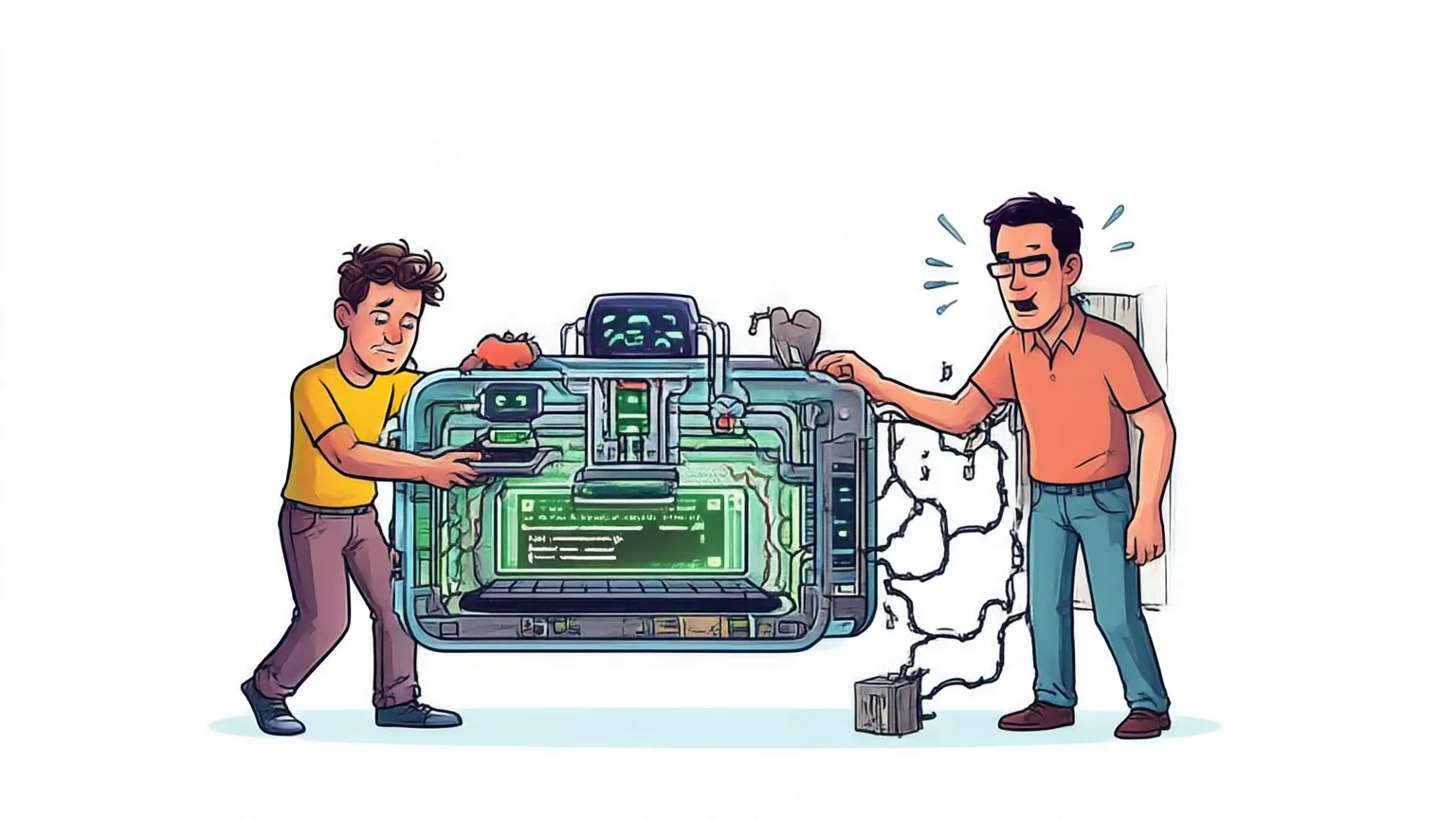
An AI agent can change how it works without changing the model underneath it. This paper studies lasting edits to the instructions, memory and software that guide an agent. It sets out a process for proposing and checking those edits. The aim is to understand when accumulated changes remain reliable.
- Problem: Changes to an agent's supporting software can persist and affect later tasks. Accepting a change based on current feedback is not enough to establish that it will work on new tasks or preserve earlier abilities, especially as tasks and evaluation methods change.
- New idea: The framework treats the agent's harness, meaning its supporting instructions, memory and software, as something that can be revised while the underlying model stays fixed. It separates what gets changed from how changes are proposed and accepted. It describes the search as evolutionary optimization, meaning a process that proposes variations and selects which to keep. It also develops an acceptance rule using fresh, independent validation data, meaning examples reserved for checking proposed changes.
- Simple example: Think of a team revising a shared work manual after reviewing completed jobs. Accepted edits carry into later work, but the team still needs to check that a new procedure helps without breaking an older one.
- Evidence: Under explicit assumptions, the analysis derives an expected bound on performance beyond the evaluation data, a bound on retention tied to allowed regressions on earlier tasks, and an acceptance rule with a high-probability guarantee using fresh, independent validation data. The abstract describes a 66-page discussion and examples from prior work. It reports no measured performance gains.
- Limitation: The theoretical guarantees depend on explicit assumptions, and the retention result depends on limits placed on regressions. The abstract says reliable deployment still requires continual validation and separate safeguards for learning, software permissions and consequential actions.
- Why it matters: Persistent software changes need checks because they can shape an agent's behavior long after the run that produced them.
- Paper: Self-Evolving Agent Harness
Trending AI Repositories
Ranking source: GitHub Trending.
stablyai/orca
Orca is a TypeScript project from stablyai built around coding agents. Its support for using your existing subscription makes it relevant if you already pay for one.
- What it is: The project lives in the stablyai/orca GitHub repository. Its README links to a releases page and the project site, onOrca.dev.
- What it does: Orca is the place for working with a fleet of agents (e.g. Grok Bot, Claude Code). Run any coding agent with your own subscription. Available on desktop, mobile and remote runtime.
- Who it helps: It helps developers who work with multiple coding agents. They can use Orca to work with those agents across desktop, mobile and a remote runtime.
- Limitation: The supplied README excerpt does not include setup instructions or explain which subscriptions are supported.
- Repository: stablyai/orca
Sources
- 01Hugging Face Papers · Hugging Face Papers
- 02GitHub Trending · GitHub Trending
- 03Anthropic consults law firms to set fair negotiation norms before AI agents start cutting deals · The Decoder
- 04Meta removes language that raised scraping and AI training concerns · TechCrunch
- 05Replit makes OpenAI its default over Anthropic, CEO says · TechCrunch
- 06Websites are closing their doors to AI agents · The Verge
- 07MJev-Spatial: System One Spatial Intelligence via Native Attention Matching · arXiv
- 08RoTA-Bench: Evaluating 3D Spatial Reasoning through Interactive Projection Alignment · arXiv
- 09Self-Evolving Agent Harness · arXiv