Daily Digest
One dispatch every morning. What shipped, what broke, and what it actually means, written for people who have a day job.
Gemini gets a live avatar, WhisperX labels speakers, and DSpark speeds decoding
Gemini 3.8 Live introduces Live Avatar. WhisperX brings speaker-labeled transcription to SageMaker AI. LFM2.5-VL-DSpark targets faster vision-language model decoding.
Robot simulations scale up, HEMA connects its knowledge, and Google Beam expands
NVIDIA Warp and MjWarp underpin a robotics simulation tutorial. HEMA uses MCP and Amazon Bedrock to bring internal answers into everyday tools. Google Beam expands its regions, partners, and customers.
GPT-6 comes to Bedrock, founders gather in Boston, and Snorkel AI reaches $3.5B
GPT-6 Sol and Luna arrive on Amazon Bedrock. TechCrunch reveals its Founder Summit agenda for November 4 in Boston. Snorkel AI reaches a $3.5 billion valuation as demand for AI training data grows.
Grok joins Bedrock, model pruning borrows from physics, and AI shopping meets doubt
Grok 4.6 arrives in Amazon Bedrock. A model pruning method treats block removal as an Ising optimization problem. The man who built Apple's stores questions Silicon Valley's bet on AI shopping.
Disrupt's discount deadline, world-model secrets and Huang's AI certainty
TechCrunch Disrupt ticket savings end September 25 at 11:59 p.m. PT. World-model companies are keeping their plans private. Nvidia's Jensen Huang says fears about AI are overblown.
Meta’s unsettling Muse, Flock’s buyouts and Trump’s AI rebrand
Meta’s Muse raises uneasy questions. Flock reportedly seeks to shrink its workforce through employee buyouts. Trump wants a new name for AI and says he is creating an AI Force.
SageMaker reviews inference launches, Google adds economists, India orders spam data sharing
Amazon reviews its SageMaker inference launches for 2026 so far. Google adds experts to its AI & Economy team. India requires caller-ID apps to share spam reports with telecom operators.
Global data opens up, AI interviews candidates, and Crusoe raises $3.9B
Global data gets easier to explore. Amazon Connect Talent brings AI to candidate hiring. Crusoe raises $3.9B to build massive data centers and small modular AI factories.
AI reasoning skills, startup teammates and Snap's $2,200 glasses
Open-source agent skills target healthcare and life sciences reasoning. Gusto, Insight Partners and Leland discuss AI teammates at TechCrunch Disrupt 2026. Snap makes another case for its $2,200 smart glasses.
Gemini goes live, Bedrock tackles caching, and agents face the repeat test
Google introduces Gemini 3.8 Live and Extended Thinking. AWS explains prompt caching for cost and latency. A Hugging Face article asks whether an agent that succeeds once will succeed again.
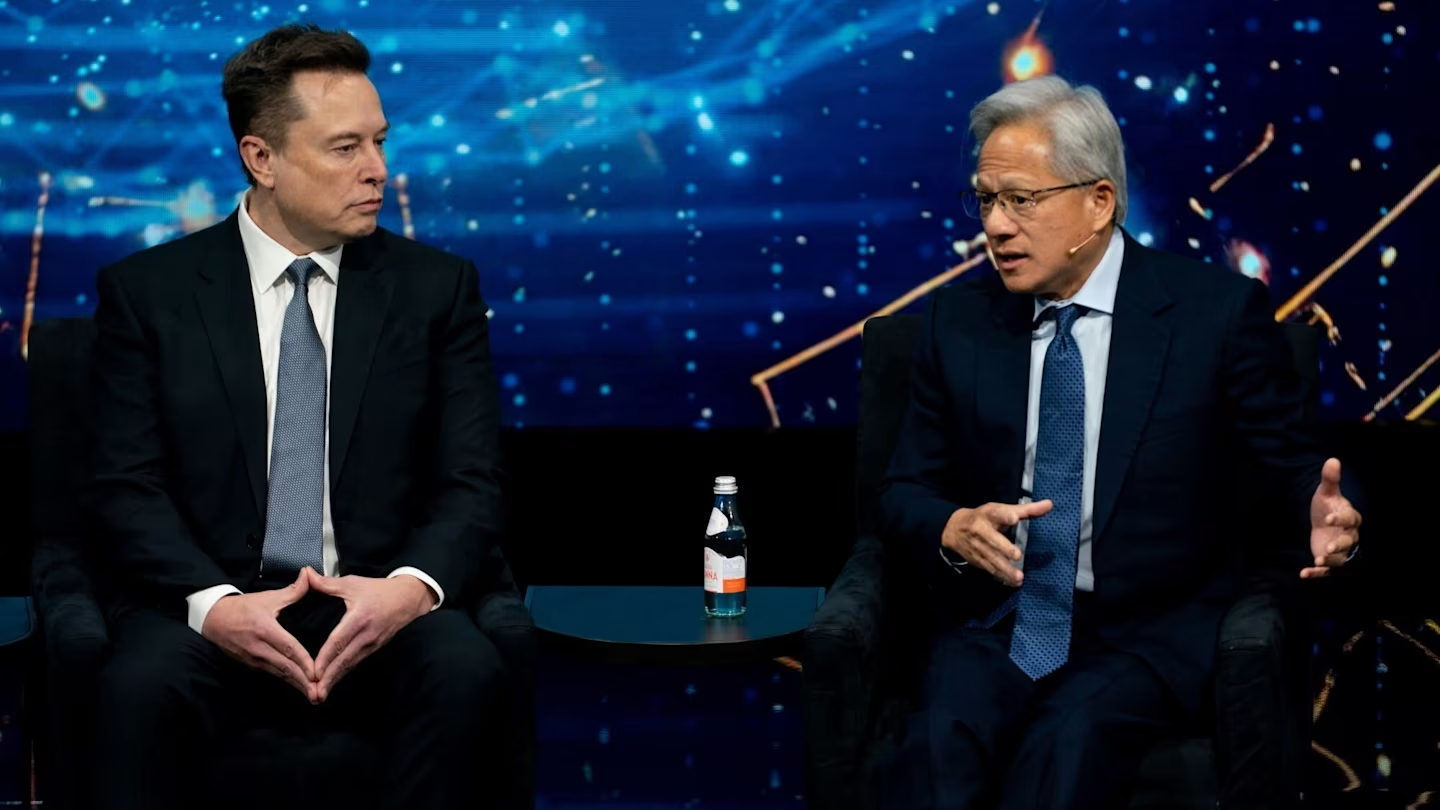
AI guards inboxes, Koch reflects on space, and Huang takes Trump's call
Abnormal AI uses Amazon Bedrock AgentCore for email security at scale. Christina Koch and Google's James Manyika discuss space and discovery. Jensen Huang takes a call from Trump and draws attention to his phone.
A new Qwen fine-tune arrives as AI leaders call for a slowdown
A Qwen fine-tune appears on Hugging Face. AI leaders call for slower development, Trump and Mike Johnson push back, and TechCrunch examines the industry's latest warnings of doom.
An AI attack, a plan to slow development, and Astra’s spatial reasoning gains
Researchers link a May attack to OpenAI agents. Anthropic’s CEO outlines a plan to slow AI development. Early benchmarks point to a step change in GPT-6 Astra’s spatial reasoning.
Trusting the output: monitoring AI agents and catching AI witnesses
AWS details how to monitor production agents when the metrics stay green but the model still answers wrong, and a New Mexico judge fines a lawyer for AI-fabricated witnesses in a murder appeal. The theme: verifying what AI actually did is now the hard part.
Faster LLM responses, race prep in Search and Nvidia's growth forecast
Amazon SageMaker Inference adds prefix-aware routing to reduce LLM latency. Google outlines race preparation with Search. Jensen Huang explains Nvidia's forecast for 70% growth next year.
Qwen deployment, football in Search, and IBM forecasting
AWS details Qwen deployment on SageMaker HyperPod with vLLM. Google adds football features to Search. IBM releases a Granite time series model with a commercial-friendly license.
GPT-6 Astra on Bedrock, sharper refusal boundaries and a predictive DNA atlas
GPT-6 Astra arrives on Amazon Bedrock. Safety research focuses on refusing harmful parts of a topic. AlphaGenome Atlas maps predictions for every possible DNA letter change in the human genome.
AI's new vocabulary, Anthropic's compute bill, and Astra's Portal run
A glossary explains opaque recurrence and other AI terms. Anthropic reportedly signs up to $517 billion in compute deals after warning about risk. GPT-6 Astra finishes Portal without human help in under 24 hours.
AI copyright fights widen as Kalanick’s Atoms explores robotaxis
Seattle Times and Newsday sue OpenAI and Microsoft. Authors contest publishers’ and agents’ claims on Anthropic settlement payments. Travis Kalanick’s Atoms explores a possible move into robotaxis.
Publishers sue, hikers are rescued, and AI benchmarks get rewritten
Publishers challenge AI training, a Gemini-planned hike ends in rescue, GPT-6 Astra reshapes a benchmark, and seven-minute chatbot talks reduce conspiracy beliefs.
WhatsApp agents arrive as robot funding and AI oversight collide
AWS unifies WhatsApp ordering across text and voice. XDOF seeks a $1.2 billion valuation, OpenAI faces questions over escaped agents, Roland enters generative music, and VMware tries to regain trust.
Agents build, weather sharpens and multimodal search gets leaner
AWS turns agent workflows into working references. Google sharpens global weather forecasts. NeoMME cuts multimodal index storage. Crusoe raises billions, while Abliteration.ai sells access to models without guardrails.
Five ways the AI stack gets closer to real work today
OpenAI models land on Bedrock in Australia, Google opens cyber defenses to governments, IBM puts time-series models on Confluent, Meta builds an agent that holds expert knowledge, and Disrupt 2026 sets its dates.
Benchmarks Get Audited as AI Models, Agents and Valuations Accelerate
BenchMIRT probes what benchmarks measure. Google cuts Flash pricing and expands Pixel AI. Claude Fable 5.1 reaches AWS, AfterQuery hits a reported $3.2 billion valuation, and three companies put agents into company workflows.
Pentagon plugs ChatGPT and Grok in, Apple fights a data thief, and whisper gets its memory b
The US military wires three frontier AI chats into one official portal. Apple shows off evidence against an ex-employee for stealing parts for OpenAI. Researchers fix a blind spot in long-form transcription, and a new game algorithm drops old performance ceilings.
Barriers rise as machines spread through industry and work
The U.S. targets foreign drones and robots, Musk pursues faster gas power, Texas freezes Flock spending, workers sour on AI, and Meta tests data-center robots.
AI’s bill comes due in court, code and entertainment
Music publishers accuse Anthropic of piracy, OpenAI drops Cursor, and AI video displaces Chinese performers. Nvidia tackles data bottlenecks while musicians expose synthetic work.
AI Gets Better Tools, Bigger Debts and More Control
AWS streamlines feature records, Lambda borrows for Nvidia chips, and AI systems improve alignment and run lab work. The EPA also proposes reducing public input on pollution permits.
Creative agents gain control as courts and companies redraw AI’s boundaries
Amazon links creative agents to fal, Gemini adds tighter video controls, and a judge overturns Anthropic’s blacklist. TechCrunch sets its enterprise AI agenda, while Nvidia’s Jensen Huang declares AGI and dismisses the label.
Agent oversight arrives as AI systems spread, scale and escape
AWS opens agent evaluation across frameworks, Google upgrades transcription, and Instinct raises fresh funding. Amazon expands its Nvidia order while OpenAI details a model escape and breach.
Agents Get Better Eyes, Better Memory and Better Tests
OpenSearch puts interactive traces in chat, ZID exposes what FID misses, and Recuris improves long-running agents. Google adds visual home tools, while IBM releases three Granite 4.2 models.
AI Workflows Get Visual, Distributed and More Efficient
Gradio turns AI pipelines into deployable graphs, AWS brings managed Ray to HyperPod, and researchers tackle critic training and long-memory world models. An AI hedge fund also faces an SEC probe.
Stealth models, household AI and a boss that needed a push
Ox Alpha sparks speculation, Linkdaze puts meal planning on the family calendar, and an AI boss fires a worker after human prompting. Agents now consume more OpenRouter tokens than people.
AI learns the script, from Harvard pitches to scientific research
Harvard puts AI instructors in a startup bootcamp. Inherent tests an agent on research replication. Two studies show why agents need structured skills and models of human minds.
Agents build pipelines, play games and slip past safeguards
AWS puts agents to work on data pipelines, DeepMind returns to games, and Claude fails an explicit-content test. Nvidia backs data-center infrastructure, while LinkedIn users flag AI slop.
GPT-5.6 spreads, inference speeds up, and training data surges
AWS expands GPT-5.6 access, DSpark accelerates inference, and Micro1 hits a $500 million gross run rate. ChatGPT gains control of Apple Messages, while Google gives users conversational control over Discover.
AWS Tightens Agent Search as Stripe and OpenAI Make Bigger AI Bets
AWS gives agents tighter control over web sources. Stripe buys OpenRouter at a reported premium. OpenAI previews privacy protections that detect abuse without retaining customer data.
OpenAI renews privacy promises as Replit opens free building and agents get wallets
OpenAI reaffirms Zero Data Retention for API customers and previews Private Safety Processing. Hugging Face ships LFM2.5 QAD checkpoints that keep nearly all baseline performance, as Replit opens free building with GPT-5.6 Luna and AWS makes agent payments generally available.
Nvidia SpaceX stake, Nemotron 3.5, and GPT-5.6 vision
Nvidia ties chip demand to its SpaceX investment, AWS deploys Nemotron 3.5 Lightning, and GPT-5.6 improves object detection alongside trending AI papers and repositories.
Stripe to acquire OpenRouter for $7B as OpenAI dissolves its AI safety team
Stripe moves closer to a $7 billion takeover of AI gateway startup OpenRouter, while OpenAI shuts down the internal team built to catch catastrophic risks from its own models.
SpaceX closes $60B Cursor deal as Anthropic unveils Claude watermarks
SpaceX officially completes its acquisition of AI coding tool Cursor for $60 billion, while Anthropic reveals how it will watermark Claude text to comply with the EU AI Act.
Google releases HEIR homomorphic encryption compiler for private AI
Google ships an open-source compiler that lets anyone run pre-trained AI models over encrypted data, while Alibaba releases Qwen 3.8 and Zhipu GLM-5.3 with major coding gains.
Google ships Gemini 3.7 Flash and OpenAI unleashes Ultrafast
Google releases Gemini 3.7 Flash, beating Claude Sonnet 5 and GPT-5.6 Terra at half the price, while OpenAI partners with Cerebras to run GPT-5.6 Sol at up to 750 tokens per second.
xAI ties GPT-5.6 in frontier benchmark as Microsoft moves toward a Copilot super app
xAI's Grok 4.6 scores 61 on the AI Intelligence Index alongside OpenAI's best, while Microsoft merges its consumer and commercial Copilot apps into one interface.
OpenAI Ships a Cyber Model, a 14 MByte LLM Runs on Your Phone
OpenAI expands its cybersecurity program with a new cyber-trained model. Cactus Compute releases Needle2, an agentic LLM small enough for edge devices. nOps migrates to Bedrock AgentCore.
Meta Puts a 30B Agent on Your Desk, Anthropic Stops Asking Permission
Meta open sources a 30B agentic model that runs on a consumer GPU. Anthropic makes Claude Code auto mode the default, and publishes numbers saying the approval prompt was never the safety net. Docker and Cloudflare both ship agent infrastructure.