By ThinkIdiot
Managed inference, Gemini at work and Nadella’s economic case for AGI
Get this by email →
NVIDIA Dynamo comes to Amazon SageMaker HyperPod Inference. Google puts Gemini to work on users’ behalf. Satya Nadella says he is AGI-pilled.
News
Managed NVIDIA Dynamo on Amazon SageMaker HyperPod Inference
Amazon SageMaker HyperPod Inference now supports NVIDIA Dynamo for distributed inference. AWS lets users serve large models across multiple nodes without building the orchestration layer themselves. GLM-5.3 illustrates the need: its FP8 weights exceed the 640 GB of GPU memory on a single ml.p5.48xlarge instance, before KV cache and runtime overhead.
Separate serving pools still need full model weights
Dynamo supports disaggregated prefill and decode, alongside KV-aware routing. It works with vLLM, SGLang, and TensorRT-LLM. Disaggregated serving loads full model weights into both the prefill and decode pools. KV cache moves between those pools over EFA. HyperPod monitors node, GPU, and EFA health and manages node replacement for fault recovery. Deployments configured through InferenceEndpointConfig with dynamoSpec support invocation through SageMaker endpoints. (AWS Machine Learning)
thinkidiot take: GLM-5.3 exceeds a single instance’s 640 GB of GPU memory before cache and runtime overhead enter the picture. I would use managed orchestration for that deployment because distributing the model is already a requirement. I would also account for full weights in both pools before choosing disaggregated serving. Taking node replacement off the operator’s hands is the stronger selling point here.
Put Gemini to work for you
Google announced task capabilities using Gemini 4 Hydrogen on November 17, 2026. The free update is rolling out in the U.S., Japan, Korea, Canada, Australia, and India. Gemini can schedule appointments, analyze utility bills, and purchase items through integrated services, with advanced features starting in the U.S.
A task can start with a text or a forwarded email
The Gemini app provides a Chat-to-Task toggle. Users can also access tasks by texting on Android or iOS. Forwarding an email to gemini@google.com provides another entry point. Google says Gemini operates in hardware-isolated virtual machines to protect private data and account information. In the author’s example, Gemini called two dealerships concurrently. It added a service appointment to Google Calendar in less than five minutes. (Google)
thinkidiot take: The author’s example gets from calls to two dealerships to a calendar appointment in less than five minutes. I would start with that appointment workflow because the result is concrete: a booking recorded in Google Calendar. That is the kind of completed task I would judge this service on. For my use, finishing the booking matters more than having several ways to submit the request.
Satya Nadella says he’s AGI-pilled now
Microsoft CEO Satya Nadella said he is AGI-pilled at a roundtable after his Microsoft Ignite keynote. His interest centers on AI’s economic and political effects. He questioned how the political economy would organize around AGI.
Model choice sits beside a warning about monopoly
Nadella said he does not think frontier models such as Claude are conscious. He warned that monopoly control by one AI model could threaten the economy and democracy. He also questioned the future role of firms and human capital if models can learn everything they observe. At Ignite, Microsoft promoted AI tools that promise enterprise clients model selection by cost. Those tools also promise the ability to run their own models. Control over their data is another part of the enterprise offering. (The Verge)
thinkidiot take: Microsoft’s Ignite pitch promises enterprises model choice by cost and the ability to run their own models. I would make those capabilities the practical test of Nadella’s warning about monopoly control. Choosing a model and controlling data put his economic concerns into purchasing decisions. I give those commitments more weight than his embrace of the AGI label.
Not even Sam Altman is safe from AI deepfakes on Instagram
Earlier in November, Meta chief AI officer Alexandr Wang posted an AI-generated Instagram clip promoting Muse, Meta’s consumer AI agent. The clip depicts a four-way call between Wang, Meta CEO Mark Zuckerberg, OpenAI CEO Sam Altman, and Muse mascot Jolly. The generated version of Altman is dressed as Jolly.
Video labels and image disclosure follow different rules
Meta requires AI-generated videos depicting people to carry AI labels. Wang’s post carries that label. The article says Meta does not impose the same disclosure requirement on static AI-generated images. Meta spokesperson Tracy Clayton addressed the use of Altman’s likeness. Clayton said Altman had made his likeness available for AI content generation through OpenAI’s Sora app. (The Verge)
thinkidiot take: Meta requires labels on AI-generated videos depicting people but does not impose the same disclosure requirement on static AI-generated images. I would label either format when publishing a generated likeness. Wang’s labeled clip shows how disclosure works within the video rule. Making that disclosure depend on the format is a distinction I would remove.
Introducing GPT-6.2 Astra and Sol
OpenAI has introduced GPT-6.2 Astra and Sol. The models are available across ChatGPT Work and Codex. The release also brings them to the API.
The claim pairs better work with lower cost
OpenAI claims better professional outputs, coding and computer use, alongside improved efficiency at lower cost. (OpenAI)
thinkidiot take: OpenAI claims improved efficiency at lower cost for GPT-6.2 Astra and Sol. I would compare them on coding work I already run, judging the output alongside its cost. That puts the coding and efficiency claims into the same decision. For my use, lower cost earns a switch only when the work holds up.
Trending AI Papers
Ranking source: Hugging Face Papers for 2026-11-18.
Weight-Space Programming Doesn't Need Transformers

An AI model can build another model by writing the numbers that determine its behavior. This paper asks what kind of model makes sense when those numbers are written directly rather than learned through training. Given freedom to choose, the models built searchable tables of facts. The researchers explore whether that choice makes the resulting systems smaller, faster, and easier to correct.
- Problem: The Transformer is a neural network design favored for efficient training and GPU execution. Those advantages do not necessarily make it the best choice when an AI writes its internal numbers directly. The paper tests whether keeping that design imposes unnecessary costs.
- New idea: Weight-space programming means using a language model to write another model's weights, the numbers that determine its behavior. The researchers let the language models choose the structure those weights would take. They chose sparse tables, which store selected facts in rows that a fixed lookup procedure can search. The researchers then proposed an associative memory, a model that retrieves stored information through matching.
- Simple example: Think of a reference book with a separate entry for each fact. If an entry gives the wrong answer, you can find and replace it. The table-based models offer a similar way to trace errors to individual rows.
- Evidence: With ten labeled examples and a sandbox, all three tested language models chose table-based designs when allowed to choose the architecture. Test accuracy reached 54.4%. One design beat the most accurate released Transformer written by the same language model while using about 1,800 times fewer parameters. The proposed associative-memory model ran up to 17 times faster on GPUs than a same-sized Transformer.
- Limitation: Pretrained language models remained more accurate. The main experiments focused on multiple-choice questions, and the conclusion concerns models whose weights are written directly.
- Why it matters: Choosing a structure suited to directly written weights could make these models smaller, faster, and easier to repair.
- Paper: Weight-Space Programming Doesn't Need Transformers
ForceHarness: Turning Force into Action and Physics for Frozen Frontier Models
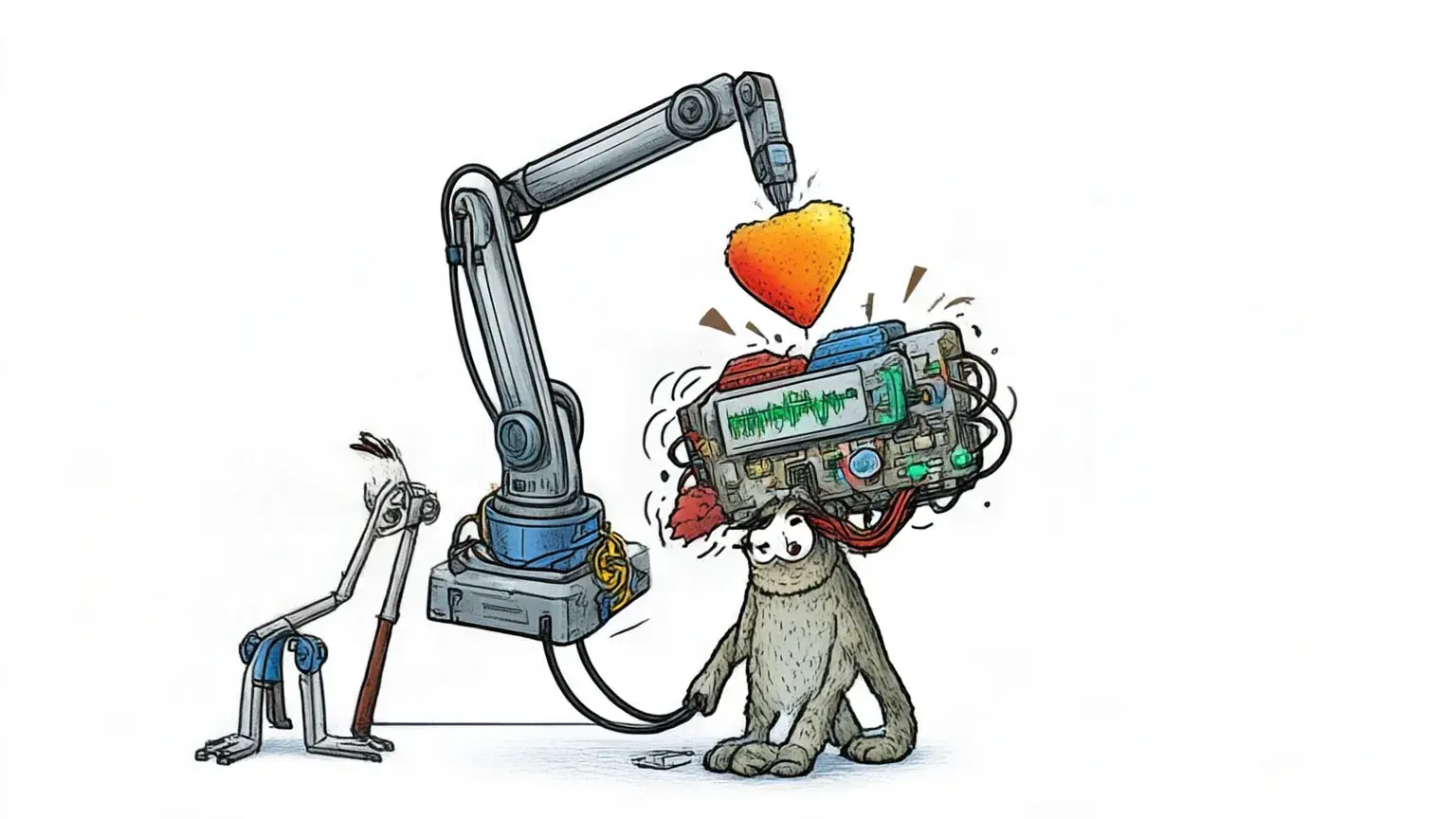
A robot's camera cannot reveal everything it needs to know about physical contact. ForceHarness gives an existing AI model a way to act on force measurements without further training. It handles rapid adjustments near the robot and turns sensor readings into information the model can understand. The aim is to help robots complete tasks where seeing an object is not enough.
- Problem: Contact forces change faster than a model accessed through an API, a software interface, can respond. The unchanged model also cannot interpret raw streams of force readings. A useful system must both react quickly and explain what the measurements mean.
- New idea: ForceHarness is a control layer that connects force sensing to a frozen model, meaning a model whose learned settings stay unchanged. It estimates force at the robot's hand from a wrist sensor or joint torques, the turning forces at its joints. It supplies short actions that adjust force on their own and stop when a contact event occurs. A translation step converts the recorded forces into physical quantities and reports uncertainty so the model can decide what to do next.
- Simple example: Imagine pushing a drawer and feeling resistance. Your hand can adjust its push before you consciously decide what to try next. ForceHarness gives the robot a similar division of work: quick force adjustments below, followed by a physical summary for the model.
- Evidence: On a real robot arm without a wrist force sensor, GPT-6 Astra's success rate without task demonstrations rose from 3.3% to 90.0%. In simulation, ForceHarness added 17.5 percentage points on ForceBench and 34.3 percentage points on HiddenPhys. It outperformed force-aware systems trained on demonstrations on both benchmarks and matched hand-written expert controllers on HiddenPhys.
- Limitation: The abstract reports a real-arm result and simulation benchmarks, including seven tasks in HiddenPhys. It does not establish how broadly the gains transfer to other robots or contact tasks.
- Why it matters: Robots could use force feedback more effectively without retraining the AI model that directs them.
- Paper: ForceHarness: Turning Force into Action and Physics for
Multi-Branch Transformer
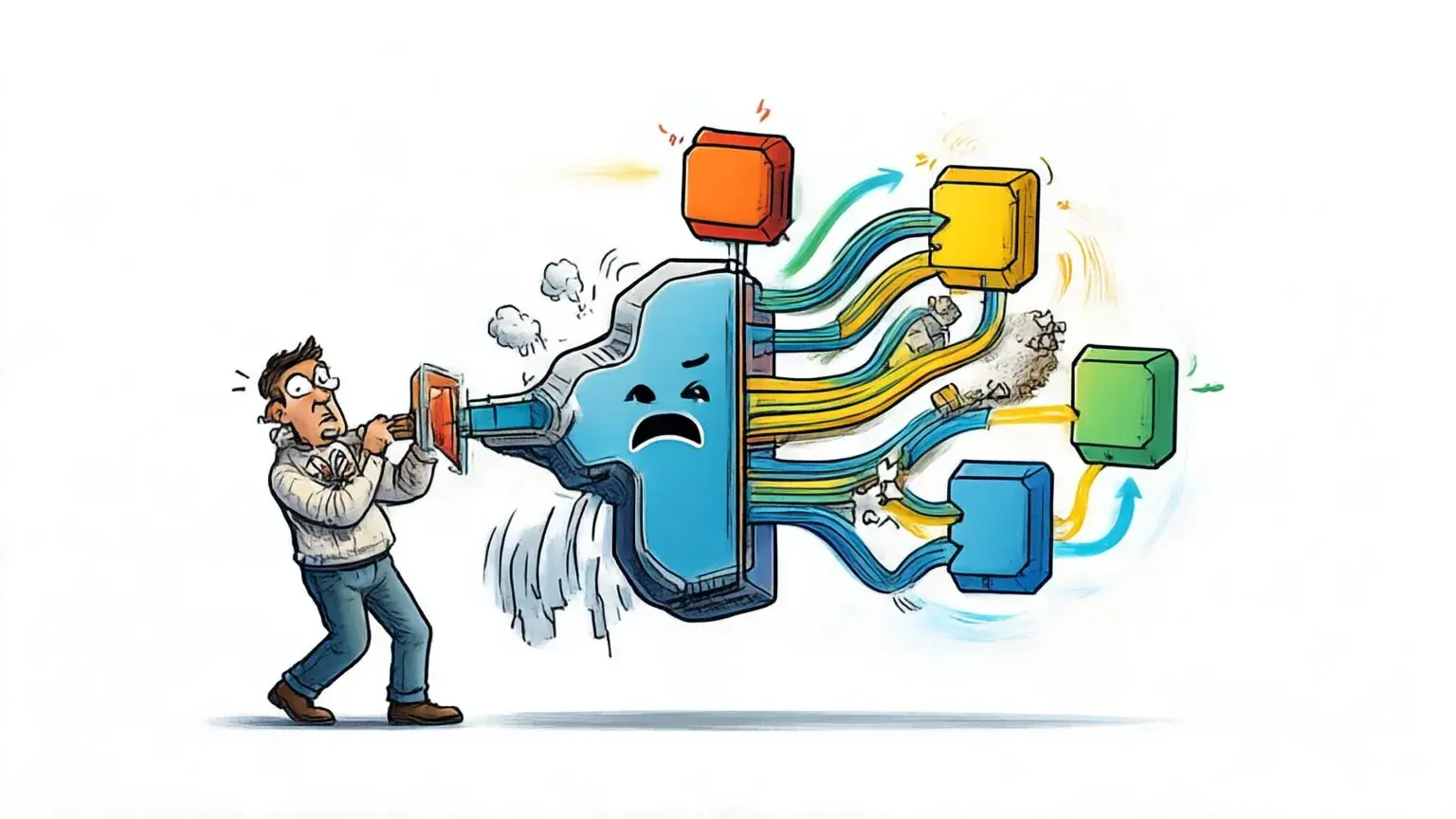
Language models usually grow by adding more processing stages or making each stage larger. This paper explores splitting part of the work across parallel paths. Those paths process information separately before their results are combined. The goal is to improve prediction quality and text generation speed within comparable training budgets.
- Problem: Making a model wider or deeper leaves another design option unexplored: processing through parallel paths. The paper tests whether that option improves quality within the same parameter and training budgets. It also addresses the memory and speed costs of retaining information while generating text from long inputs.
- New idea: The Multi-Branch Transformer splits processing into branches, separate sequences of processing blocks with their own learned settings. Shared layers process the input before the split and process the combined results afterward. Its Balanced version combines choices about block width, the size of each processing stage, and depth, the number of stages in sequence. Joint-KV lets the branches share a key-value cache, stored information from earlier text that the model reuses during generation.
- Simple example: Imagine a document passing through a shared intake desk, then going to several readers working at the same time. Their notes are combined before a final review. A shared notebook lets those readers reuse information instead of keeping separate copies.
- Evidence: Experiments covered four model scales from 0.8 billion to 2.1 billion total parameters. Two-branch Wide-Shallow models consistently beat sequential Transformers under matched parameter and training-compute budgets, and Balanced models improved further. Fitted curves indicated that standard Transformers needed up to 1.26 times as much training body compute to match the final models' validation loss, a measure of prediction error on held-out data. The final models reduced full-model key-value cache storage by up to 34% and delivered up to 51.4% higher decoding throughput on a single H200 GPU.
- Limitation: The experiments covered models with 0.8 billion to 2.1 billion total parameters, and the reported speed result used a single H200 GPU. The abstract does not establish the same gains at larger scales or on other hardware, and the training-compute comparison comes from fitted curves.
- Why it matters: Parallel processing paths could improve language-model quality and generation speed while reducing memory use.
- Paper: Multi-Branch Transformer
Trending AI Repositories
Ranking source: GitHub Trending.
Sources
- 01Hugging Face Papers · Hugging Face Papers
- 02GitHub Trending · GitHub Trending
- 03Managed NVIDIA Dynamo on Amazon SageMaker HyperPod Inference · AWS Machine Learning
- 04Put Gemini to work for you · Google
- 05Satya Nadella says he’s AGI-pilled now · The Verge
- 06Not even Sam Altman is safe from AI deepfakes on Instagram · The Verge
- 07Introducing GPT-6.2 Astra and Sol · OpenAI
- 08Weight-Space Programming Doesn't Need Transformers · arXiv
- 09ForceHarness: Turning Force into Action and Physics for Frozen Frontier Models · arXiv
- 10Multi-Branch Transformer · arXiv