AI networks open up, GPT access spreads, and self-improvement hits blind spots
Get this by email →
Open networking takes the stage at OCP Summit 2026. Amazon Bedrock expands access to OpenAI GPT models through global inference. Sakana AI improves a model's solving and judging, but shared blind spots let errors pass.
News
OCP Summit 2026: Powering AI with Open Innovations in Scale-Up, Scale-Out, and Scale-Across Networks
Meta introduced its next generation of open networking infrastructure at the 2026 Open Compute Project Global Summit. IcePack is its first liquid-cooled network rack. Its IceCube switch blades deliver 102.4 Tbps with 128×800G non-blocking capacity, doubling the bandwidth of Meta's 51.2T platforms.
Different switch chips share an open software stack
IcePack follows OCP's ORV3-HPRv1 standard. IceCube variants use either Broadcom Tomahawk6C or NVIDIA Spectrum-6 ASICs, and both run Meta's open-source FBOSS with OCP SAI. Flattened Planar Fabric is a multiplane backend scale-out fabric that changes how GPUs connect to the network. Meta's MTIA 300 uses the Ethernet-based 51.2T Tahan switch to deliver 6.4 Tbps per accelerator. Meta, Microsoft and Alibaba co-lead the Open Switch Platform Architecture initiative, whose v1.0 specification has been submitted to OCP. MetaRoCE, Meta's RDMA transport protocol for AI networks, now has open-source implementations. (Meta Engineering)
thinkidiot take: IceCube doubles bandwidth over Meta's 51.2T platforms while both chip variants run FBOSS with OCP SAI. I would start by comparing those variants under that shared software stack. The same software spans Broadcom and NVIDIA hardware, giving that comparison a concrete common ground. For me, that is the more useful part of this release than the bandwidth increase alone.
Accessing OpenAI GPT models on Amazon Bedrock with global cross-Region inference in Thailand, Malaysia, Singapore, Indonesia, and Taiwan
AWS has outlined access to OpenAI GPT-6 models on Amazon Bedrock through global cross-Region inference. GPT-6 Sol and GPT-6 Luna are available through this route from Thailand, Malaysia, Singapore, Indonesia and Taiwan. GPT-6 Astra is listed from Singapore. Requests use a global inference profile ID instead of a model ID, and Bedrock selects the destination Region.
Billing and monitoring stay with the source Region
All three models accept text and image input and support client-side tool use and prompt caching. Sol and Luna offer reasoning levels none, low, medium, high, xhigh and max. Astra supports the same levels except none. Invocation options include the Converse API, OpenAI-compatible APIs and coding clients. Only the source Region needs activation. Billing, quota tracking, AWS CloudTrail and Amazon CloudWatch stay in that source Region. The post also covers IAM and SCP permissions and quota sizing. (AWS Machine Learning)
thinkidiot take: Bedrock chooses the destination Region while billing, quotas and monitoring stay in the source Region. I would put source-region quota sizing and CloudWatch monitoring first when setting this up. Those are the controls the post keeps local even as inference moves across Regions. I consider that operational arrangement more useful than the choice of API.
Sakana AI's self-improving model gets better at solving and judging, but can't catch its own blind spots
Sakana AI and UC Berkeley developed Multi-Agent Self-Supervision, or MASS, to improve a model without a stronger teacher model. Copies of one model solve tasks, evaluate results and optimize workflows. After two rounds, win rates against the base model reach nearly 70 percent. But errors shared across those roles can pass as progress and enter subsequent training.
Three test tasks measure the gains
The base model is Qwen3.6-27B, running with Qwen Code as its harness. Researchers use 12 research tasks generated by GPT-5.5 across finance, robotics and pharmaceuticals. Nine tasks are reserved for training and three for testing. Only eight training tasks produce data because workflow search fails to beat the reference on one task. In the outer loop, the champion workflow runs 18 times per task. The model ranks those results and selects up to 15 runs for training. (The Decoder)
thinkidiot take: The evaluator sometimes accepts flawed steps or manipulated solutions for further training. I would inspect the selected runs before using them to update the model. The same process that selects useful work also admits errors, so a higher win rate does not settle the question of training quality. I would treat MASS as a workflow experiment, not a judge I trust to approve its own progress.
WindBorne wins a hefty US Air Force contract for its balloon data
WindBorne won a U.S. Air Force contract worth up to $49 million for its weather balloon data. The Air Force has ordered $1.7 million so far, with further purchases made as data is needed. The contract lets it order data for specific regions at specific times. It was awarded without competitive bidding.
The balloon fleet also feeds an AI forecasting model
WindBorne operates about 700 autonomous weather balloons worldwide. It sells their atmospheric sensor readings and feeds those readings into its AI forecasting model. The company disclosed a $37 million Series B funding round in August. It released WeatherMesh 6 earlier in the summer. WindBorne says that model forecasts more accurately than ECMWF's traditional physics-based model. In August, it became the first organization to send an unpowered flight system into a typhoon's eye to collect data. (TechCrunch)
thinkidiot take: The Air Force has ordered $1.7 million against a contract ceiling of $49 million. I would track further data orders to judge the scale of this deal. Purchases happen as data is needed, so the ceiling is not a record of demand already delivered. The ability to request readings by region and time is the strongest part of this story for me.
Honeyjar offers AI tools to improve PR and comms at every company
Honeyjar offers AI tools that automate announcement writing, find journalists for pitches and identify speaking opportunities. CEO Michelle Masek said its waitlist received 10,000 signups in the first 24 hours. Beta testers include Nextdoor, Coco Robotics, Bloomberg Beta, Mission North and Full Picture.
Customers still press send
Honeyjar builds media lists, scans news and social media, and tracks coverage. It can also draft pitch emails and social posts in a customer's voice, but the customer must send those emails or publish those posts. Honeyjar is participating in TechCrunch Disrupt's Startup Battlefield 200. (TechCrunch)
thinkidiot take: Honeyjar drafts pitch emails and social posts, but customers must send or publish them. I would use that step to review the wording and journalist selection together. The tool handles both discovery and drafting, while the final action stays with the customer. That is a division of work I would keep.
Trending AI Papers
Ranking source: Hugging Face Papers for 2026-10-13.
Scaling Agentic Data for Long-Horizon Terminal Intelligence
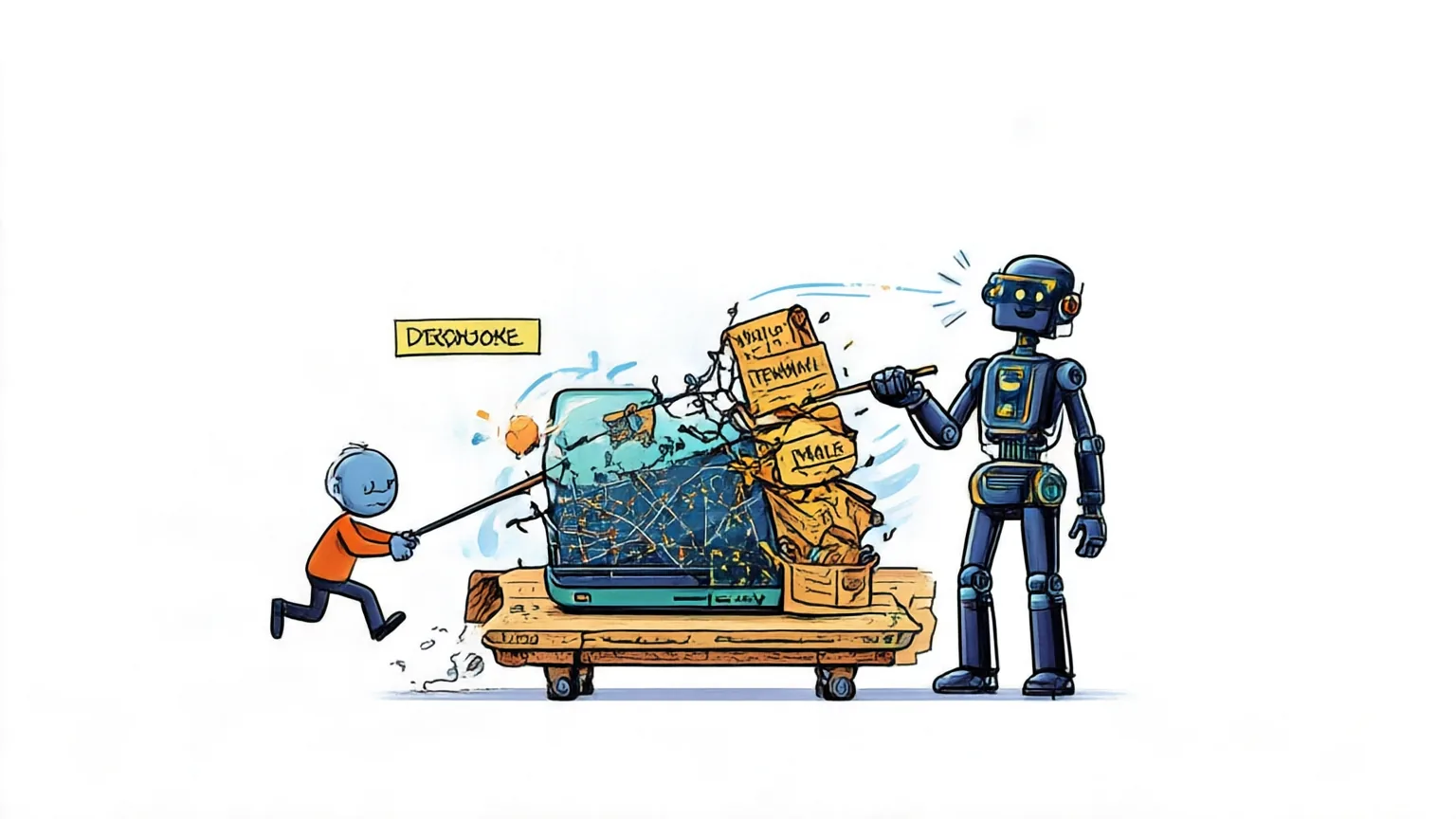
An AI that can run a command still has much to learn about finishing a job. TerminalHorizon builds practice tasks that require an agent to investigate, act, check its work and keep going. It also checks whether the task setup has already done work the agent should learn to do. The aim is to teach agents how to carry a demanding assignment through to a finished result.
- Problem: Short training examples show individual actions but miss how an agent learns from evidence over a longer job. Automatically built practice environments can make this worse by solving or simplifying the hard parts before the agent starts.
- New idea: TerminalHorizon is an automated system for building training tasks for agents that work through a computer terminal, a text interface for running commands. It uses separate attempts at the work to uncover steps that the task setup has removed. That evidence guides changes to the environment so the agent must do those steps itself. It then adds requirements that build on earlier results while keeping the overall goal the same.
- Simple example: Imagine a repair exercise where someone has already found the fault and loosened the broken part. TerminalHorizon aims to restore the missing work, then add follow-up requirements so the learner must test and improve the repair.
- Evidence: The authors built 1.5K task environments and used the resulting data to train Qwen3.5-27B, producing TerminalHorizon-27B. They report substantial gains on all 12 benchmarks, without giving individual scores in the abstract. Research case studies with a 12-hour budget each also showed continued experimentation and improvements carried into final deliverables.
- Limitation: The abstract gives no benchmark scores or separate tests showing how much each part of the task-building process contributes.
- Why it matters: Agents need practice with the full course of a job to learn how to finish work that requires investigation and revision.
- Paper: Scaling Agentic Data for Long-Horizon Terminal Intelligence
Multi-Stream Attention Residuals
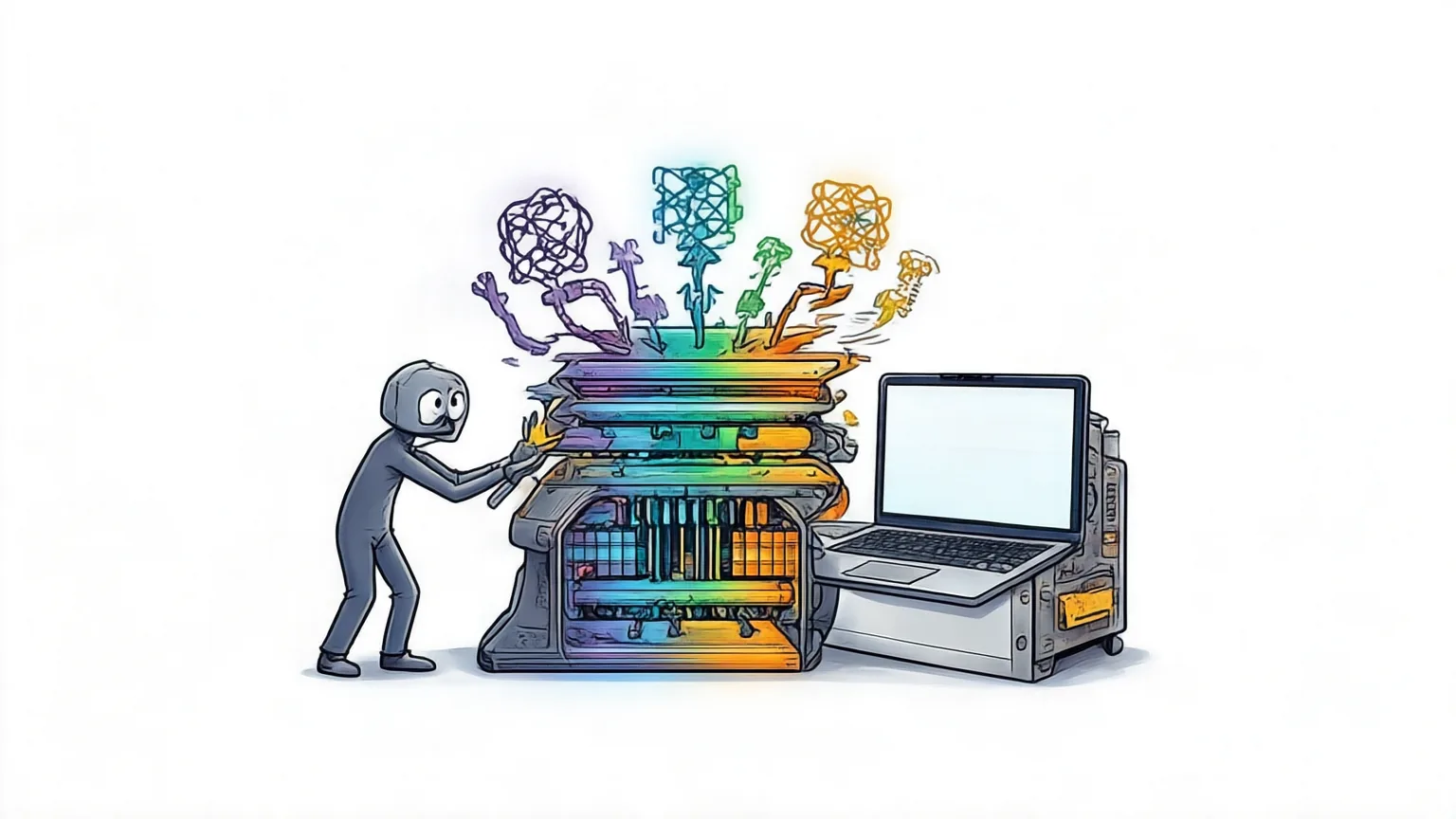
As an AI model processes information, later stages can draw on work done earlier. This paper introduces a way to give those stages several views of that earlier work. The method chooses and combines useful information without keeping a separate stored copy for every view. Its aim is to improve model performance with little extra computational cost.
- Problem: Attention Residuals lets a model select information from earlier processing layers, but uses a single retrieval stream. The paper asks whether several contextual views can improve that selection without the storage and communication costs of maintaining several streams throughout the model.
- New idea: Multi-Stream Attention Residuals, or MSAR, uses several attention heads, separate selectors that draw information from earlier layers. Each selector gets a different view through causal convolutions, operations that combine preceding sequence information over different spans. Adaptive mixing, a learned way of combining the selected information, produces one input for the next layer. The extra streams are created when needed rather than stored throughout processing.
- Simple example: Imagine reviewing earlier notes through several lenses: the nearby wording, a broader passage and the longer context. MSAR works like combining those readings into one set of working notes without keeping a permanent copy for every lens.
- Evidence: MSAR outperformed all compared residual methods on all 12 downstream benchmarks at both the 18B and 28B mixture-of-experts model scales. Scaling experiments reported a 1.58 times compute speedup at the same loss, a measure of prediction error, over standard residual connections. The corresponding figures were 1.35 times for Attention Residuals and 1.30 times for manifold-constrained Hyper-Connections.
- Limitation: The abstract does not give measured runtime or memory costs, so the reported compute advantage does not establish an equivalent reduction in elapsed training time.
- Why it matters: Better use of earlier processing could let models reach the same prediction quality with less computation.
- Paper: Multi-Stream Attention Residuals
GroundingPI: A Grounding Foundation Model towards Physical Intelligence with Visual Primitives
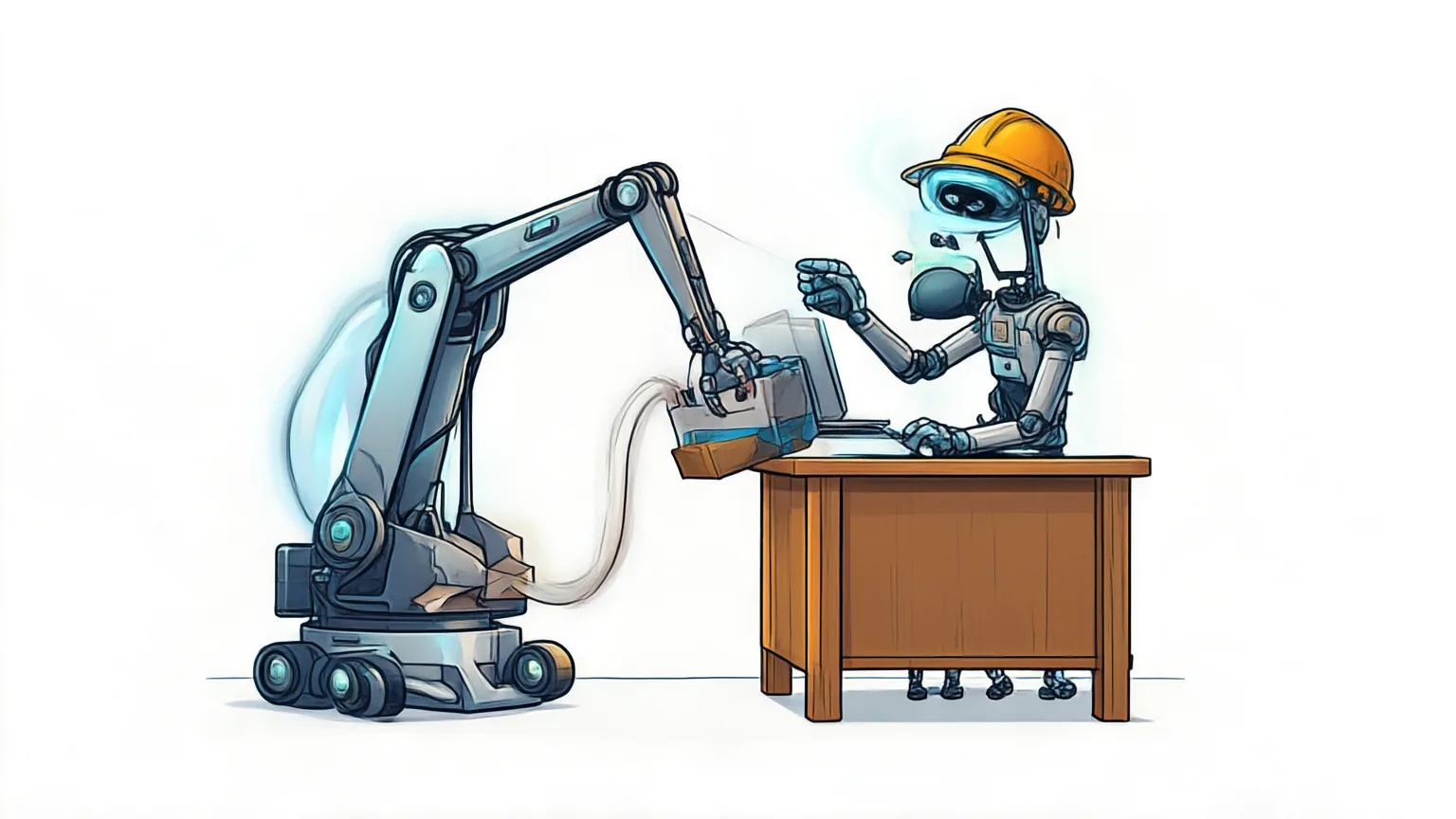
A robot needs to pick out the right object before it can act on it. GroundingPI trains an AI model to mark object locations directly in images. The work focuses on visual skills that general image and language models still struggle with, including finding small objects in crowded scenes. The authors test whether those skills also help robots and driving systems.
- Problem: Robots and driving systems need accurate object locations quickly enough to adjust their actions as new observations arrive. Their visual components often come from general image-language or video-generation models, which still struggle with clutter and tiny targets.
- New idea: GroundingPI is a 4B-parameter model for grounding, the task of identifying a target object and locating it in an image. It outputs points and boxes using quantized coordinates, positions encoded as discrete values in a shared set of output symbols. Training combines image, language and spatial learning with labeled examples and reinforcement learning, which uses rewards to guide improvement. The trained model can then serve as the visual component of a robot or driving system.
- Simple example: Imagine asking a robot to pick up a tiny object from a crowded table. GroundingPI's role is to mark which object you mean and where it is, giving the robot a visual target for its action.
- Evidence: Across 34 grounding benchmarks covering 11 perceptual capabilities, GroundingPI averaged 73.68% against 44 baselines, exceeding the larger GPT-6 Astra at 71.54%. On RoboTwin 2.0, it beat every evaluated mainstream visual backbone in all four out-of-distribution settings, with gains up to 24.8% relative to the strongest backbone. On RoboCasa-GR1, it used 50% of the demonstrations to outperform baselines trained with 75%. On nuScenes, it recorded an average open-loop L2 error, a distance-based error measure, of 0.296 m.
- Limitation: The abstract gives no timing results to establish whether the model is fast enough for continuous feedback control. Its reported driving error comes from an open-loop evaluation, which does not show how actions affect later observations.
- Why it matters: Learning to locate the right object precisely can improve the visual information that robots and driving systems use to act.
- Paper: GroundingPI: A Grounding Foundation Model towards Physical
Trending AI Repositories
Ranking source: GitHub Trending.
open-webui/open-webui
Open WebUI is a Python project for working with AI through a web interface. Its support for Ollama and the OpenAI API gives readers using either a reason to look.
- What it is: Open WebUI is a self-hosted AI interface that can be extended and supports Ollama and the OpenAI API.
- What it does: User-friendly AI Interface (Supports Ollama, OpenAI API, ...)
- Who it helps: It serves people using Ollama or the OpenAI API. They can use Open WebUI as an interface to those tools.
- Limitation: The supplied README excerpt gives no setup instructions or system requirements.
- Repository: open-webui/open-webui
microsoft/BitNet
BitNet is a C++ project presented in its README as bitnet.cpp. Links to a technical report and a Hugging Face collection give readers starting points for examining the work.
- What it is: bitnet.cpp is Microsoft's C++ inference framework for 1-bit language models.
- What it does: Official inference framework for 1-bit LLMs
- Who it helps: It is relevant to developers working with 1-bit language models. They can follow the README links to the technical report and Hugging Face collection.
- Limitation: The supplied README excerpt gives no hardware requirements or performance results for BitNet's language-model inference itself. Its performance claim concerns VibeASR.cpp.
- Repository: microsoft/BitNet
Sources
- 01Hugging Face Papers · Hugging Face Papers
- 02GitHub Trending · GitHub Trending
- 03OCP Summit 2026: Powering AI with Open Innovations in Scale-Up, Scale-Out, and Scale-Across Networks · Meta Engineering
- 04Accessing OpenAI GPT models on Amazon Bedrock with global cross-Region inference in Thailand, Malaysia, Singapore, Indonesia, and Taiwan · AWS Machine Learning
- 05Sakana AI's self-improving model gets better at solving and judging, but can't catch its own blind spots · The Decoder
- 06WindBorne wins a hefty US Air Force contract for its balloon data · TechCrunch
- 07Honeyjar offers AI tools to improve PR and comms at every company · TechCrunch
- 08Scaling Agentic Data for Long-Horizon Terminal Intelligence · arXiv
- 09Multi-Stream Attention Residuals · arXiv
- 10GroundingPI: A Grounding Foundation Model towards Physical Intelligence with Visual Primitives · arXiv