Small embeddings, lasting context and another batch of AI mathematics
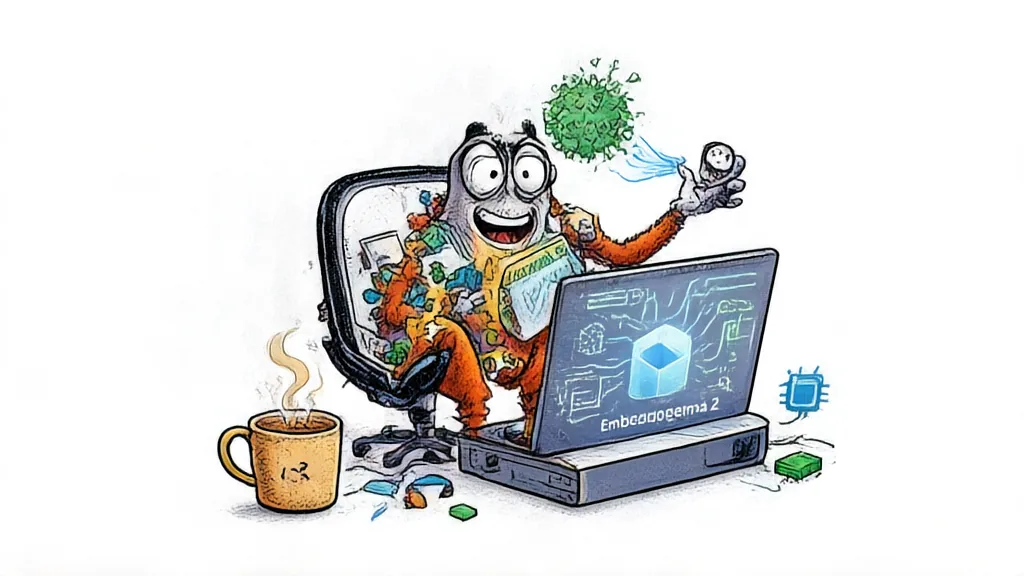
EmbeddingGemma 2 brings an open, lightweight model to multimodal embeddings. An AgentCore and OpenClaw tutorial builds an assistant with context. OpenAI releases another batch of mathematical breakthroughs.
News
EmbeddingGemma 2: an open, lightweight multimodal embedding model
Google DeepMind released EmbeddingGemma 2, a 740 million parameter model built on the Gemma 4 architecture. It maps text, code, images, video and audio into a shared embedding space for on-device retrieval. The release uses the Apache 2.0 license.
Memory and storage scale with the inputs you need
Text-only workloads require 270 million parameters, with optional encoders adding 170 million for vision and 300 million for audio. Output vectors start at 768 dimensions and can be truncated to 512, 256 or 128 dimensions. That provides up to a sixfold reduction in storage. With quantization on a Google Pixel 11 Pro, active RAM for weights is approximately 191MB for text-only use and 567MB for the full multimodal model. The model has an 8K-token context. That supports up to 5.5 minutes of audio, 29 images, 58 video frames or interleaved combinations. (Google DeepMind)
thinkidiot take: Text-only weights take approximately 191MB of active RAM in the reported quantized Pixel 11 Pro setup. I would start there for a local text retrieval project and add the vision or audio encoder when the inputs require it. The full multimodal setup raises that weight memory figure to 567MB, so input choices have a concrete cost. For my projects, that modularity matters more than loading every supported format from the start.
Building a context-aware AI assistant on AgentCore and OpenClaw
AWS Machine Learning published a tutorial for building a personal assistant with OpenClaw on Amazon Bedrock AgentCore runtime. It uses AgentCore memory to retain context across conversations. Chats become durable, structured knowledge that the assistant can retrieve using metadata filters.
An assistant that bills for active compute
The example is Sprout, a gardening assistant contained in one CloudFormation template. It deploys with one command and reportedly costs a few dollars monthly for light personal use. Telegram webhooks and Amazon EventBridge Scheduler jobs both invoke it through the InvokeAgentRuntime API. The example specifies Claude Haiku 4.5 for text and Claude Sonnet 4.5 for vision, or equivalents available in the user's account. AgentCore runtime bills for active compute rather than wall-clock uptime. Time spent waiting for I/O, including model responses, is excluded. (AWS Machine Learning)
thinkidiot take: AgentCore excludes time spent waiting for model responses from its runtime compute billing. I would use the Sprout template to test whether metadata filters bring back the right gardening records across conversations. That puts a concrete retrieval task alongside the reported light-use cost of a few dollars monthly. For a personal assistant, I value relevant recall more than the convenience of deploying it with one command.
OpenAI drops another batch of mathematical breakthroughs
OpenAI released 722 mathematical manuscripts produced by an unreleased frontier model. They cover 372 result families that group related papers. The Advisory Group on Mathematics and Artificial Intelligence says the release includes solutions to hundreds of open questions.
Disclosure standards meet a large manuscript release
The release includes some reasoning summaries, compute estimates and statistics on how many problems were attempted. OpenAI claims the average result used compute equivalent to three hours of ChatGPT Pro thinking. It is publishing the results in a GitHub repository. The repository includes protocols for paper revisions and citations. AGMAI's late-September recommendations call for disclosure of model names, prompts and compute costs. They also discourage using mathematical releases as model marketing. (The Verge)
thinkidiot take: The 722 manuscripts come from a frontier model that has not been released. I would start with the repository's reasoning summaries and revision protocols when examining a result. Those materials support scrutiny of the papers, but they do not give me the model to run. I put more weight on inspectable results and clear disclosures than on the size of the batch.
Ex-Ramp engineers raise $20M for platform Melius after scrapping their first product
Melius announced $25 million in total funding. That comprises a $20 million Series A led by CRV and a $5 million seed round led by General Catalyst. Its replacement platform generates ad campaigns, images and videos from plain-language ideas.
From managing ad spend to making the ads
Co-founders Joowon Kim, Young Kim and Arnav Ramu previously worked together as engineers at Ramp. They spent more than six months building an AI performance-marketing tool. That product focused on helping marketers manage and optimize ad spend. The founders discarded its entire codebase before changing direction. Melius emerged from stealth in July and claims it exceeded $1 million in annualized revenue within two months. (TechCrunch)
thinkidiot take: The founders discarded an entire codebase after more than six months of work. I would judge the replacement by turning a plain-language idea into a campaign and inspecting its images and videos. The reported annualized revenue gives the new direction a commercial result, but it does not show me the quality of those assets. For me, the output deserves more weight than either the funding or the drama of starting over.
How AI decision models could change content moderation
Musubi announced PolicyLM-1.7B on October 6, 2026. It released the lightweight model with open weights. The model is built for real-time content moderation.
Policy changes without another training run
PolicyLM-1.7B is designed to apply plain-English content policies to messages in under 50 milliseconds. It is designed to handle complex policies without special training. Changes to those policies do not require retraining, according to the model's stated design. Its output is a binary judgment of whether content belongs to a category. Musubi says developers can run the model themselves. (TechCrunch)
thinkidiot take: PolicyLM-1.7B is designed to accommodate policy changes without retraining. I would test that by revising a plain-English policy and comparing its binary judgments on the same messages. That directly examines the promised ability to change the rules without another training run. For my evaluation, following those revisions matters more than the stated response time of under 50 milliseconds.
Trending AI Papers
Ranking source: Hugging Face Papers for 2026-10-07.
DuoMatching: Joint-Marginal Distribution Matching for Few-Step Video Generation
DuoMatching aims to make generated videos look better and follow instructions more closely. It trains a video model with help from both a video generator and an image generator. The video generator guides how frames work together, while the image generator helps improve individual pictures. The aim is to gain clearer, better composed scenes while keeping movement intact.
- Problem: Existing training methods use a video generator to teach a video model how sequences of frames should fit together. This helps prevent the video from going off course as it continues, but leaves weaknesses in picture quality and how well the content matches the request.
- New idea: DuoMatching combines guidance on whole video sequences with separate guidance on individual frames. An image teacher, a model that generates images, supplies the frame guidance. LatentBridge translates between the internal visual representations used by that teacher and the video model being trained. Latent Variation Sampling spreads the image guidance across different parts of the video to avoid repeatedly teaching similar frames.
- Simple example: Think of a film student learning from both a director and a photographer. The director helps the sequence hold together, while the photographer helps improve selected shots throughout the film.
- Evidence: People evaluating the videos preferred DuoMatching over each tested baseline more than 80% of the time. Experiments also report better visual quality, composition, and agreement with the requested content, with movement largely preserved.
- Limitation: The abstract says movement is largely preserved, but does not quantify what motion quality is lost.
- Why it matters: Learning from image generators could help video models produce better pictures without giving up coherent movement.
- Paper: DuoMatching: Joint-Marginal Distribution Matching for
HuatuoGPT-3: RL-Only Domain Adaptation from Base Models
HuatuoGPT-3 explores how to teach a general language model medical skills through reward-based training. Its training method uses another model's answers as temporary help. It gives extra attention to useful parts of those answers early on, then removes the guidance when the learner can do better. The aim is to build medical models through a simpler training process.
- Problem: The usual approach first trains a model to copy example answers and then trains it through rewards, adding complexity and potentially narrowing what it explores. Reward-based training alone struggles to get started. Adding a teacher helps, but the learner can absorb useful details too slowly and later become held back by the teacher's old answers.
- New idea: One-stage Policy Optimization, or OnePO, trains a model through rewards while treating another model's answers as temporary guidance. Adaptive Objective Evolution changes the training objective to emphasize useful parts of teacher answers that the learner would otherwise be unlikely to produce. Teacher Retirement removes teacher answers once the learner can outperform them. Together, these mechanisms aim to provide early help without letting that help limit later progress.
- Simple example: Think of a trainee studying an instructor's worked examples. Early lessons focus on useful details the trainee keeps missing. Once the trainee can produce better answers, those examples stop guiding the practice.
- Evidence: With 20K training samples, OnePO scores 67.2 on HealthBench (Total), beating supervised training followed by reinforcement learning by 2.7 points and pure reinforcement learning by 7.4 points. The resulting HuatuoGPT-3 model with 27 billion parameters scores 70.1 on HealthBench (Total) and 71.4 on HealthBench Professional. The abstract reports that it surpasses frontier models including GPT-6 Astra.
- Limitation: The abstract reports medical benchmark scores, but gives no evidence of safety or effectiveness in patient care.
- Why it matters: Temporary teacher guidance could make medical model training simpler while improving measured performance.
- Paper: HuatuoGPT-3: RL-Only Domain Adaptation from Base Models
AutoSciBench: Autonomous Benchmark Generation for Evaluating Scientific Agents
AutoSciBench builds and revises tests for AI systems that tackle scientific tasks. It watches how those systems solve questions and uses the feedback to improve the tests. When a question allows a shortcut, it changes the task to demand closer work with the evidence. The aim is to keep tests useful as the systems become more capable.
- Problem: Tests lose their ability to reveal weaknesses when capable systems can solve too many of their questions. Creating fresh scientific tests takes time, labor, and specialist knowledge, making regular updates difficult.
- New idea: AutoSciBench describes each task with a concept, which sets the scientific field, type of data, and reasoning needed, and a recipe, which specifies how to build and check the question, working environment, and correct answer. It uses records of attempted solutions and evaluator feedback to revise either part when shortcuts appear. Those revisions push tasks toward checking original data, interpreting partial results, and combining evidence. Lessons from earlier revisions also guide the creation of new task concepts.
- Simple example: Imagine a teacher noticing that students can answer a science worksheet by spotting clues in the wording. The teacher rewrites it so students must inspect the data and explain how the evidence supports their answer, then uses that lesson when writing the next worksheet.
- Evidence: Compared with human-curated tests, generated tests lower average solver accuracy by 22.4 percentage points in computational biology and 25.5 percentage points in materials science. Generated tasks also receive higher average quality ratings in all three tested fields: computational biology, materials science, and clinical imaging.
- Limitation: The abstract does not establish whether the tests remain useful through repeated updates as scientific AI systems improve.
- Why it matters: Automatically revising scientific tests could help reveal weaknesses that existing tests stop catching.
- Paper: AutoSciBench: Autonomous Benchmark Generation for
Trending AI Repositories
Ranking source: GitHub Trending.
morluto/rea
REA provides one MCP for investigating binaries, applications and runtime behavior. It connects the question of how a feature works with inspection at the binary level.
- What it is: This TypeScript project sits at the MCP interface for reverse engineering work.
- What it does: Reverse engineer anything with agents, from app behavior down to native binaries.
- Who it helps: It helps developers investigating features they want to understand. They can examine application behavior and the binaries behind it.
- Limitation: The supplied excerpt does not specify which binary formats or platforms it supports.
- Repository: morluto/rea
deepseek-ai/DeepGEMM
DeepGEMM brings several core computations for modern large language models into one CUDA codebase. DeepJIT compiles its kernels at runtime, removing the need for CUDA compilation during installation.
- What it is: DeepGEMM provides GPU computation kernels for large language models.
- What it does: DeepGEMM: clean and efficient BLAS kernel library on GPU
- Who it helps: It helps developers working on large language model computation. They can use FP8, FP4 and BF16 GEMMs alongside fused MoE with overlapped communication.
- Limitation: Kernel compilation still happens at runtime through DeepJIT.
- Repository: deepseek-ai/DeepGEMM
cathrynlavery/diagram-design
Diagram Design is a project for making editorial diagrams with coding assistants. It gives that work an explicit visual direction, including a rule against shadows.
- What it is: The project provides 42 diagram types for coding assistants and produces self-contained HTML and SVG.
- What it does: Editorial diagram design for Claude Code, Codex, GitHub Copilot, Factory Droid, and Pi. 42 diagram types. Self-contained HTML + SVG. No shadows. No Mermaid slop.
- Who it helps: It helps people using coding assistants to create diagrams. They can work with a supplied range of diagram types in HTML and SVG.
- Limitation: The supplied excerpt does not explain how to install or invoke it.
- Repository: cathrynlavery/diagram-design
Sources
- 01Hugging Face Papers · Hugging Face Papers
- 02GitHub Trending · GitHub Trending
- 03EmbeddingGemma 2: an open, lightweight multimodal embedding model · Google DeepMind
- 04Building a context-aware AI assistant on AgentCore and OpenClaw · AWS Machine Learning
- 05OpenAI drops another batch of mathematical breakthroughs · The Verge
- 06Ex-Ramp engineers raise $20M for platform Melius after scrapping their first product · TechCrunch
- 07How AI decision models could change content moderation · TechCrunch
- 08DuoMatching: Joint-Marginal Distribution Matching for Few-Step Video Generation · arXiv
- 09HuatuoGPT-3: RL-Only Domain Adaptation from Base Models · arXiv
- 10AutoSciBench: Autonomous Benchmark Generation for Evaluating Scientific Agents · arXiv
Join the Idiots
New lab every Sunday. No spam, unsubscribe anytime.