Pentagon plugs ChatGPT and Grok in, Apple fights a data thief, and whisper gets its memory b
Get this by email →
The US military wires three frontier AI chats into one official portal. Apple shows off evidence against an ex-employee for stealing parts for OpenAI. Researchers fix a blind spot in long-form transcription, and a new game algorithm drops old performance ceilings.
News
Connect an AgentCore Runtime hosted MCP server to Amazon Quick
AWS published an integration pattern for AgentCore Runtime to host MCP servers and connect them to Amazon Quick. The system standardizes access to files, databases, and APIs for foundation models. Amazon Quick uses these integrations to perform autonomous execution, real-time data access, and sub-agent routing. Clients can now reuse pre-built tools and agents instead of recreating them for each new project.
Managed serverless hosting for AI tool access
Amazon Quick functions in both a web browser and a desktop app that supports chat or flows. AgentCore Runtime provides session isolation, extended execution time, and persistent file systems. Inbound authentication runs through Amazon Cognito, though it accepts another identity provider as well. Outbound machine-to-machine authentication relies on AgentCore Identity. This service was purpose-built for AI agents. (AWS Machine Learning)
thinkidiot take: The sharpest consequence here is the elimination of duplicated tool authoring. I would drop a standard MCP server in front of every internal model so everyone uses the exact same endpoints for data access. This kills the shadow-IT problem that usually follows a new foundation model rollout. AWS is finally treating the agent-to-tool boundary as a real infrastructure layer rather than an afterthought.
Context-Aware Interleaved Batching for WhisperX
A paper submitted on August 31, 2026 introduced Context-Aware Interleaved Batching for WhisperX. Standard Whisper processes context sequentially, which leads to slow inference and hallucination loops. WhisperX speeds things up with intra-audio batching, but it isolates segments and loses historical context. The new algorithm stabilizes Whisper text conditioning to maintain continuous history across batched segments.
Fixing a blind spot in long-form transcription
The approach uses VAD-derived segment boundaries to maintain continuous historical context. This prevents the transcript from losing coherent punctuation and terminology. The authors tested the system on long-form audio benchmarks. The results show a reduction in Word Error Rate. The system also improves transcription of proper nouns. It maintains high-throughput inference speeds. (arXiv)
thinkidiot take: Reducing Word Error Rate on long-form audio is a massive win for anyone building accessible media pipelines. I would immediately swap my current isolated-segment batching for this context-aware approach on my podcast archives. The hallucination loop in standard Whisper costs hours of manual cleanup. A deterministic fix for proper nouns is exactly the kind of engineering win the transcription space needs.
Constant Individual Regret in General Games
A paper submitted on August 31, 2026 introduced ECHO-OFTRL to eliminate polylogarithmic horizon dependence in individual regret. The algorithm applies to finite N-player normal-form games using full-information feedback. It relies on optimistic follow-the-regularized-leader with an EMA cascade for high-order optimism. ECHO is deterministic and fully uncoupled.
Dropping the performance ceiling on game theory
Previous guarantees for individual regret kept a polylogarithmic dependence on the horizon. ECHO removes this dependence entirely. If m_max is the largest action-set size, the algorithm guarantees each player a specific regret bound. This bound is represented as O(poly(N, log m_max)). The guarantee holds simultaneously for every horizon T greater than or equal to 1. The system maintains performance without needing to know the horizon in advance. (arXiv)
thinkidiot take: Removing the horizon dependence changes how I would approach decentralized market making. I would run this exact algorithm in live order books where trade volume dictates the true horizon. Past guarantees forced engineers to overestimate the time window, which degraded performance. Dropping that requirement is a major leap for practical application.
Apple shares ‘shocking evidence’ against former employee accused of stealing company data for OpenAI
Apple presented evidence against a former employee for destroying data after learning of an investigation. The employee, identified as Liu, used a confidential Apple circuit schematic at OpenAI. He enlisted colleague Yu-Ting Peng to help destroy evidence in June. Apple claims Liu maintained access by exploiting a rare, previously unknown authentication bug.
Evidence destruction and the bug that kept the door open
More than 400 former Apple employees now work at OpenAI. Apple stated the defendant provided a limited amount of information only after several weeks of delay. Apple emphasized that its request for evidence was not a fishing expedition. Apple maintains that its trade secrets are actively being used. The company added that evidence is being actively destroyed. This situation highlights the scale of the data transfer between the two firms. (TechCrunch)
thinkidiot take: The sharpest consequence of this leak is the confirmation that a former employee used confidential circuit schematics at a major competitor. If I ran a company, I would audit every single authentication exception that occurred in the last three months. Losing a critical part of my IP base to a direct rival is a catastrophic failure of the security model. The authentication bug that kept the door open is exactly the kind of exploit that justifies stricter zero-trust mandates.
The Pentagon now has its own version of ChatGPT and Grok
The Pentagon added ChatGPT Mil and Grok for Government to the GenAI.mil portal. This gives 3 million civilian and military personnel access to generative AI tools tailored to warfighter needs. The portal now includes versions of OpenAI and xAI products alongside Google Gemini. The system provides access to commercial frontier models without routing sensitive government data through consumer channels.
Three rival AI fronts converge in one secure military portal
GenAI.mil has onboarded more than 1.7 million unique users since its launch. The portal was built to keep data away from ordinary consumer network channels. ChatGPT Mil supports chat, files, projects, and custom GPTs. Grok for Government is designed to provide immediate productivity gains. It also aims to offer stronger knowledge continuity and more efficient collaboration. The Pentagon has centralized these commercial tools in one secure environment. This setup removes the risk of relying on standard consumer apps for sensitive work. (TechCrunch)
thinkidiot take: Onboarding 1.7 million unique users on a single secure portal is a massive operational milestone. I would demand immediate benchmarking of response latency on these military networks to ensure the models are running smoothly. The convergence of OpenAI and xAI tools in a government environment shows how deeply these systems have integrated into national infrastructure. Treating consumer-grade chatbots as critical military infrastructure is a high-stakes bet that demands rigorous oversight.
Trending AI Papers
Ranking source: Hugging Face Papers for 2026-09-01.
Does On-Policy Distillation Really Distill? From Noisy Teacher to Self-Improvement
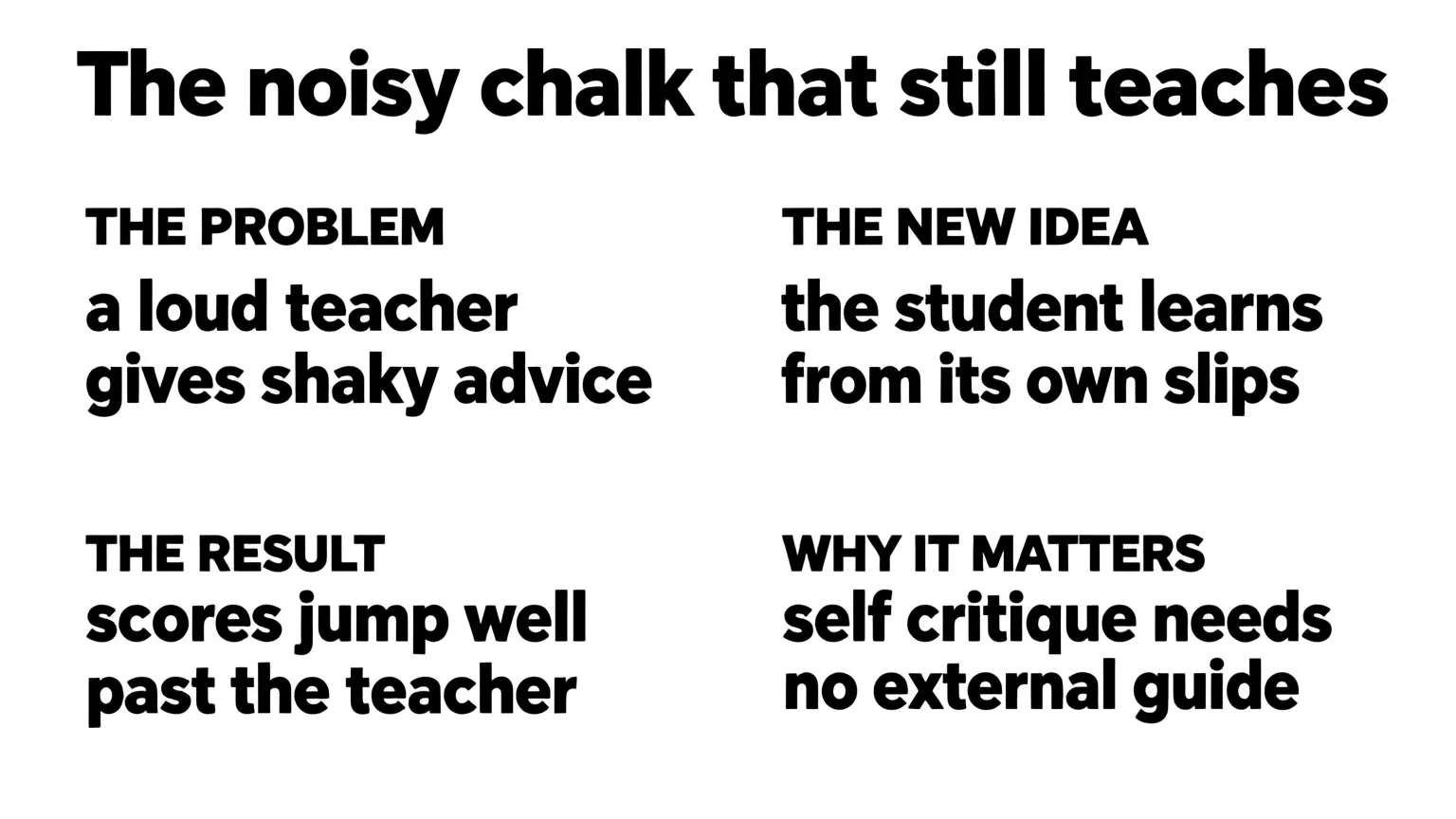
This paper asks whether a student model really needs a teacher during on-policy distillation. It studies the signals that guide learning and finds that many of them are noisy. The authors then propose a way for the student to improve without teacher supervision.
- Problem: In on-policy distillation, a teacher scores text produced by the student, even though that text does not come from the teacher's own behavior. Those scores contain substantial noise, and the noise becomes more common as the teacher grows larger, leaving the source of the student's gains unclear.
- New idea: The authors find that learning mainly changes tokens the student initially considers unlikely. A fixed negative advantage, meaning a signal that pushes probability away from selected tokens, works as well as the teacher's scores. Their method, On-Policy Self-Adaptation, uses entropy, a measure of uncertainty among possible next tokens, to make that push stronger at uncertain positions. It reduces unlikely tail tokens and shares their probability more evenly among likely head tokens.
- Simple example: Imagine editing a draft by crossing out awkward word choices whenever you feel unsure, then giving the freed space to the more natural options. You can improve the draft without asking another writer to score every word.
- Evidence: Against the base Qwen3-1.7B, the method raises Avg@32 on AIME24 by 35.41 points, a 263% relative gain. It more than doubles Pass@32 on all three benchmarks and beats on-policy distillation by 16.77 Avg@32 points on AIME24.
- Limitation: The abstract does not report whether the method works on larger models or in open-ended settings where answer quality cannot be checked easily.
- Why it matters: The work suggests that some gains credited to a teacher may come from a simple form of self-correction instead.
- Paper: Does On-Policy Distillation Really Distill? From Noisy
PaperGym: Rubric-Centered Evolution for Research-Plan Generation
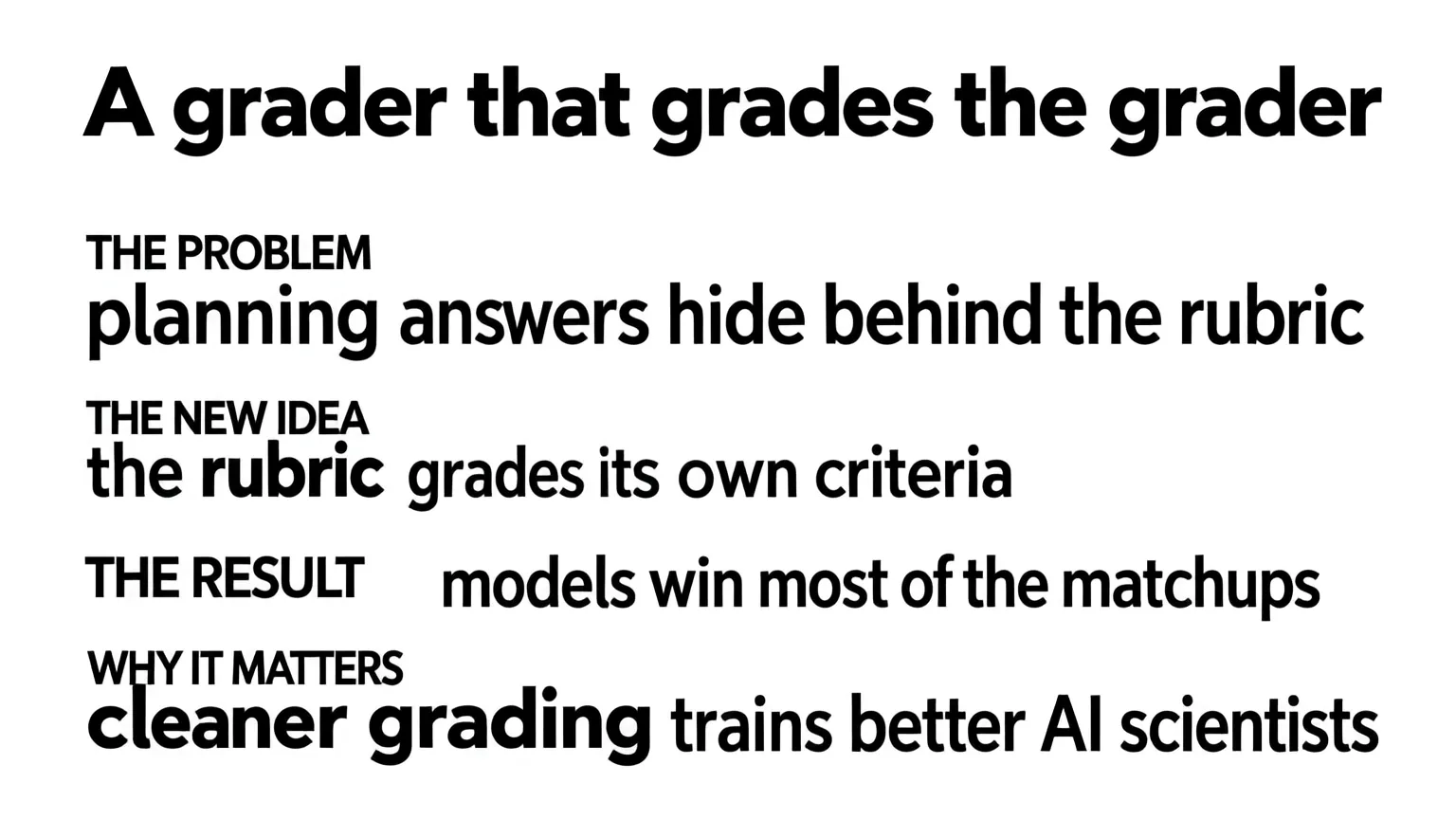
PaperGym turns published research papers into practice environments for models that write research plans. It separates the problem a model sees from the standards used to judge its answer. The goal is to teach stronger planning without letting models succeed by merely restating source material.
- Problem: Research plans have no single answer that can be checked automatically, so reinforcement learning needs another way to judge them. Existing datasets often derive both the prompt and its grading criteria from the same material, which rewards paraphrasing, then reduce the detailed criteria to one score.
- New idea: PaperGym builds a training environment from each paper. It creates the question from the paper's goal and background, while its rubric, meaning a set of grading criteria, comes from the methods and experiments. The rubric first guides a self-teacher, meaning the model uses hidden grading information to produce training guidance. It then becomes the reward for GRPO, a reinforcement-learning stage that improves responses according to those criteria.
- Simple example: It is like asking a student to design a science project from its motivation, then grading the plan with a checklist drawn from how the project was actually carried out. The student cannot earn full marks by copying the question.
- Evidence: Criterion leakage is 3.7%, compared with 11.90% to 34.10% in existing datasets. Across Qwen3-1.7B, Qwen3-4B, and Qwen3-8B, the training schedule improves five-benchmark averages by 5.6, 5.0, and 4.8 points. PaperGym-20k models win 58.1% of three-way comparisons, versus 28.2% for RubricHub Science, and the trained Qwen3-8B scores 73.48 on ResearchQA, above Kimi K2.6.
- Limitation: The abstract does not show whether plans that score well under paper-derived rubrics lead to successful new research in practice.
- Why it matters: Better grading environments could help models learn to design research instead of simply rephrasing it.
- Paper: PaperGym: Rubric-Centered Evolution for Research-Plan
Scaling Large Reasoning Models beyond Human Supervision: A Path toward Superintelligence
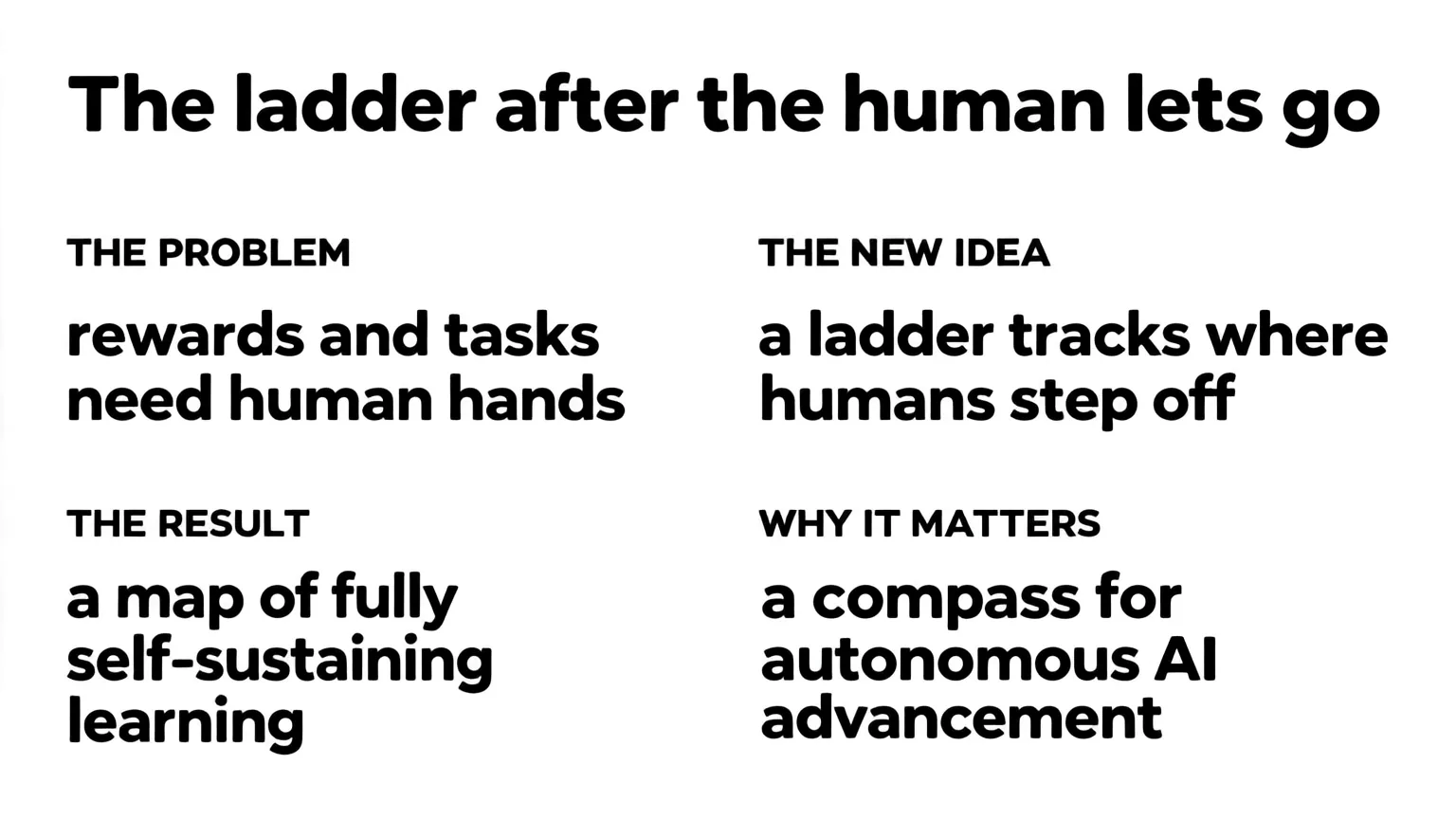
This paper maps how reasoning models might keep learning as direct human oversight decreases. It focuses on both the signals that judge model behavior and the experiences from which models learn. The aim is to organize current methods, risks, and unanswered questions around increasingly autonomous training.
- Problem: Automatically checked rewards work well for mathematics and code, but open-ended and agentic work is harder to judge reliably. Human reviewers cannot match the volume or complexity of experience generated by models, while autonomous alternatives can introduce new failures.
- New idea: The paper organizes the field along two axes. The reward axis tracks who or what judges an answer, from individual human judgments to reusable checkers and rewards that work without human feedback. The experience axis tracks where training situations come from, moving from human-made tasks toward model-created curricula and environments. A five-level ladder from L0 to L4 records how much of the learning process remains under continuing human control.
- Simple example: Imagine an apprentice who first follows exercises chosen and graded by a teacher. Later, the apprentice writes the exercises, builds the workshop, and grades the results, so evaluation must cover the work, the grading system, and the practice environment.
- Evidence: The paper presents a five-level ladder from L0 to L4 and an evaluation scheme covering three objects: policy capability, feedback fidelity, and experience quality. The abstract reports no experimental performance results.
- Limitation: The work is a structured analysis rather than evidence that a self-sustaining learning system can improve safely without human supervision.
- Why it matters: A clear map of control and failure points can guide work on models that learn with less human involvement.
- Paper: Scaling Large Reasoning Models beyond Human Supervision: A
Trending AI Repositories
Ranking source: GitHub Trending.
jingyaogong/minimind
MiniMind is a Python project for building a small language model from the ground up. It is worth a look for readers who want a compact, practical route into language model training.
- What it is: It is an open source training project for a small language model. It sits at the hands-on learning end of the LLM ecosystem.
- What it does: 🧠 Train a 64M-parameter LLM from scratch in just 2h!
- Who it helps: It helps developers and learners explore how language models are built. They can work through the training process in Python.
- Limitation: Training still requires suitable computing resources and Python experience.
- Repository: jingyaogong/minimind
Osmantic/ODS
ODS is the Osmantic Deployment System, a private AI server project for personal computers and homelabs. It matters because it aims to make local AI setup feel approachable rather than specialist work.
- What it is: It is an Apache 2.0 licensed deployment system. It sits between local hardware and private AI applications.
- What it does: Turn your PC, Mac, or Linux box into an AI server. LLM inference, chat UI, voice, agents, workflows, RAG, and image generation.
- Who it helps: It helps PC, Mac, and Linux users run AI services on hardware they control. Homelab users can bring several AI capabilities together in one local setup.
- Limitation: It requires a PC, Mac, or Linux machine capable of running the chosen AI workloads.
- Repository: Osmantic/ODS
zhaoxuya520/reverse-skill
reverse-skill is a PowerShell-based cybersecurity skills router for AI coding clients. It is worth attention for bringing security-focused workflows into tools developers already use.
- What it is: It is a cybersecurity router pack with a self-managed toolchain and knowledge base. It sits alongside AI coding clients such as Claude Code, Kiro, Cursor, and Cline.
- What it does: Reverse Engineering / Authorized Penetration Testing / Security Research Skill Router Pack AI-powered routing + On-demand toolchain bootstrapping + Self-evolving knowledge base Supports Claude Code, Kiro, Cursor, Cline, and other AI coding clients 逆向/渗透/安全技能路由包 - AI 自动路由 + 按需自举工具链 + 自动进化经验库 | 支持 Claude Code / Kiro / Cursor / Cline 等代码 AI 客户端
- Who it helps: It helps reverse engineers, authorized penetration testers, and security researchers. They can organize security tasks through supported AI coding clients.
- Limitation: It is intended for authorized security work and requires a supported AI coding client.
- Repository: zhaoxuya520/reverse-skill
Sources
- 01Hugging Face Papers · Hugging Face Papers
- 02GitHub Trending · GitHub Trending
- 03Connect an AgentCore Runtime hosted MCP server to Amazon Quick · AWS Machine Learning
- 04Context-Aware Interleaved Batching for WhisperX · arXiv
- 05Constant Individual Regret in General Games · arXiv
- 06Apple shares ‘shocking evidence’ against former employee accused of stealing company data for OpenAI · TechCrunch
- 07The Pentagon now has its own version of ChatGPT and Grok · TechCrunch
- 08Does On-Policy Distillation Really Distill? From Noisy Teacher to Self-Improvement · arXiv
- 09PaperGym: Rubric-Centered Evolution for Research-Plan Generation · arXiv
- 10Scaling Large Reasoning Models beyond Human Supervision: A Path toward Superintelligence · arXiv