ML 7: The Blind Hiker (Gradient Descent)
Gradient descent is just a blind hiker walking downhill. Understand how every neural network on Earth learns, in 3 minutes, with zero calculus required.
🎮 Play with this: The Blind Hiker, Gradient Descent Playground. Drag the ball, change the function, and break things on purpose.
The Root of All Learning
How does a Neural Network actually "learn"? How does the Line in Linear Regression find the perfect angle?
It uses Gradient Descent.
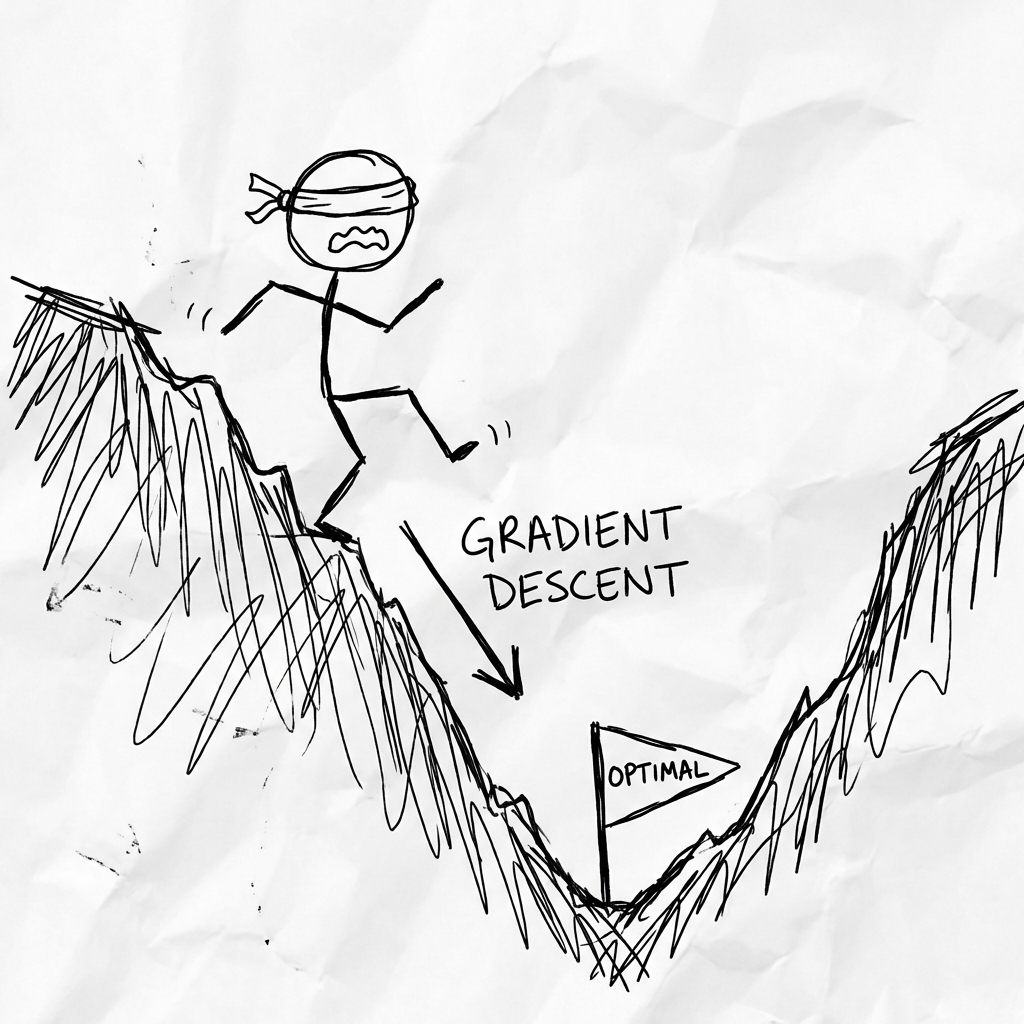
The Mountain Analogy
Imagine:
- You are on a mountain.
- You are blindfolded.
- You want to reach the bottom (the lowest error).
How do you do it? You feel the ground with your foot.
- If it slopes down to the left, you step left.
- If it slopes down to the right, you step right.
You take a small step (Learning Rate). Then you repeat. Step by step, you descend until you hit the valley.
The Learning Rate (Step Size)
- Too Big: You take a giant leap. You might jump over the valley and land on the other side. You bounce back and forth forever.
- Too Small: You take microscopic baby steps. It takes 10,000 years to reach the bottom.
- Just Right: Goldilocks.
The Math (Scary but simple)
The "Slope" is the Gradient (Derivative).
Cost Function C = How wrong your model is.
We want to minimize C.
New Weight = Old Weight - (Learning Rate * Slope)
If slope is positive, we go negative (downhill). If slope is negative, we go positive (downhill).
The Code (Concept)
Usually libraries handle this, but you can write it yourself:
weight = 0.5
learning_rate = 0.01

for step in range(100):
   gradient = compute_derivative(weight) # Math magic
   weight = weight - (learning_rate * gradient)
Local Minima (The Trap)
Sometimes you hit a small valley (pothole) and think you are at the bottom. But the real bottom is miles away. This is a Local Minimum. Advanced optimizers (like Adam) have momentum, like a heavy ball rolling down, to help jump out of small potholes and keep going.
Summary
Gradient Descent is just trial and error with a sense of direction. It is the engine inside ChatGPT, AlphaGo, and pretty much everything else.
Next up: The student who studies too hard.