ML 6: The Mean Girls (K-Means Clustering)
Sorting things when you have absolutely no idea what they are.
Unsupervised Learning
So far, we've had a cheat sheet. We knew which dots were "Dogs" and which were "Wolves". This is called Supervised Learning.
But what if you just have a bucket of Legos? No labels. No instructions. Just chaotic plastic.
You start grouping them yourself:
- "These are red."
- "These are blue."
- "These are weird tiny heads."
This is Clustering. And the most famous algorithm is K-Means.
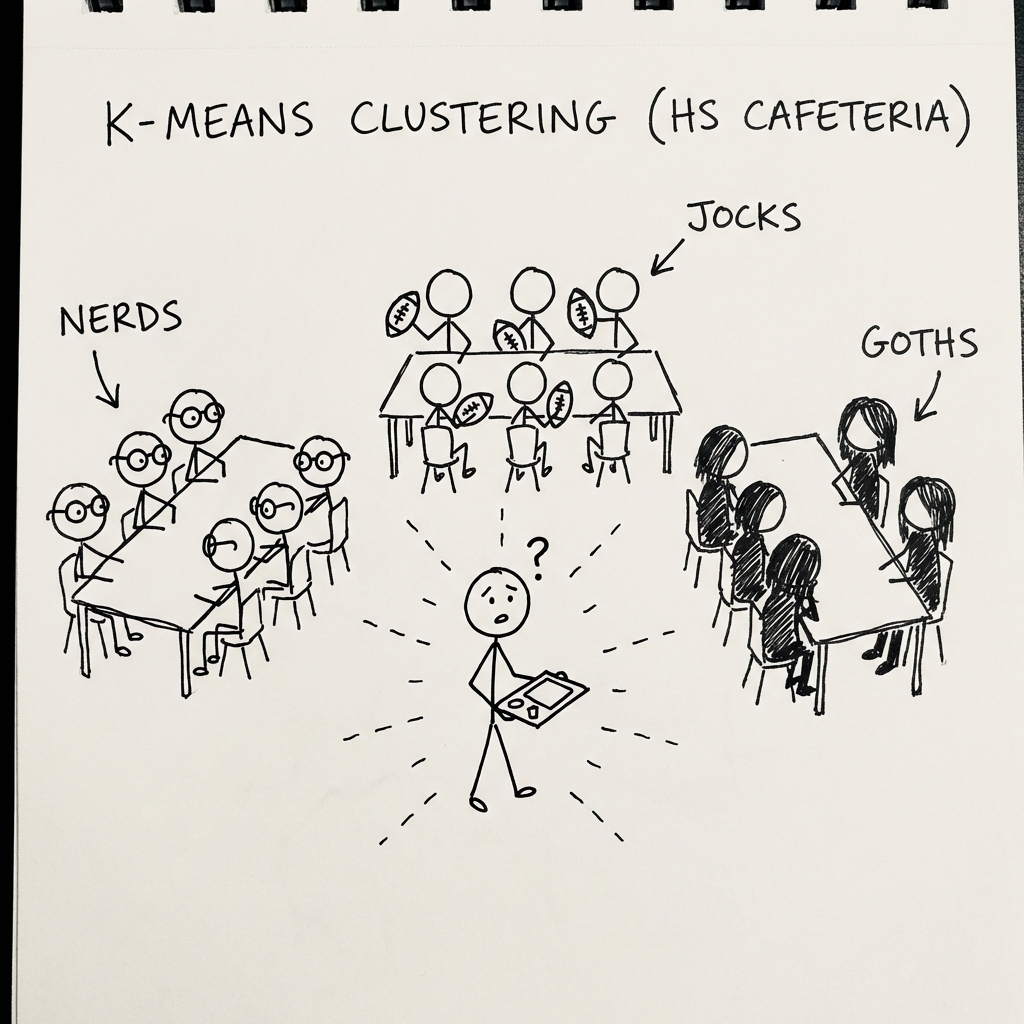
How K-Means Works
Imagine a high school cafeteria.
- Selection: You pick
Krandom tables (centroids). Let's say K=3 (Jocks, Nerds, Goths). - Assignment: Every student sits at the table they are most similar to.
- Update: The "center" of the table shifts to be indeed in the middle of everyone sitting there.
- Repeat: People move tables if the center shifts away from them.
- Eventually, everyone settles down.
Interactive Demo: The Party Mixer
You have to tell the algorithm K (how many groups you want).
- K=2: Two big blobs.
- K=10: Ten tiny cliques.
The Code (Python)
from sklearn.cluster import KMeans

# 1. The Sorter
# n_clusters=3 means we want 3 groups
kmeans = KMeans(n_clusters=3)

# 2. Fit (Notice we only give X, no y!)
# The model doesn't know the answers. It finds them.
kmeans.fit(X_data)

# 3. Get the labels
groups = kmeans.labels_
# Output: [0, 1, 0, 2, 1, ...]
The Problem
How do you choose K? If K is too small, everything is mashed together. If K is too big, every person is their own group. There is a method called the "Elbow Method" to find the best K, but honestly, often you just guess and see what looks pretty.
Summary
K-Means is like organizing a messy room by throwing similar things into piles. It doesn't know what the pile is (it won't label it "Socks"), but it knows they belong together.
Next up: The engine that powers almost all modern ML. The Blind Hiker.