ML 4: The 20 Questions (Decision Trees)
How to make decisions like a toddler asking 'Why?' repeatedly.
The Akinator
Remember that game "20 Questions"? "Is it a person?" -> Yes. "Is he alive?" -> No. "Is he a scientist?" -> Yes. "Is it Einstein?" -> Yes.
That is literally a Decision Tree.
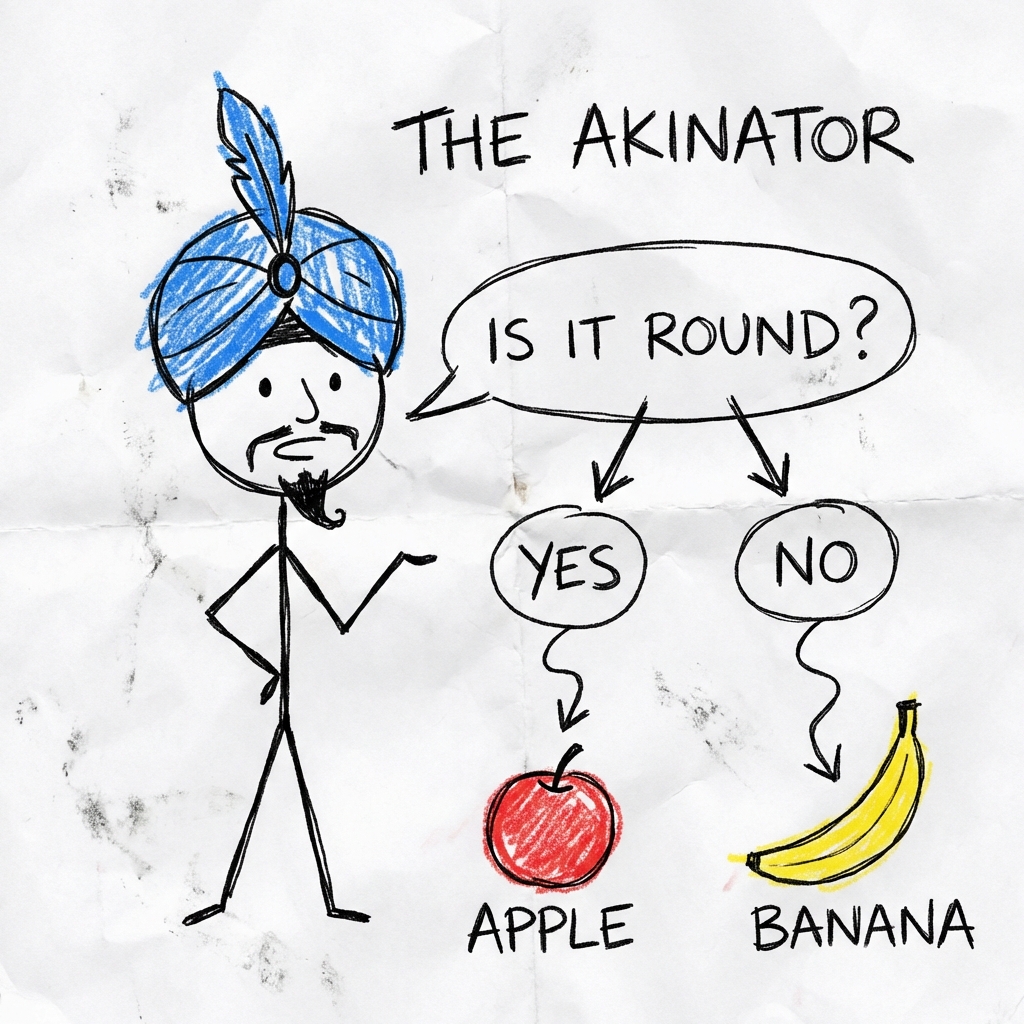
The Flowchart of Life
A Decision Tree is just a flowchart that splits your data into smaller and smaller groups until it's confident enough to guess.
Imagine you are hiring a developer:
- Q1: Do they know Python?
- No: Don't hire.
- Yes: Go to Q2.
- Q2: Do they copy-paste from StackOverflow?
- No: Suspicious. Don't hire.
- Yes: HIRE IMMEDIATELY.
Interactive Demo: The Splitter
The tree makes "Cuts" in the data.
- Cut 1: Is
Color == Red? - Cut 2: Is
Size > 5cm?
Unlike the Linear Regression line which is diagonal, Decision Tree cuts are always horizontal or vertical. They are like steps on a staircase.
The Code (Python)
We use DecisionTreeClassifier. It's great because you can actually see why it made a decision (unlike Neural Networks which are black boxes of magic).
from sklearn.tree import DecisionTreeClassifier

# 1. The Question Asker
model = DecisionTreeClassifier(max_depth=3)

# 2. Train on fruit data
# Features: [Redness (0-10), Size (0-10)]
X = [[10, 5], [1, 5], [10, 1]]
y = ["Apple", "Orange", "Cherry"]
model.fit(X, y)

# 3. Predict
print(model.predict([[9, 6]]))
# Output: "Apple"
The Catch (Overfitting)
If you let the tree ask infinite questions, it becomes too specific. "Is it a round fruit, red, with a scar on the left side, bought on a Tuesday?" -> "That specific Apple I ate yesterday."
This is called Overfitting. The tree memorized the data instead of learning the rules. We stop this by setting a max_depth (limiting the number of questions).
Summary
Decision Trees are simple, interpretable, and work exactly like your brain when choosing what to eat for lunch. "Is it healthy? -> No. -> Is it tasty? -> Yes. -> Pizza."
Next up: What happens when we plant a whole forest of these trees?